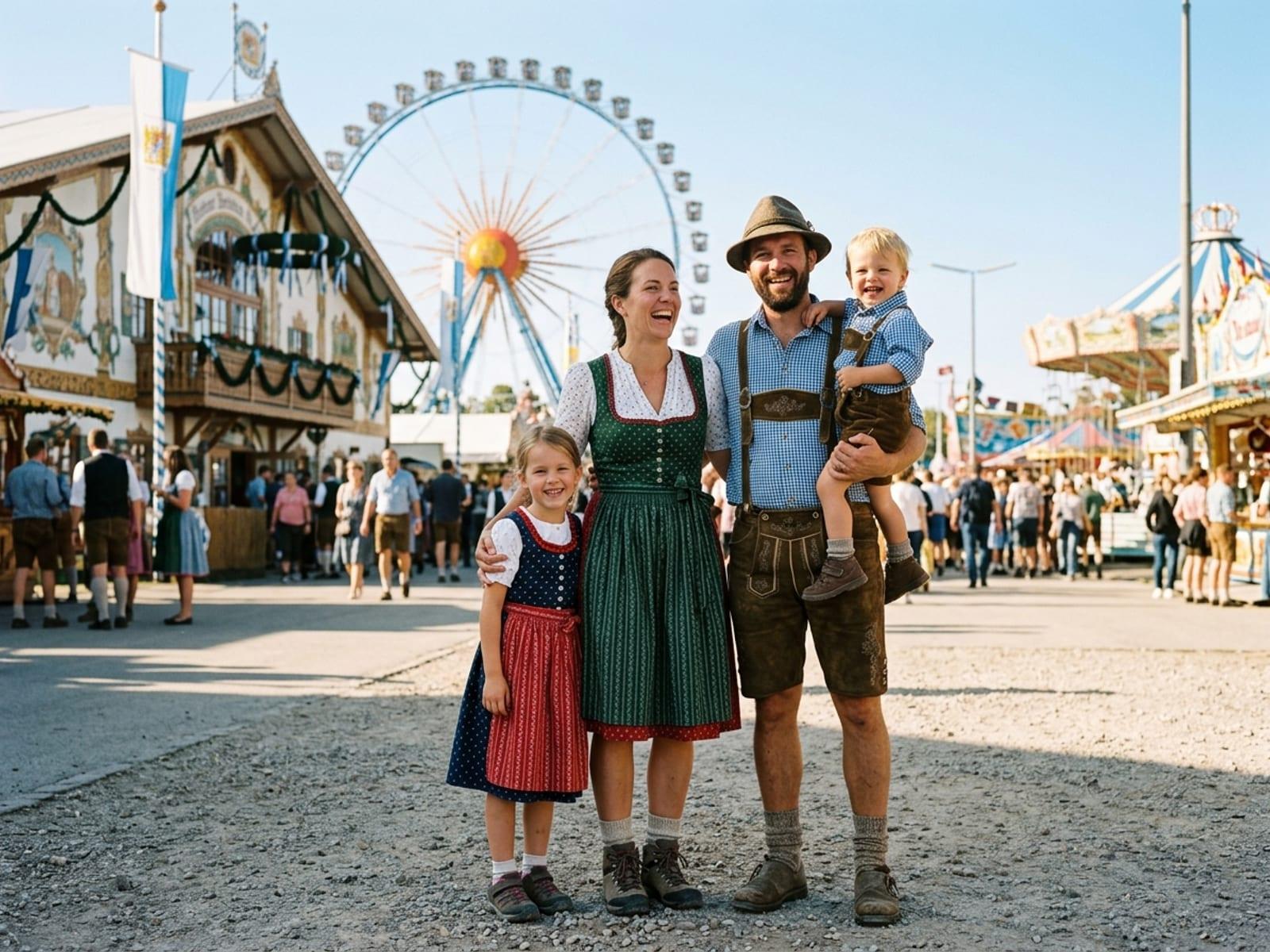
Oktoberfest runs every year from a Saturday in mid-September into early October on the Theresienwiese, a big open field in Munich. It has a reputation as a festival where grown-ups drink beer, but the grounds also hold a full funfair, and during the day you'll see lots of families. With the official rules for children and the crowds in mind, families do best to plan around weekday daytimes and leave before dark.
A festival that began as a royal wedding
It all started in October 1810, with the wedding of Bavaria's Crown Prince Ludwig (later King Ludwig I) and Princess Therese. The celebrations closed with a horse race on a meadow outside the city gates, and the meadow was named after the bride: Theresienwiese, or "Therese's meadow." That's why locals still call the festival grounds the Wiesn. The festival came back the following year and has been held every year since, apart from years of war and epidemic.
So why does an "October festival" start in September? Over time it was moved earlier to catch better weather. Today it opens on the first Saturday after September 15 and normally closes on the first Sunday in October. If that Sunday falls on October 1 or 2, though, the festival runs on until October 3, German Unity Day. It lasts roughly 16 to 18 days, and the exact dates for each year are announced on the official website.
Opening Saturday, and the Sunday costume parade
On the first Saturday, the festival's tent hosts and the breweries ride from the city to the grounds in horse-drawn carriages. At noon, the mayor of Munich taps the first keg in the Schottenhamel tent and declares "O'zapft is!" ("It's tapped!"), and Oktoberfest officially begins.
For families, the highlight is the Costume and Riflemen's Parade (Trachten- und Schützenzug) on the second day, Sunday. It sets off from Maximilianstraße in the city at 10 a.m. and covers about 7 km to the grounds. Groups in traditional dress from Bavaria and far beyond, marching bands and decorated horses all pass by, so you can soak up the festival mood from the sidewalk without setting foot in a tent. The route fills up early, so get there in good time to find a spot.
Inside the grounds, alongside the beer tents large and small, you'll find a Ferris wheel, roller coasters and old-fashioned stalls. At the south end is an area called the Oide Wiesn ("old Wiesn"), with vintage rides, puppet shows and a museum tent. It's an easy place for younger children to enjoy. Admission and ride prices are set each year and posted on the official website.
Kids' dirndls and lederhosen: one inexpensive outfit bought in Munich
At the Wiesn, most people, locals and visitors alike, wear Bavarian traditional dress, known as Tracht. Women wear the dirndl, a bodice and skirt over a blouse, finished with an apron. Men wear lederhosen, leather shorts, with a checked shirt and suspenders.
Where you tie the apron bow is said to mean something. On the wearer's left means single; on the right, married or taken; in the center front, a child or young girl. It's a guideline rather than a rule, and some people simply tie it wherever is easiest. For a child, though, the center front keeps things simple.
Children's dirndls and lederhosen are widely sold around September in Munich's Tracht shops, department stores and discount chains. Kids outgrow clothes so fast that many families simply buy one inexpensive outfit once they arrive. If you'd rather use what you already own, a blouse with a floral skirt, or a checked shirt with brown shorts, is enough to get the look. Tracht is festival best, not fancy dress, so out of respect for the locals, don't wear it too sloppily.
Before the trip, you could also see how the whole family would look in dirndls and lederhosen with pokesta's AI-generated photos ($1 per photo).
The official rules for visiting with children
The Oktoberfest website sets out clear rules for visitors with children. First, children under 6 are not allowed in beer tents or other venues after 8 p.m., even with a parent. Under-16s may stay in the tents after 8 p.m. only when accompanied by a parent or guardian.
Strollers are allowed until 6 p.m., as long as the grounds aren't too crowded. On Saturdays and on October 3 they aren't allowed at all. Bags, diaper bags included, are subject to size limits too, so a quick look at the official website beforehand will save you trouble at the entrance.
Every Tuesday is Family Day, with special prices on many rides and stalls until 7 p.m. The grounds also have a family rest area with benches, changing tables and children's toilets. At the entrances, staff sometimes hand out wristbands where you can write a parent's phone number in case a child gets lost. Take one and put it on your child's wrist.
Food is what most kids look forward to. Giant pretzels (Brezn), roast chicken (Hendl), fish grilled on a stick, sugar-roasted almonds: all the classics are on offer at the stalls and in the tents. The tents serve soft drinks as well as beer. Beer comes in one-liter mugs as standard, and with toasts flying across the table, make sure none end up within a child's reach.
Traditional dress or not, bring warm layers. Munich in late September and early October can be warm on a sunny afternoon and chilly in the mornings and evenings, and it does rain. Pack a cardigan to throw over a dirndl, or a thin down jacket for the kids.
To dodge the worst of the crowds, choose weekdays over weekends, and mornings to early afternoon over evenings. If you want lunch in a tent, weekday daytimes are when it's relatively easy to get a seat. The later it gets, the more drunk adults there are, so families are best off planning to leave the grounds before dark. Move dinner to a beer garden under the chestnut trees outside the grounds, and start the next morning with a Weisswurst breakfast.
When to go and how to get there
The gateway airport is Munich International Airport (MUC). From there, S-Bahn suburban trains (S1 and S8) run through the central station into the city center in about 45 minutes. From elsewhere in Germany or other European cities, you can also arrive by rail at Munich Hauptbahnhof. The Theresienwiese grounds are about a 15-minute walk from the central station. During the festival the nearest subway station gets extremely crowded, so it can pay to get off one stop early and walk.
Hotel prices in Munich climb during the festival, and rooms go fast. Once your dates are set, book early; steering clear of the opening day and the final weekend makes getting around somewhat easier. One way to split it: spend a busy weekend on a day trip to Neuschwanstein Castle and go to the grounds on a weekday. If the city is full, you can stay in a nearby town and come in on the S-Bahn. Entry requirements for Germany vary by nationality, so check your own government's official information before you travel.
References
- Oktoberfest.de, "A few rules and tips for visiting the Wiesn with children" https://www.oktoberfest.de/en/information/children-and-family/information-for-wiesn-visitors-with-children
- Oktoberfest.de, "Hints and tips for a visit to the Oktoberfest with children" https://www.oktoberfest.de/en/information/children-and-family/wiesn-tips-for-families
- Oktoberfest.de, "The traditional costume and hunters' parade at the Oktoberfest" https://www.oktoberfest.de/en/information/events/the-traditional-costume-and-hunters-parade
- Oktoberfest.de, "Parade of the Oktoberfest landlords and breweries" https://www.oktoberfest.de/en/information/events/parade-of-the-landlords-and-breweries
- muenchen.de, "Oktoberfest outfit: Costumes, dresses and lederhosen" https://www.muenchen.de/en/events/oktoberfest/outfit-costumes-dresses-lederhosen
- trachten.de, "How to Tie the Dirndl Bow Correctly" https://trachten.de/en/blog/dirndl-bow-how-to-tie-it-correctly
- muenchen.de, "Oktoberfest FAQ" https://www.muenchen.de/en/events/oktoberfest/visitor-service/faq
- History.com, "What Are the Origins of Oktoberfest?" https://www.history.com/articles/oktoberfest-origins
- Wikipedia, "Munich Airport station" https://en.wikipedia.org/wiki/Munich_Airport_station