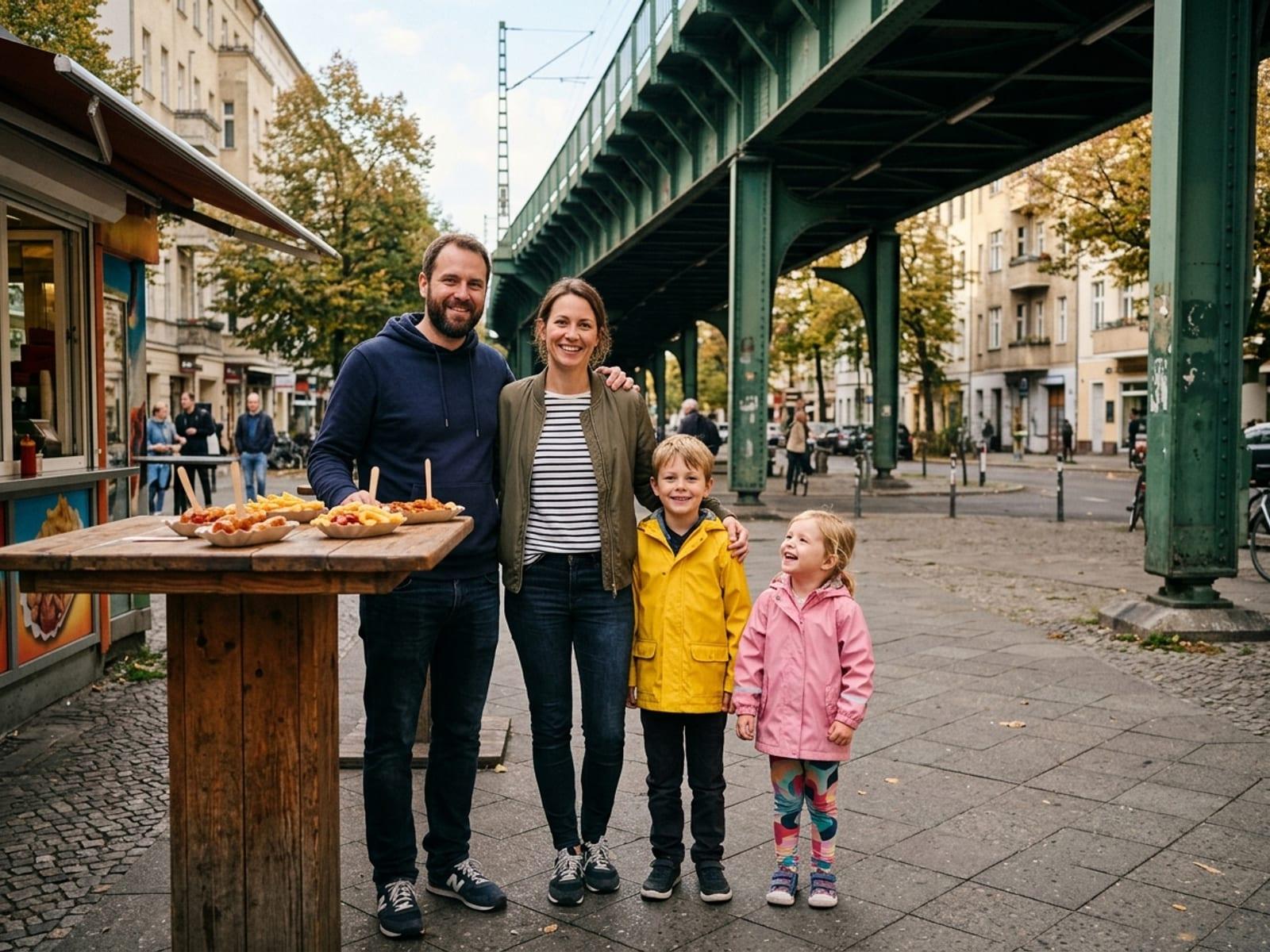
A grilled sausage is cut into rounds, drowned in tomato sauce mixed with curry powder, and finished with another dusting of curry powder on top. That's Berlin's currywurst, served on a paper tray with a tiny fork and eaten standing up. It was born in West Berlin in 1949, and today it's treated as a city symbol on a par with the TV Tower and the Brandenburg Gate. You choose how spicy it is, and the portions are small, so it's an easy stop to fit into a day of walking around the city with children.
Ketchup and curry powder at a postwar snack stand
The person usually credited with inventing it is Herta Heuwer. From the summer of 1949 she ran a snack stand in West Berlin's Charlottenburg district, at the corner of Kantstraße and Kaiser-Friedrich-Straße. By her own account, the sauce came about on 4 September that year. She mixed ketchup (or, in some versions, Worcestershire sauce) and curry powder obtained from British soldiers stationed in the city with other spices, poured it over grilled sausage and started selling it. The sauce was later registered as a trademark under the name "Chillup" (in 1959). A memorial plaque was put up in 2003 at Kantstraße 101, where her stand used to be.
There's also a claim that currywurst began in Hamburg, and it became the subject of Uwe Timm's 1993 novel Die Entdeckung der Currywurst (The Invention of Curried Sausage), but that version has never been confirmed. Currywurst is also popular in the Ruhr region and in Hamburg, and the type of sausage and the taste of the sauce shift a little from region to region. Set it beside Munich's white-sausage breakfast and you can see how one sausage-loving country can have completely different rules about how to eat one.
In 2009 Berlin even got a German Currywurst Museum, which drew around 350,000 visitors a year before it closed for good in December 2018. Older guidebooks may still list it, but you can no longer visit.
It started as a street snack, but currywurst has long since settled into everyday German eating. It turns up on children's menus in restaurants, and supermarkets sell kits for making it at home. Volkswagen even makes its own branded currywurst at its Wolfsburg plant, about 7 million of them a year.
With skin or without? That's the first question
Berlin currywurst comes in two versions: mit Darm, with the sausage casing (Darm in German), and ohne Darm, without it. The skinless kind is pale and cylindrical, soft and easy to bite through, so it usually suits young children better. The version with skin has a casing that grills up crisp and savory. Ordering one of each and sharing them around the family is a good way to compare.
It comes with either a small bread roll (Brötchen) for mopping up sauce, or fries. Fries with mayonnaise is a common pairing. When you order, name the sausage and the side together, as in "Currywurst mit Pommes" (currywurst with fries).
At some stands you can make it hotter with cayenne pepper, asking for scharf (hot) or extra scharf (extra hot), or have dried chili flakes added. If you say nothing, most places serve a version where the sweetness of the ketchup comes through first. The curry powder is sprinkled on at the end, though, so for a child who isn't used to spices, ask for less curry powder or scrape a little sauce aside before handing it over. Some stands let you pick a heat level on a scale of one to ten, so check the numbers or chili symbols on the menu before ordering.
An old-timer in the east, a favorite in the west
According to visitBerlin, the city's tourism board, the two places guidebooks recommend most are Konnopke in the east and Curry 36 in the west.
Konnopke's Imbiß goes back to 1930, when Max Konnopke and his wife Charlotte started selling sausages from a tray hung around the neck. In 1960 they set up at their current spot on Schönhauser Allee in Prenzlauer Berg, under the elevated tracks of the U2 underground line. The story goes that after the Berlin Wall went up and ketchup became unobtainable in East Berlin, they began serving currywurst with a homemade sauce, and the stand is credited with spreading currywurst across East Berlin. The nearest station is Eberswalder Straße on the U2, and the stand is just south of it.
Curry 36, at Mehringdamm 36 in Kreuzberg, is presented as the west's flagship and is said to be popular with taxi drivers. The tourism board also mentions Zur Bratpfanne in Steglitz, which has served currywurst since 1949, and Curry Baude, inside the station building at Gesundbrunnen.
At all of them, the basic setup is standing room only. The tables come up to about elbow height on an adult, which is too high for most children. Lift little ones up, or carry your food to a nearby bench or park and eat there in peace. Lines tend to form at lunchtime and in the early evening, so going a bit earlier, say before noon, cuts the wait. Opening hours and closing days differ from place to place and can change, so check each stand's official site or the tourism board's page before you set out.
Things to watch when kids are eating
Currywurst is usually made with pork. Families who don't eat pork will need to look for halal or kosher places that use beef sausage. The sauce is often a closely guarded house recipe, and you can't tell what's in it by looking. EU rules require food businesses, including restaurants and stands, to give customers information on the main allergens, so if there's an ingredient you need to avoid, ask about "Allergene" before you order.
One serving is about the size of a light snack for an adult. For a hungry older child, add an extra portion of fries; for a small child, a few pieces from an adult's tray is plenty. The sauce splatters, so wet wipes and jackets you don't mind getting dirty make things easier. If you're curious what a family photo around a street-stand table might look like, you can try it with pokesta's AI photos ($1 per photo).
Any time of year, near almost any station
Currywurst isn't seasonal. Stands are scattered all over the city, and the best thing about it is how easily it fits in between sights. The gateway airport is Berlin Brandenburg Airport (BER), about 18 km southeast of the city center. The FEX airport express gets you from the airport station to Berlin Hauptbahnhof in a little over 20 minutes.
If you want to keep eating your way through Germany, one idea is to head south from Berlin to try Spreewald gherkins. Heading north instead? Hamburg has herring rolls at the Sunday-morning Fischmarkt. Entry requirements for Germany vary by nationality, so check your own government's official information before you travel.
References