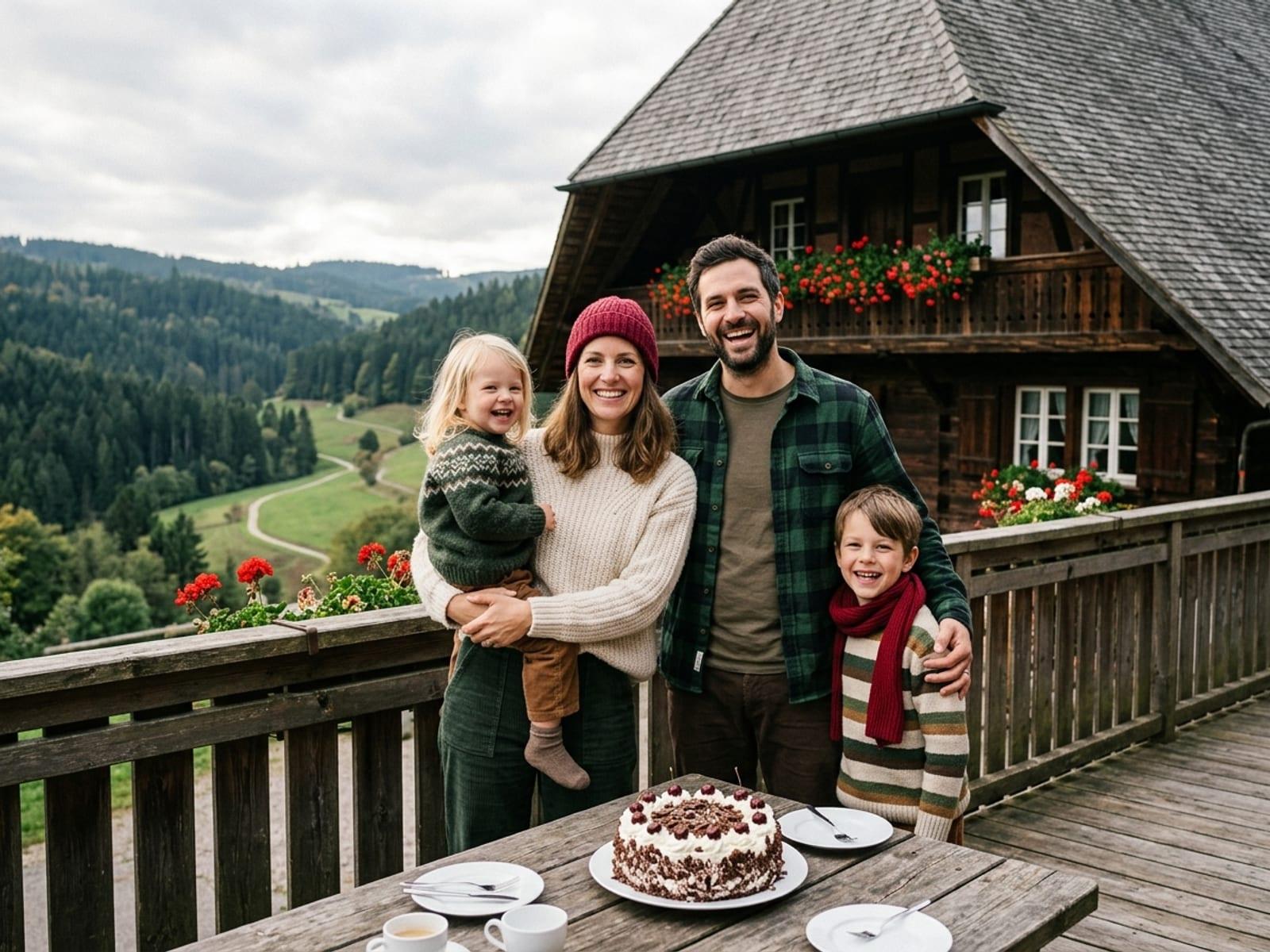
Chocolate sponge, cherries, plenty of whipped cream and a covering of chocolate shavings: Schwarzwälder Kirschtorte, Black Forest cherry cake, is known around the world as Germany's signature cake. Can kids eat it? The German original is best left to the adults. It has to contain enough Kirschwasser, a cherry brandy, for you to taste it clearly, and that brandy goes into the cream uncooked. In the cafés and Konditoreien of the Black Forest towns, the grown-ups can have the real thing with afternoon coffee while the children order something else, such as apple cake.
Can kids eat it? The alcohol isn't cooked off
The real Kirschtorte is a cake for grown-ups. Kirschwasser is a spirit of at least 37.5 percent alcohol, and it goes into the cream and filling without being heated. The classic recipe on the German food site LECKER uses nine tablespoons of it and says children should skip this cake. The amount in a slice varies by bakery and recipe, and we couldn't find a reliable figure.
Germany's consumer advice centre, the Verbraucherzentrale, says alcohol doesn't fully disappear even in baking or cooking, and that there's no dependable rule of thumb for how much is left. It advises against buying products containing alcohol for children, because regular exposure can make it easier for them to try alcohol later.
There's a legal angle too. Section 9 of Germany's Youth Protection Act (Jugendschutzgesetz) says that in restaurants, shops and other public places, spirits and foods containing spirits in more than a negligible amount can't be sold to under-18s, and under-18s can't be allowed to consume them there. The exception for a teenager accompanied by a parent applies only to beer, wine and the like. The law gives no figure, though, and we found no official statement on whether a slice of Kirschtorte crosses that line. With no clear answer, the simple choice is a different cake for the kids.
Don't count on a label, either. Bakeries and cafés don't have to give an ingredient list for unpackaged cakes, so you'll need to ask. In German, "Ist da Alkohol drin?" ("Is there alcohol in it?") does the job. German cafés and bakeries also offer cakes made without alcohol, like apple cake or cheesecake. On packaged cakes, look for Kirschwasser in the ingredient list and read the small print: when Hamburg's consumer advice centre checked 18 products in 2021, only one had a clear notice on the front. Outside Germany, cakes sold as Black Forest may use a different spirit or none at all, so check those the same way.
If you bake at home, LECKER suggests swapping the Kirschwasser for cherry juice. Under the German definition that makes it a different cake, but your kids won't mind.
Germans have a habit of coffee and cake in the afternoon. In many places you choose your slice from the display case, so you can order just by pointing. Ordering a few different kinds and sharing them is a good way to try more flavors as a family.
You can see what a family photo around a Kirschtorte might look like with pokesta's AI photos ($1 per photo).
No Kirschwasser taste, no right to the name
Germany has official guidelines for fine bakery products, the Leitsätze für Feine Backwaren, which describe what certain cakes and pastries should contain. They define Schwarzwälder Kirschtorte as a cream or buttercream cake made with Kirschwasser, and require the added Kirschwasser to be clearly noticeable in the taste. The dark sponge base must also contain at least 3 percent cocoa. So if a shop in Germany sells a cake under this name, assume it contains alcohol.
Kirschwasser is a clear spirit distilled from fermented cherries, traditionally made mostly in the Black Forest. It's added to the cream and to the cherry syrup, not baked, so the alcohol doesn't cook off.
Today's usual version is assembled from a cocoa sponge sliced into several layers, with cherry filling and whipped cream in between. The whole cake is covered in cream and decorated on top with piped cream, cherries and chocolate shavings. The German food writer Ursula Heinzelmann has called it "the most famous German torte." Outside Germany it's made far more freely: without alcohol, with rum instead of Kirschwasser, even with blueberry jam in place of cherries. Eating it at the source is a chance to taste what all those versions started from.
Named for the dark forest, or for a hat?
Why "Black Forest"? There are several theories. One says the dark chocolate shavings recall the region's dense, dark fir forests. Another says it's because Kirschwasser comes mainly from the Black Forest. A third connects it to the colors of the region's traditional dress.
The third theory usually brings up the Bollenhut, a hat worn by women in a few Black Forest villages. It's a whitewashed straw hat topped with 14 large wool pompoms in a cross shape, 11 of them visible. Unmarried women wear red pompoms and married women black. The original hats weighed about 500 g, but modern ones can reach 2 kg, and a girl first wears the red hat at her church confirmation. Red cherries lined up on white cream do look a lot like that hat. The Bollenhut was originally worn by Protestant women in three villages, including Gutach, but it has since become a symbol of the whole Black Forest.
Surprisingly, it isn't clear that the cake was born in the Black Forest at all. The earliest known written mention of the name is in a regulation issued in February 1915 by the town of Brandenburg an der Havel, near Berlin. Other theories credit a confectioner in Bad Godesberg, now part of Bonn, in 1915, or a confectioner in Tübingen in 1930. The first printed recipe dates from 1934, and unlike today's cake, it had a base of hazelnut shortcrust pastry.
Family stops in the Black Forest
If you've come all this way for cake, you'll want to enjoy the forest too. One place that works well with children is the Black Forest Open Air Museum (Vogtsbauernhof) in Gutach. It opened in 1964 as the first open-air museum in Baden-Württemberg, and its old farmhouses with their huge roofs include one built in 1612. There are mills, a sawmill, farm animals and an adventure playground, plus demonstrations of traditional daily life and work. It's open from the end of March to early November and closed in winter. Gutach is also one of the Bollenhut villages, so visiting here ties in neatly with the story behind the cake's name, which helps children connect the dots.
Southeast of Gutach, Triberg has one of Germany's highest waterfalls, with a total drop of about 150 m over several cascades, as well as what is billed as the world's largest cuckoo clock. The paths around the falls have lots of steps, so a baby carrier works better than a stroller. Mountain weather changes quickly, so bring a light jacket and rain gear whatever the season.
Everyday clothes in muted colors work both for forest walks and in town. Add one touch of red to your photos, and it echoes the cherries and the Bollenhut and says Black Forest at a glance.
When to go and how to get there
Kirschtorte is available all year round. In Todtnauberg, in the Black Forest, a contest for the best Black Forest cake has been held every two years since 2006 (the tenth was in 2025). The dates change from year to year. For forest walks, the fresh green of May and June or the autumn colors of October are the most pleasant times. Come in May or June and you can also catch white asparagus season in Schwetzingen, to the north, which ends on 24 June.
The main gateway airport is Stuttgart (STR). On your first evening there, try the same state's home cooking, Swabian Maultaschen and Spätzle. For the southern Black Forest, Frankfurt Airport, Zurich Airport in Switzerland or EuroAirport Basel-Mulhouse on the French-Swiss border may be closer, so pick based on where you're heading. Train services are limited in parts of the forest, so if you're visiting several towns, a rental car is the easiest option. Entry requirements for Germany depend on your nationality, so check your own government's official information before you travel.
Real Kirschtorte for the adults, apple cake for the kids. Sitting at the same table with different cakes is very much the local way.
References