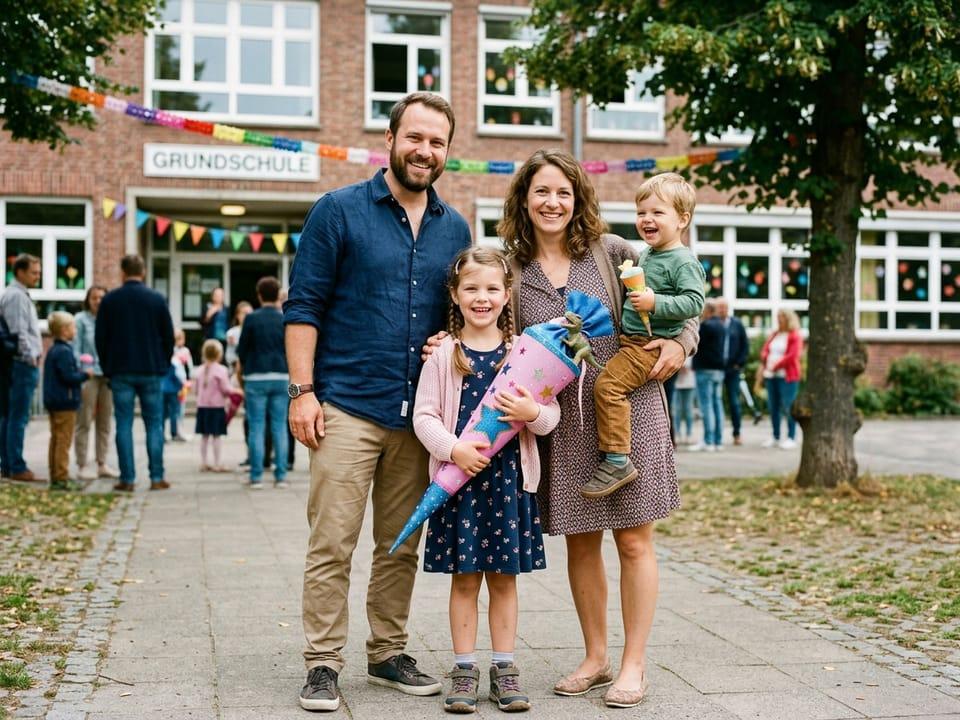
The day a child starts Grundschule is a big family occasion in Germany. The new pupil carries a Schultüte, a large paper cone filled with sweets and small school things, which isn't opened until everyone is back home. After the school ceremony, a photo with the Schultüte and the new school bag is the classic picture of the day. Whether you book a studio, leave it to the school photographer or take the pictures yourselves comes down to how the day runs and which moments you want to keep.
The date depends on your state
Children who turn six by a cut-off date, somewhere between 30 June and 30 September depending on the state, start school that year. Summer holidays are staggered by state within a window from 20 June to 15 September, and the new school year begins once they're over, so Einschulung can fall in August or in September depending on where you live. In one Bavarian town the start of the school holidays even grew into a festival: Dinkelsbühl's Kinderzeche goes back to an outing that the town's schoolchildren made at the beginning of their holidays.
In Saxony and Saxony-Anhalt, the new term starts on a Thursday, first-graders actually begin on the following Monday, and the Schuleingang celebration is held on the Saturday in between. In the east, kindergartens often get children ready with a Zuckertütenfest; Zuckertüte, "sugar bag", is what central Germany calls the Schultüte.
How the day runs, and when you can take photos
Most schools mark the first day with a ceremony. It may include an ecumenical service, a performance by the third and fourth classes, and the new pupils filing out of the hall behind their class teacher to their classroom. Afterwards, many families carry on celebrating at home.
That leaves four main windows for photos: at home before you leave, in the schoolyard before and after the ceremony, when the children come out after their first time in the classroom, and at the family celebration. The procession to the classroom happens once, and you may only see backs. Rather than chasing it, wait at the classroom door for faces.
A studio session: before or after?
A studio gives you control over light and time. The day itself is a rush of ceremony and family, and clothes and hair gradually come undone. In a studio you can work out with the photographer how a child should hold that enormous cone.
If you book before the day, the Schultüte has to be finished in time. If you're making it yourselves, start early, and if the contents are meant to be a surprise, fill it with tissue paper for the shoot so it keeps its shape. A session a few weeks after school starts catches a child who has settled in and already looks a little older. Around 11 November, schools and kindergartens often hold a St Martin's lantern walk, and set next to the Einschulung pictures, those photos show how much a child has changed in two or three months of school.
Before booking, ask whether siblings and grandparents can join, how many edited photos you'll get and how long they take, and whether the studio has props such as a chalkboard.
Leaving it to the school photographer
Class photos have been taken in German schools since around 1880. Traditionally, school photographers pictured children who had just started school with a board reading "Zur Erinnerung an meine Schulzeit", in memory of my school days. A photographer may still come in to take class photos and individual portraits, and sometimes you can only order whole sets. Check the school's letters to find out when the photos will be taken and how ordering works.
Doing it yourself: the chalkboard and the oversized cone
If you take the photos yourselves, you can borrow a set-up you'll see everywhere: a small chalkboard with the town, the date and "Mein erster Schultag", my first day of school, with the child standing in front of it or beside it.
A Schultüte is big for a six-year-old. When Germany was divided, hexagonal cones 85cm long became the norm in the East, while round ones, mostly around 70cm, stayed popular in the West. Crouch to your child's waist height and shoot a vertical frame from head to toe; it shows both how big the cone is and how small the child is. Hugging it with both arms tends to hide the face, so have them hold it in one arm, or rest the tip lightly on the ground.
The new school bag, the Schulranzen, has its own German quirk. The DIN 58124 standard calls for at least 20 percent fluorescent material and retroreflective material on 10 percent of the front and side surfaces. Retroreflective patches bounce light straight back towards its source, so with the flash on they turn into glaring white blocks. Switch the flash off at the front door or in the school hall. Fluorescent orange and yellow will also be the loudest colours in the frame, so plain, muted clothes keep the eye on your child's face and the cone.
In the schoolyard at midday, move into the shade of the building or a tree. And back home, the moment the cone is finally opened is one you can only get on this day.
Other children in your photos
The schoolyard will be full of other children. Under section 22 of Germany's Kunsturhebergesetz (KUG), pictures of people may as a rule only be distributed or shown publicly with the consent of the person pictured. Keep photos where other children's faces are clearly recognisable off social media, or check with their parents first.
The cone used to come from the godparents
The early records of the custom cluster in Saxony and Thuringia. The oldest comes from someone who started school in Gersdorf, Saxony, in 1781 or 1782, followed by accounts from Jena (1817), Dresden (1820) and Leipzig (1836). In Leipzig and Dresden, children were told that a Schultüte tree grew in the teacher's house, and that once the cones were big enough it was time to start school. You could borrow the story for a picture: hang the cone from a branch in the garden or on the balcony and photograph your child "picking" it.
Originally it was the godparents, the Paten, who handed over the Schultüte. Today it's mostly the parents, but if you invite the godparents to the family celebration and let them hand it over, the photo carries the old custom with it.
If grandparents or godparents can't make it to the celebration, pokesta can create a photo of the whole family with the new pupil and the Schultüte with AI, using each person's own phone photos ($1 per photo, first one free).
References