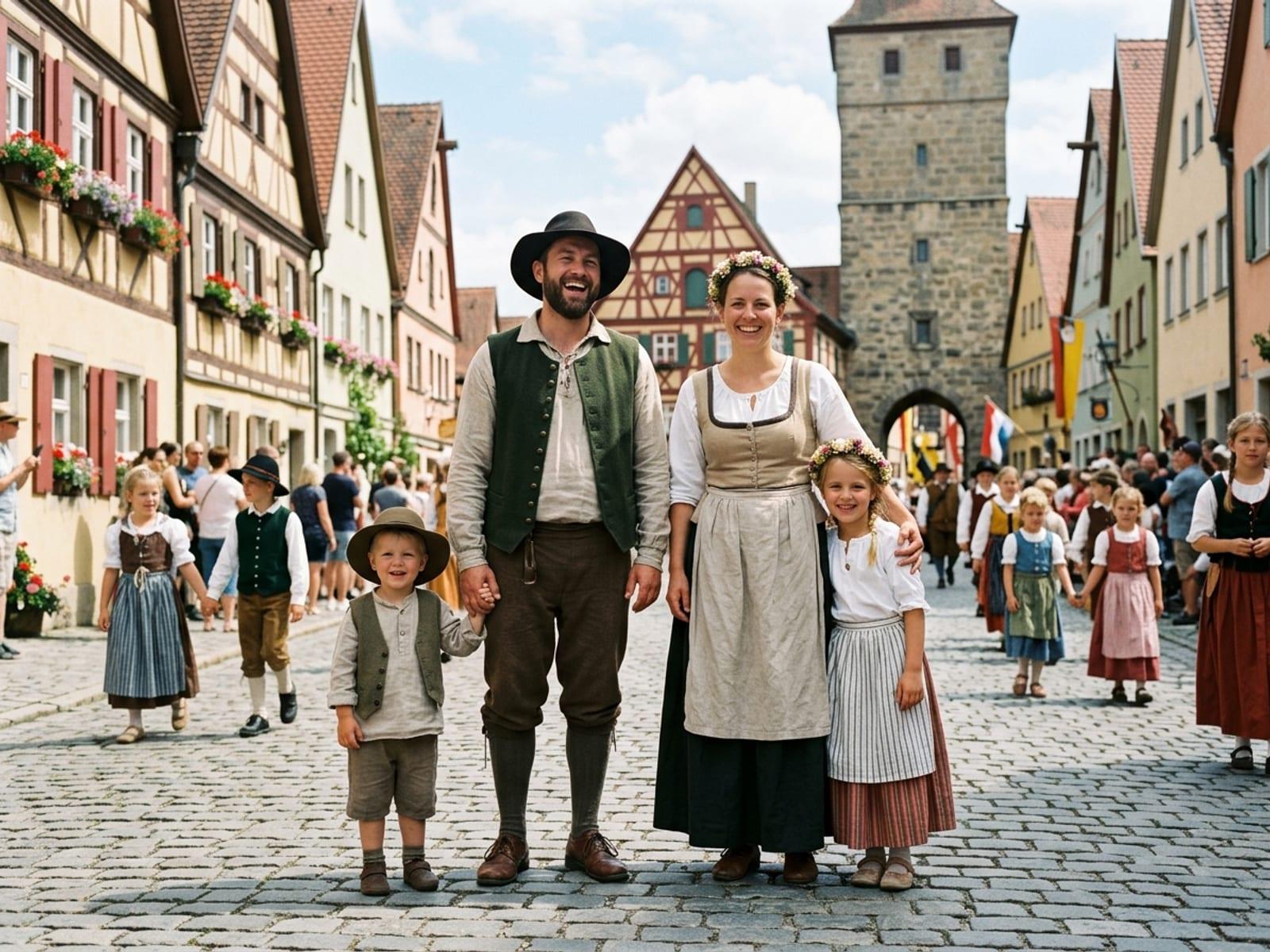
Every July, the walled town of Dinkelsbühl on Germany's Romantic Road holds a ten-day festival called the Kinderzeche. It retells a legend from the Thirty Years' War, when the town's children are said to have begged an enemy officer for mercy and saved their town, and it's the town's own children who act it out, march in it and play the music. More than 1,100 people take part, most of them children and teenagers. The official website gives the 2027 dates as 16 to 25 July.
The siege of 1632 and Lore, the watchman's daughter
The legend is set in 1632. Swedish troops under Colonel Sperreuth surround the town and demand its surrender. As the story goes, Lore, the daughter of the tower watchman, gathers the town's children and leads them out to plead with the colonel. He has recently lost a son, the sight of the children moves him, and he leaves the town unharmed.
The historical record says the town surrendered that May without a fight, and the story of the children saving it has never been confirmed as fact. The festival's roots are older, though. It goes back to a school outing, when pupils were taken to a village inn at the start of their holidays. Church accounts from 1629 record a payment to a teacher for taking the children to the Zeche, a word for a feast or a round of food and drink, and that's where the festival's name comes from. In the late 19th century, a play based on the legend was added to the school celebration, and the festival took on its present form.
The historical play by Ludwig Stark premiered on 12 July 1897. For more than 120 years since, townspeople have passed its roles down. In 2016 the Kinderzeche was added to Germany's national inventory of intangible cultural heritage.
Open-air drama, parades and the boys' band
The ten days are built around the two weekends on either side of the third Monday in July, and there are three main things to see.
The first is the historical play. It's staged in the Schranne, a historic building in the old town, about seven times during the festival. Lore and the children, the town councillors and the Swedish colonel all appear, and the play moves from the tension of the siege to the reconciliation. The dialogue is in German, but when the children line up before the colonel, you don't need the language to follow what's happening. Tickets are required and can be bought online in advance.
The second is the grand parade through town. Horsemen, flag bearers, fanfare players, floats and schoolchildren in period dress make their way over the cobbles of the old town. In 2026, parades set off at 2 p.m. on the first Sunday and at noon on the following Monday. During the festival, scenes from the town's days as a Free Imperial City are performed in the old town's lanes, and outside the gates a tented Swedish army camp is recreated.
The third is the Knabenkapelle, the boys' band. It started in 1868 with 20 members and now has more than 100, who play in 18th-century Rococo military uniforms. Watching children their own age march past with instruments tends to stay with young spectators. A Volksfest, a traditional fair with rides, runs in town at the same time. The boys' band also plays outside the festival, at the spring Easter market and in concerts.
Tips for watching as a family
For the parade, where you stand is everything. Crowds gather early near the town gates and along the main street of the old town, so with small children, find a slightly wider spot along the route and claim some shade while you wait. On sunny days in southern Germany in July, the sun is strong and it can get hot, so bring hats, water and sunscreen. Summer thunderstorms happen too, so pack light rain gear as well.
If you're going to the play, you might pick a morning performance to suit your child's attention span. Each performance runs for quite a while, so with very young children it's often better to focus on the parades and the camp. School-age children, on the other hand, get a lot out of reading up on the legend and seeing the play once. Afterward, every time they pass a costumed child in town, they can spot someone from the scene they watched.
Dinkelsbühl's old town is compact, and everything inside the walls is within walking distance. The rows of colorful half-timbered houses with their gables facing the street are worth photographing even on non-festival days. Fitting in a walk along the walls or a rest in the shade between parades helps children last the day.
Tell your children the story of Lore and the colonel before you go, and they'll see the play and the parades differently. Even if they can't understand the words, knowing that this is about children stopping a quarrel between adults lets them follow what's happening on stage in their own way. Depending on their age, you can also explain that in the historical record the town surrendered without a fight, and that the play is a legend the town has cherished. That makes the festival more interesting, not less.
Ordinary travel clothes are fine. Local children wear 17th-century-style costumes for the festival, but visitors don't need to copy them. If you'd like to match the mood, simple combinations such as a white blouse with a longer skirt, or a linen shirt with a waistcoat, look right against the half-timbered streets.
You can see how a photo of your family walking these cobbled streets might turn out with pokesta's AI photos ($1 per photo). If you're in southern Germany in autumn, there's Oktoberfest, and in winter, Nuremberg's Christmas market is close by.
When to go and how to get there
The Kinderzeche runs for ten days covering the weekends around the third Monday in July. In 2027 that's 16 to 25 July. Performance dates and parade times are published in the official program each year, so check them before you plan.
Dinkelsbühl has no passenger train station. The nearest stations include Ellwangen (20 km), Crailsheim (22 km), Dombühl (25 km) and Ansbach (42 km), with buses onward from there. Public buses also run from Nuremberg and Nördlingen, but the number of services varies by route and day, so look up the timetable in advance. The nearest airports are Nuremberg (NUE), about 95 km away, and Stuttgart, about 122 km away. For a family trip, the easiest plan is often to rent a car, drive the Romantic Road and combine Dinkelsbühl with Rothenburg and its walkable town wall to the north. Hotels in town fill up on festival weekends, so book early. Entry requirements for Germany depend on your nationality, so check your own government's official information before you travel.
Whether or not the legend is true matters less than the fact that the town's children keep performing it, year after year, as their own festival. Seeing how your child reacts to kids their own age on that stage is one of the best things you'll bring home.
References