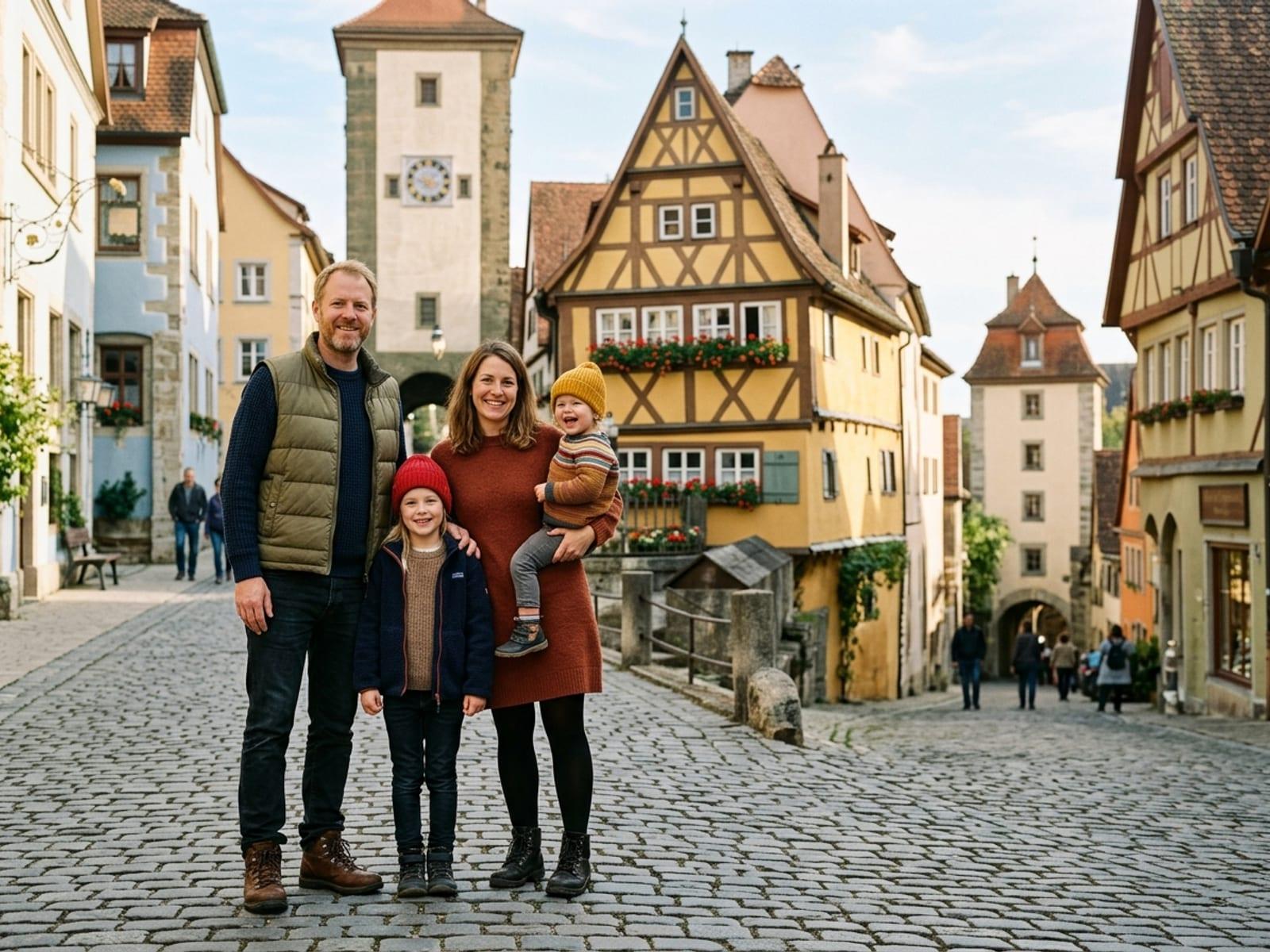
Half-timbered houses huddle together, and at the end of each cobbled lane rises a tower with a pointed roof. Rothenburg ob der Tauber, in the Franconia region of Bavaria in southern Germany, draws travelers from all over the world for its remarkably well-preserved medieval townscape. The town is ringed by walls you can walk along. With a population of just over 10,000 and its sights packed inside the walls, it's small enough for children's legs to enjoy fully in a single day, at any time of year.
A prosperous Free Imperial City behind its walls
Rothenburg's story begins around 1170, when the Hohenstaufen dynasty built a castle here. In 1274 the Habsburg king Rudolf I granted it the privileges of a Free Imperial City. Free Imperial Cities were towns allowed to govern themselves under the emperor, and Rothenburg flourished as one of them until it became part of Bavaria in 1803.
Near the end of the Second World War, an air raid on 31 March 1945 damaged nearly 40 percent of the buildings in the eastern part of the old town and killed 39 people. The town was hit as an alternative target because the original one, an oil depot at Ebrach, was hidden by haze. Restoration and rebuilding followed after the war, and part of what you see today is the result of that work.
In 1950 the tourist route known as the Romantic Road was created, and Rothenburg became one of the towns along it. It's considered the first tourist route in Germany. Follow it south to its end at Füssen and you reach Neuschwanstein Castle.
The "Tower Trail": about 4 km along the walls
The town walls run for about 4 km. In all, 46 historic towers survive in the old town, and gates such as the Rödertor, Galgentor, Klingentor, Burgtor, Kobolzeller Tor and Spitaltor serve as its entrances. The Spitaltor is the newest and most heavily fortified of the town's defenses. Rothenburg is one of the few towns in Germany whose walls survive completely.
The Turmweg (Tower Trail) follows the walls around the outside of the town. According to the town, the path is step-free and manageable with a stroller, and there are three playgrounds along it. You can also climb up to the walkway on top of the walls and look down over the rooftops as you go, but getting up and down means stairs. The full loop is about 4 km, so with small children it's more realistic to walk just one section, starting around the Rödertor, and drop back into town partway. The tourist information office on the Marktplatz has Tower Trail booklets in German and English, and the town's website has short videos about each gate. Turn it into a knights' game, counting gates and towers as you go, and kids will keep walking happily.
The most famous view inside the walls is the Plönlein, a name meaning "little square by the fountain." A narrow yellow half-timbered house and a fountain sit between two towers. On the left, beyond the Siebersturm, is the hospital quarter; on the right, the Kobolzeller Tor tower, built in 1360, guards the road down into the Tauber valley. This view has been copied over and over as the image of a typical medieval European town, and it even appears in Disney's Pinocchio (1940). The castle garden (Burggarten) makes a good rest stop, with places for children to hide and play and views for the adults.
The Town Hall tower and the "big gulp" on the clock
The heart of the town is the Marktplatz. The Town Hall on the square has a tower you can climb for a view straight down over the town. The way up is by stairs, so don't push it if a child is scared of heights or still needs carrying.
On the square, the building of the Ratstrinkstube, the old councillors' tavern, has a mechanical clock where, at set times, figures act out the draining of a giant tankard. It's based on the legend of the Meistertrunk (the "master draught"). In 1631, during the Thirty Years' War, the imperial general Tilly captured the town, and former mayor Georg Nusch is said to have saved it from destruction by downing 3.25 liters of wine in one go. The story, however, first appeared around 1770, isn't mentioned in any eyewitness accounts from the time, and is thought not to have actually happened. It still matters a great deal to the townspeople: an open-air play, Der Meistertrunk, has been performed every year since 1881, and it was added to Bavaria's intangible cultural heritage inventory in 2014 and Germany's national inventory in 2016. The play is staged each year around Pentecost. Check the clock times with the tourist office before you wait on the square, so you and the kids don't miss the figures moving.
Choose museums by your children's ages
The old town has several small museums. The Christmas Museum, devoted to all things Christmas, is an easy one even for young children. There's also the Rothenburg Museum, called the Reichsstadtmuseum (Imperial City Museum) until 2019, and the Craftsmen's House (Alt-Rothenburger Handwerkerhaus).
The Medieval Crime Museum, on the other hand, covers the history of law and punishment, including torture instruments. Older children interested in history may find it fascinating, but some exhibits are frightening for little ones, so choose with their ages in mind. At the armory (Waffenkammer), the whole family can try on medieval costumes. There are also themed guided tours led by guides dressed as a night watchman, an executioner, a craftsman's widow and others, who tell stories of life in the old days; even if you don't follow the language, the costumes and gestures carry the mood. Opening hours and prices change with the seasons, so check each venue's official website.
For a snack between sights, try the local specialty, the Schneeball ("snowball"). Strips of dough are woven into a ball, placed in a special mold and deep-fried, making a pastry about 8 to 10 cm across, coated with powdered sugar or chocolate. Rothenburg's archives hold an invoice from 1719, so it has at least 300 years of history. It's dry, a bit like a cookie, and keeps for a long time without refrigeration, which makes it a good souvenir. It's also hard, so break it up inside the bag before handing pieces to small children.
By train, change at Steinach, and plan ahead with a stroller
Rothenburg is worth visiting at any time of year. The nearest major airport is Nuremberg Airport (NUE). In December you could base yourselves in Nuremberg and combine Rothenburg with the Christmas market the Christkind opens. By train, the usual route is to change at nearby Steinach station onto the branch line to Rothenburg. The tourist office notes that step-free transfers aren't possible at Steinach, and advises travelers with strollers or heavy luggage to check how to make the change in advance. From Rothenburg station, the Rödertor and the old town are a few minutes' walk.
Comfortable shoes are a must on the cobblestones. To see how a family photo in front of the half-timbered houses in layered travel clothes might turn out, you can try pokesta's AI photos ($1 per photo). You can also combine the trip with Dinkelsbühl, another medieval town in Franconia. Entry requirements for Germany vary by nationality, so check your own government's official information before you travel.
References