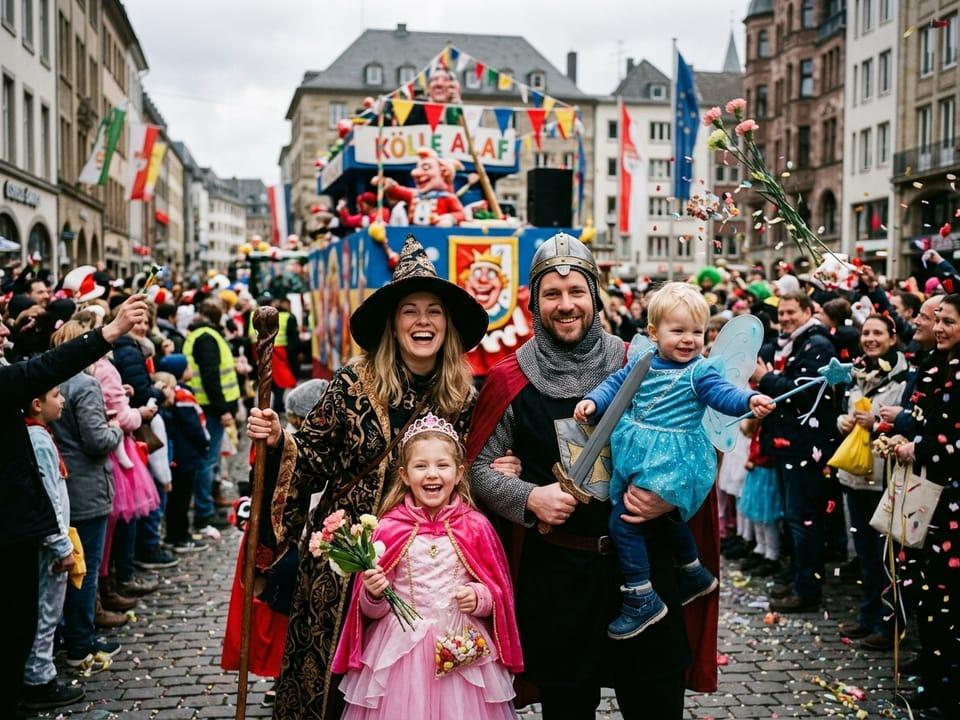
A child who refuses to dress up can still go to the Kita's Fasching party. The German childcare portal kita.de puts it plainly: nobody has to dance, have their face painted or wear a costume, and a colourful scarf or a favourite T-shirt will do. So don't force a costume on your child for the sake of a photo. Work out what is bothering them, offer half a costume, and take the picture at home a few days earlier, when nobody is in a hurry.
The refusal usually has one concrete cause
Fasching, called Karneval in the Rhineland and Fasnet in much of the south-west, peaks in the days before Ash Wednesday. In 2027, Weiberfastnacht falls on Thursday 4 February and Rosenmontag on 8 February, but each Kita sets its own party date, so ask early. That leaves you a few weeks to find out what the "no" is really about.
It is rarely the idea of dressing up itself. A costume can scratch, sit tight around the neck, or have a hood that muffles what a child hears. Anything on the face, from a rubber mask to a painted nose, feels odd to a small child. kita.de lists loud music, face paint, lots of costumes and unfamiliar guests as things that can overwhelm children at a Fasching party, and for some it is simply seeing a friend from the group suddenly turned into a dragon. Watch which part comes off first on the morning of the party. If it's the hood, the hood is the problem, not the costume.
Ask simple questions, and let your child get to know the costume before wearing it: touch the fabric, dress a teddy in it, see it on a parent in the mirror. A child who is frightened of masks may relax after watching you put one on and take it off a few times, laughing each time.
Half a costume still counts
Taking part doesn't need a full outfit. kita.de suggests animal ears, a cape with a short Velcro fastening, a painted T-shirt or a crown made of sturdy paper, which are often more practical than an elaborate costume. Each of them comes off in a second, and that matters to a child who wants a way out. Let your child choose the one piece, and pair it with clothes they already like.
Some things are better left at home anyway. The same guide advises against full masks and tight costumes that restrict vision, breathing or speech, and says long cords, long scarves, trains, hard masks and loose small parts should stay at home. If your child agrees to face paint, use products made for children, keep clear of the eyes and mouth, and don't use sprays indoors or near the face. A single painted dot on the back of the hand, tried a few days before, tells you whether face paint is going to work at all.
A short rehearsal helps too. Ten minutes of ordinary play in the costume at home, with nobody watching or praising, tells you more than any discussion.
Tell the teachers before the day
Talk to the Kita staff a few days ahead. kita.de suggests options such as arriving later, joining only briefly or wearing familiar clothes, and recommends a quiet corner with books, cushions or a painting table during the party. Children are allowed to skip activities. For under-threes, it advises keeping things short and sticking to familiar meal and nap routines and familiar carers.
One practical trick: put the costume, or the single accessory, in the bag rather than on the child. Some children who refuse at home change their mind once they see their friends dressed up, and if they don't, nothing is lost.
A studio, a photographer or your own phone
The party itself may not produce the picture you had in mind, so it helps to think about where a costume photo is most likely to work.
|
Studio |
Photographer at home |
Your own phone |
| Cost |
Session fee plus each image |
Fee by time and number of edited photos |
Free |
| For a wary child |
New room, lights, a stranger |
Familiar rooms, still a stranger |
Most relaxed |
| Changing the date |
By arrangement |
By arrangement |
Any day |
| Result |
Even light, retouched prints |
Natural moments, an edited set |
Up to you |
As one example, the Calumet photo studio on Sonnenstraße in Munich lists family sessions from €69 for about 30 minutes, choosing from 10 shots, to €139 for about 90 minutes, as of October 2026. Those prices are for one person; each extra person costs €10, and images are charged on top, at €25 for one high-resolution file and €13 to €99 for prints. The page doesn't give rescheduling rules, so ask when you book, since a winter cold can cancel a session at short notice. Prices vary by studio, season and package, so check the studio's own website.
A professional is worth paying for when you want a framed print for the grandparents, all the siblings together, or a large family group in matching costumes. For a child who is already wary of costumes, though, a stranger with studio lights is a hard sell.
Take the costume photo at home, before the party
The calmest costume photo tends to happen on an ordinary afternoon a few days before Fasching. Dress your child in favourite clothes plus the one accessory, sit them near a window, and let them put the ears or the crown on themselves. Shoot a burst and stop after five minutes, before it becomes a chore. If even that is refused, a photo of your child holding the crown is still a Fasching photo.
If a costume picture just isn't going to happen this year, there is one more way. pokesta creates a carnival family portrait with AI from the phone photos each of you already has, with everyone in costume, including the child who wouldn't dress up. It is an image made by AI, not a record of the party. It costs $1 per photo and the first one is free, so try it with a recent photo of your child before buying another costume. If you're still deciding what to buy, see Fasching costumes on a budget. Your child can join in without a costume; don't dress them up for a photo.
References