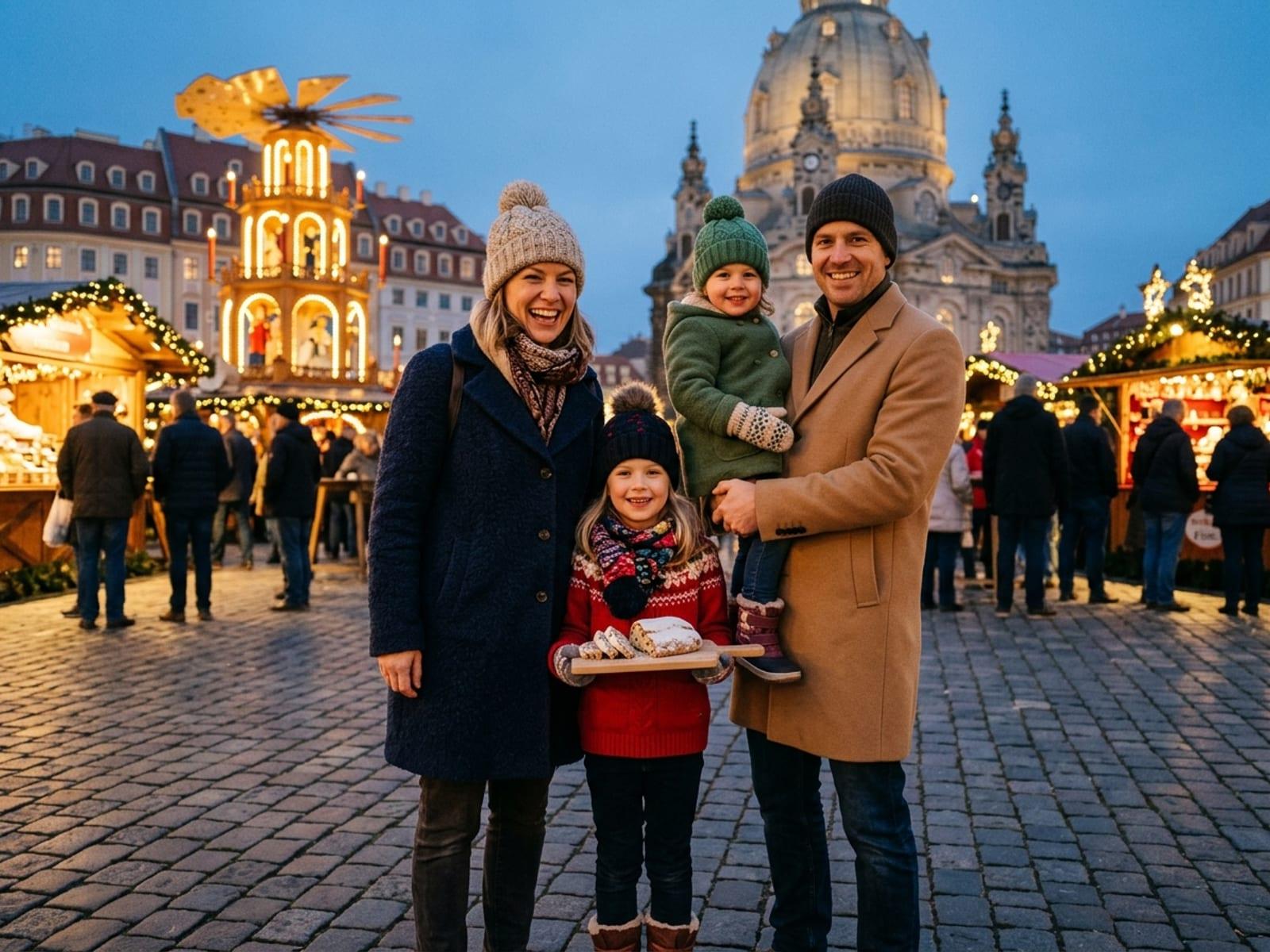
A heavy yeasted loaf, buried under a white coat of powdered sugar. Inside, it's soaked with butter and packed with raisins, candied orange and lemon peel, and almonds. Stollen is eaten all over Germany in the run-up to Christmas, but the Dresdner Stollen from the old city on the Elbe holds a special place. On a Saturday in Advent, a giant stollen weighing several tonnes is paraded through the old town and cut at one of Germany's oldest Christmas markets. Visit as a family between late November and December and you'll find the whole city wrapped up in stollen season.
It began with the pope's "Butter Letter"
The oldest document mentioning stollen as a Christmas bake is thought to be a 1329 charter granted to the bakers' guild in Naumburg, west of Dresden. The bakers were required to deliver two long white loaves at Christmas.
The story told about how Dresden's stollen came to be made with butter centers on the so-called Dresden "Butter Letter," issued by Pope Innocent VIII in 1491. In 1615 bakers in Meissen and Siebenlehn fought what became known as the "Stollen War," and in 1648 Dresden's bakers won exclusive rights to stollen.
In the 18th century, Augustus the Strong, Elector of Saxony, is said to have had a giant stollen some 13 ells long (the ell being an old unit of length) baked in 1730 for his great military camp at Zeithain. That story leads straight to today's Stollen Festival.
The real thing carries the association's seal
In 2010 names such as "Dresdner Stollen" and "Dresdner Christstollen" were registered as an EU Protected Geographical Indication (g.g.A.), which means only bakeries and confectioners in and around Dresden can use them. The names are managed by the Dresden Stollen Protection Association (Schutzverband Dresdner Stollen), whose more than 100 member businesses bake to a set base recipe.
That recipe calls for, per 100 parts flour, at least 50 parts butter, 65 parts sultanas, 20 parts candied orange and lemon peel, and 15 parts almonds. Margarine and artificial preservatives or flavorings are not allowed. The general German standard for stollen is 30 parts butter and 60 parts dried fruit, so Dresden's recipe is notably rich. You can tell the genuine article by the association's seal and the "g.g.A." label. When you buy one in a shop or at the Christmas market, look for the seal on the packaging.
The Striezelmarkt and the Advent Stollen Festival
The essential place to enjoy stollen is the Striezelmarkt, held on the Altmarkt square in the old town. It dates back to 1434, when Frederick II, Elector of Saxony, and his brother Duke Sigismund granted a privilege to the city council, and it's considered Germany's oldest Christmas market confirmed by a charter. Striezel is an old Dresden name for stollen. The market usually opens on the Wednesday before the first Sunday of Advent and runs until 24 December. In 2025 it ran from 26 November to 24 December, and it draws around 2 million visitors a year.
In the middle of the market stands a 14.62-meter wooden Christmas pyramid in the tradition of the Ore Mountains, which made it into the Guinness Book of Records in 1999. The Pflaumentoffel, a little chimney-sweep figure made of dried prunes, has been part of this market since at least 1801 and is sold as a good-luck charm. It's just the right size for a souvenir for a child.
The liveliest day is the Stollen Festival (Stollenfest), held on the Saturday before the second Sunday of Advent. Association bakers assemble a giant stollen from slab-shaped pieces baked a few days earlier, load it onto a carriage and parade it through the baroque old town. In 2019 the giant stollen was 4.10 meters long and weighed 3,950 kg; in 2025 it weighed more than 2 tonnes. The procession included about 500 people, among them marching bands, groups in costume and bakers, and about 65,000 people came to watch. When it reaches the Altmarkt, the Stollen Girl (Stollenmädchen), chosen each year, cuts the first slice with a giant knife 1.60 meters long and weighing 12 kg. The slices are then sold, and part of the proceeds goes to social welfare causes. The size of the stollen and the day's program change from year to year, so check the announcements from the city and the association.
Slice it thin for children
Stollen is a very rich bake, full of butter and candied fruit. It's meant to be eaten a little at a time from a large loaf, so a slice about 1 cm thick is plenty for a child. Powdered sugar goes everywhere, so if you're eating on your feet at the market, bring extra paper napkins.
Pay attention to allergens. Dresden stollen always contains wheat, butter (milk) and almonds, and some bakers add other ingredients. If anyone has a nut or milk allergy, always check before tasting or buying. Children who don't like raisins or candied peel may be happier with one of the other sweets sold at the market stalls.
Stollen keeps well, so it travels nicely as a gift. Rules on bringing food into a country vary, though, so check the regulations for wherever you're returning to.
Late November to 24 December, 23 minutes from the airport by train
To enjoy stollen in its home setting, go while the Striezelmarkt is open, from late November to 24 December. To catch the Stollen Festival, build the Saturday before the second Sunday of Advent into your plans. Dresden Airport (DRS) is about 9 km north of the city, and the S2 S-Bahn from the station beneath the terminal reaches Dresden main station in 23 minutes. Flights there are mostly to and from other European cities, so travelers coming from farther away may want to consider flying into Berlin or Leipzig instead.
Dresden gets cold in winter. To see how a family photo strolling through the lit-up market in wool coats, knitted hats and gloves might turn out, you can try pokesta's AI photos ($1 per photo). If you're doing a run of Christmas markets, consider adding Nuremberg's Christkindlesmarkt or the toy village of Seiffen, also in Saxony. Entry requirements for Germany vary by nationality, so check your own government's official information before you travel.
References