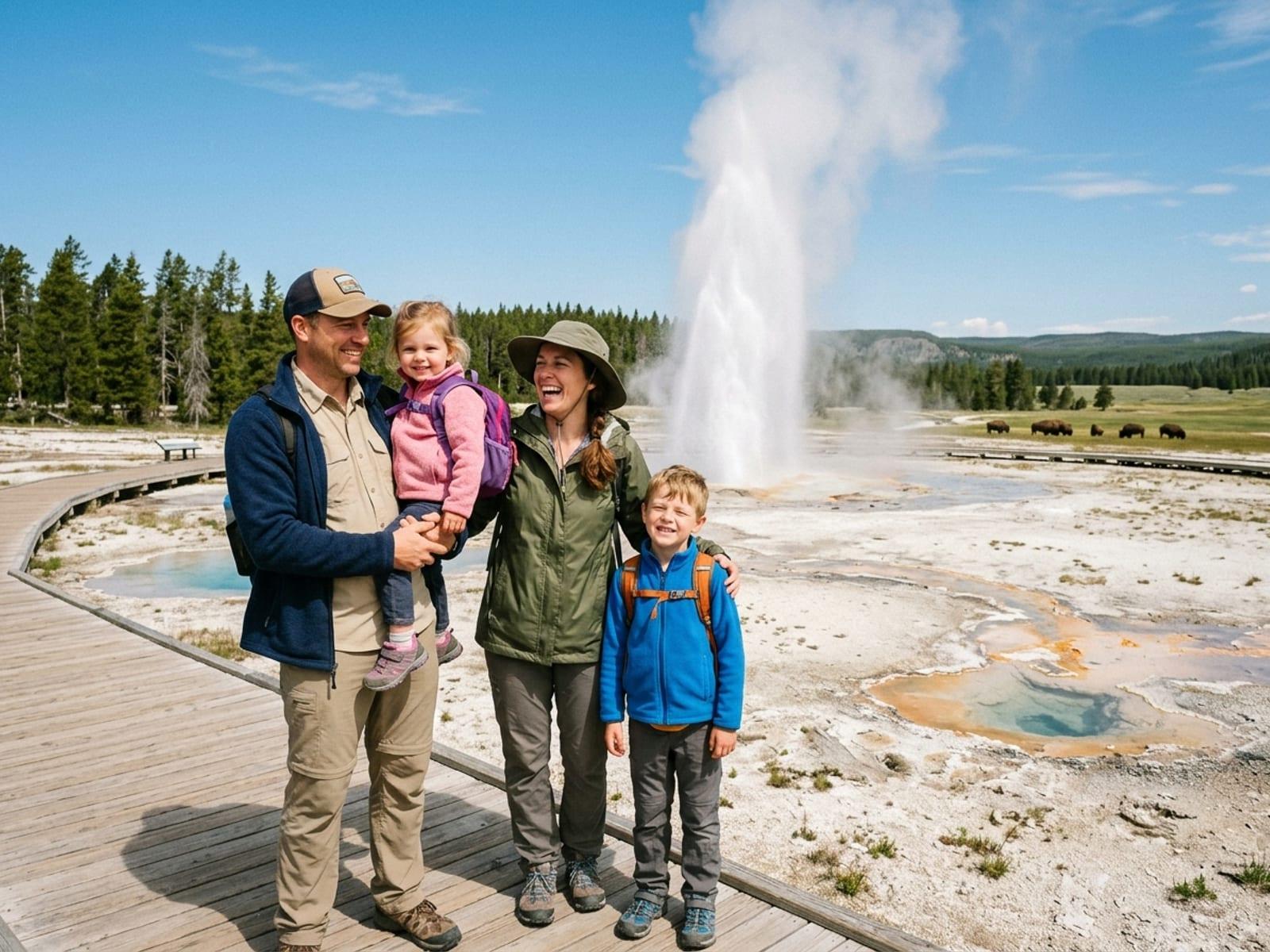
Steam gurgles up out of the ground, and then, all at once, a white column of water shoots dozens of meters into the air. Old Faithful, the geyser in Yellowstone National Park, makes children and adults alike cry out. Yellowstone became the world's first national park in 1872 and a UNESCO World Heritage Site in 1978, and it holds more than half of the world's geysers. If you're visiting as a family, check the eruption prediction and plan around it, and make two promises with your kids before anything else: stay on the boardwalks, and stay away from wild animals.
The first national park, sitting on a volcano
Yellowstone covers about 8,983 square kilometers, mostly in northwestern Wyoming, with parts reaching into Montana and Idaho. On March 1, 1872, it was designated the first national park in the United States, and it's widely considered the first in the world.
The park sits on top of the Yellowstone Caldera, an enormous basin formed by a huge eruption about 640,000 years ago. Heat from below warms water near the surface, and the park has at least 10,000 hydrothermal features, from steam vents to hot springs. Beyond the geysers and colorful springs, there's the Grand Canyon of the Yellowstone, carved by the river through volcanic rock, and Yellowstone Lake, one of the largest high-elevation lakes in North America at about 2,357 meters. Its wild bison herd is the oldest and largest on public land in the United States. In 2025 the park had about 4.76 million visits.
Old Faithful: check the prediction, then wait
The park's most famous sight, Old Faithful, is known for erupting on a regular schedule. Calistoga in California's Napa Valley has a geyser with the same name, but this is the one people usually mean. According to the National Park Service, as of January 2025 the median interval between eruptions was 102 minutes, plus or minus 10 minutes, ranging from 54 minutes at the shortest to 118 at the longest. Eruptions reach about 32 to 55 meters or more, averaging around 40 meters, and each one lasts from about a minute and a half to five minutes.
You can check the next predicted eruption at the Old Faithful Visitor Education Center, at the nearby lodges, or in the National Park Service app. The prediction comes with a window either side, so with kids, get to a viewing spot 20 to 30 minutes ahead and bring drinks and snacks so you can wait comfortably. The visitor center has exhibits explaining how geysers erupt, and a stop there during the wait makes the eruption even more impressive for children. Predictions aren't posted when the center is closed, from early November to mid-December and from mid-March to mid-April.
The Upper Geyser Basin, home to Old Faithful, packs at least 150 geysers and hundreds of hot springs into about 2.6 square kilometers, and boardwalks take you to the main sights. About 10 kilometers north is Midway Geyser Basin and the park's largest hot spring, Grand Prismatic Spring.
Stay on the boardwalk, and give bison 25 yards
In Yellowstone's thermal areas, the ground can be a thin crust over boiling water. The National Park Service insists that visitors stay on boardwalks and designated trails and never touch hot springs or their runoff; more than 20 people have died from burns after going into hot springs. Keep children within arm's reach and don't let them run on the boardwalks. If you start to feel sick, leave the area at once, since toxic gases may have collected there.
There are rules about distance from wildlife too. Stay at least 100 yards (about 91 meters) from bears, wolves and cougars, and at least 25 yards (about 23 meters) from bison, elk and all other animals. The animal that injures the most people in the park isn't the bear but the bison. If you spot one grazing by the road, don't approach it from your car; watch through binoculars or a telephoto lens. On hiking trails, the park recommends traveling in groups of three or more and making noise as you go.
The park is at high elevation, so even in summer mornings and evenings are cold and the weather changes quickly. Pack rain gear and layers whatever the season. Headache, nausea and dizziness can be signs of altitude sickness; if they're severe, go down to lower elevation and get medical help.
Junior Rangers from age 4, with a wooden badge
One thing well worth doing with kids is the National Park Service's Junior Ranger program. The Park Service runs it at many of its sites, including the National Mall during the National Cherry Blossom Festival in Washington, D.C.. It's a self-guided activity for children ages 4 and up. You can pick up the booklet at any visitor center or download it in advance from the official site. Kids complete age-appropriate activities on thermal geology, wildlife, and the relationship between wildfire and forests, then have a ranger at a visitor center check their work. In return they get an arrowhead-shaped wooden badge showing a geyser, mountains and a bison. Badges are only handed out in the park and can't be mailed, so leave some slack in your schedule.
There's also a Young Scientist booklet that treats the park's mysteries as science puzzles to solve, a good fit for older kids who like science. Ranger-led programs usually run from Memorial Day weekend at the end of May through Labor Day in early September.
Road seasons, entrance fees and the nonresident fee
The park itself is open all year, but the roads you can drive in a regular car are limited by season. For 2026, roads including the route from the West Entrance to Old Faithful are scheduled to be open from April 17 to October 31, roads from the South Entrance from May 8 to October 31, and only the road from the North Entrance to the Northeast Entrance is open year-round. From early November to late April most roads are closed to regular vehicles, and winter access is limited to snowcoach and similar tours. For a family trip, June through September, when roads and facilities are all open, is the easiest time.
The entrance fee is $35 per private vehicle, covering everyone in it for seven consecutive days. Visitors 16 and older who don't live in the United States also pay a nonresident fee of $100 per person (not needed if you enter with an annual pass; checked on the official site in October 2026). Fees and road schedules can change, so check the National Park Service's official site before you set out.
The park's five entrances are hours apart by car, so getting around inside the park basically means driving. One of the gateway airports is Bozeman Yellowstone International Airport (BZN) in Montana. Entry requirements for the United States vary by nationality, so check your own government's official information. You can also try a family photo with an erupting geyser behind you using pokesta's AI photos ($1 per photo, and your first one is free).
References