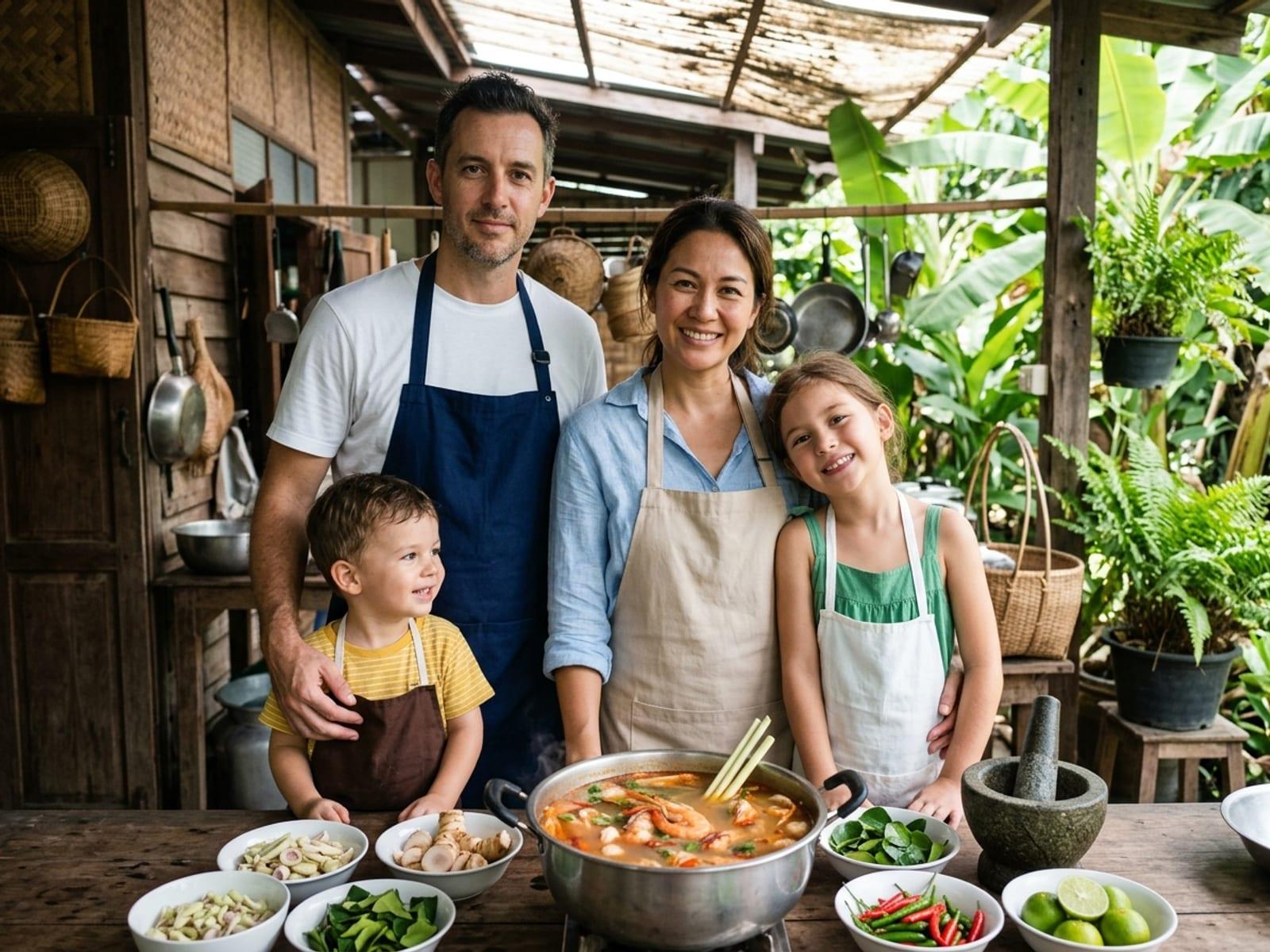
The scent of lemongrass and makrut lime leaves rises from the bowl, the first spoonful hits you with sourness, the second with heat. Tom yum kung is the prawn soup many people picture when they think of Thai food, and in December 2024 it was added to UNESCO's list of Intangible Cultural Heritage. It has a fiery reputation, but if you order the right way, children can share it too. In Bangkok you'll find it everywhere, from street stalls to specialist restaurants and cooking classes.
A soup born of riverside life in the central plains
"Tom" means to boil, "yum" means to mix, and "kung" means prawn. As the name says, it's a soup of prawns and herbs boiled together, with the flavors mixed and balanced.
According to UNESCO, tom yum kung originated among Buddhist communities living along the rivers of Thailand's central plains, long the country's main food-producing region. People who avoided killing large animals ate the freshwater prawns that were abundant in the rivers. River prawns were simmered with lemongrass, makrut lime leaves, galangal (a Thai relative of ginger) and shallots, then seasoned with local condiments. The soup was also valued for building strength and staying well through the rainy season.
The recipe was originally passed down by word of mouth, within families and at community gatherings. Today it's taught in restaurants, schools and universities. What UNESCO recognized is not only the dish itself but the knowledge of local nature and ingredients behind it, and a food culture tied to Buddhist values.
Thailand's earlier inscriptions were Khon masked dance drama (2018), Nuad Thai traditional massage (2019), Nora dance drama from the south (2021) and the New Year festival of Songkran (2023). In 2024 the kebaya, a women's garment nominated jointly with other Southeast Asian countries, was also inscribed. Tom yum kung is the first Thai dish on the list, which means an everyday bowl eaten at street stalls and at home now stands among the country's defining cultural traditions.
Sweet, sour, salty and spicy, layered together
In a word, tom yum kung is sour and spicy. Keep eating, though, and you'll notice the savoriness of the prawns, the sweetness of shallots and the slight bitterness of herbs layered underneath. The Tourism Authority of Thailand describes the balance of spicy, sour, salty and sweet as the defining feature of the dish.
The key to making it is to simmer the aromatic herbs first, and to add the lime juice and fish sauce (nam pla) only once the cooking is done. Beyond that, every home and restaurant does it a little differently: simmering prawn shells and heads for stock, adding straw mushrooms or oyster mushrooms, or deepening the flavor with nam prik pao, a paste of chilies and shrimp fried together. A scattering of coriander (cilantro) on top is standard.
Clear "nam sai" or creamy "nam khon"?
Menus often split the soup into nam sai and nam khon. Nam sai is the clear version, the traditional form, where the herbs and sourness come through directly. Nam khon is creamy, made with evaporated milk or similar, and is said to have spread in the 1980s. The dairy rounds off the edge of the heat, so people who aren't used to spicy food, and children, often find nam khon easier to eat.
There are also relatives made with other ingredients: tom yum pla with fish, tom yum gai with chicken and tom yum talay with mixed seafood. If someone in the family doesn't like prawns, the same restaurant may offer a different version.
Ordering for children: learn to ask about heat
Many Thai restaurants will adjust the spice level if you ask when ordering. "Not spicy" is mai phet in Thai, and "just a little spicy" is phet nit noi. Restaurants vary in how they respond, and even a toned-down version can be too hot for children, so have an adult taste it first before serving.
The lemongrass, galangal and lime leaves in the soup are there for aroma and usually aren't eaten. People push them to the side of the bowl. The fibers are tough, so take them out when you serve children to avoid anything catching in their throats. If anyone in the family is allergic to shellfish, remember that the stock may be made with prawn shells.
In Thailand the soup is eaten with rice, which tempers the heat. Give children a generous helping of plain rice and let them spoon a little soup over it, and the spice level becomes much more manageable.
It also helps to think about the whole table. As our guide to eating out in Thailand explains, Thai meals are usually shared, with several dishes in the middle for everyone. Order one tom yum kung for the family, plus something mild for the children such as kai jiao (Thai omelet) or khao pad (fried rice), and nobody goes hungry if the soup turns out too hot. Some places bring it out in a pot over a flame, so watch where it's placed to keep small hands away from the hot vessel.
Make your own bowl at a cooking class
Bangkok has Thai cooking classes for visitors. Some start with choosing ingredients at a market, some welcome children, and the content varies from class to class. Tasks like bruising lemongrass to release its scent or tearing lime leaves are easy for children to help with, and they learn the different aromas by smell. Age limits and prices depend on the class, so check before you sign up.
Even on days without a class, any market will have bundles of lemongrass, galangal and lime leaves for sale. Pick them up one at a time with your children, smell each one and guess which gives the soup which part of its aroma. It makes the next bowl more fun.
You can see what a family photo in aprons with herbs in hand might look like with pokesta's AI-generated photos ($1 per photo). For something sweet afterward there's mango sticky rice, and for fruit where it grows, the orchards of Chanthaburi in the east.
When to go: any time, anywhere
Tom yum kung is eaten year-round. Sweating over a bowl in the hot season and warming up with one on a cool rainy-season day are both very Thai ways to enjoy it.
The main international gateway is Suvarnabhumi Airport (BKK) in Bangkok, and many low-cost carriers use Don Mueang Airport (DMK). Entry requirements vary with nationality and change often, so check official information from your own government and the Thai government before you leave.
References