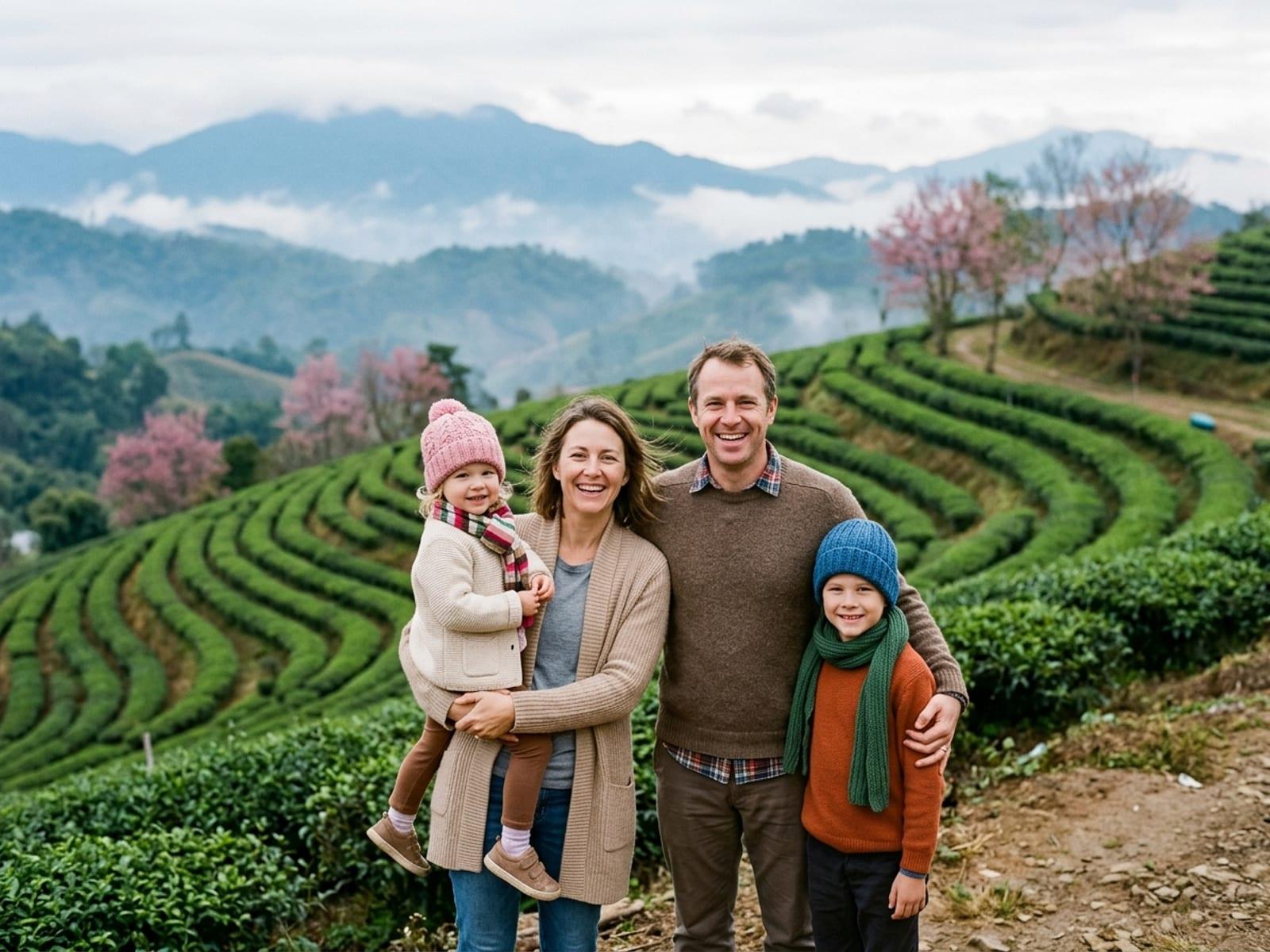
Tropical Thailand has a mountain village where you'll want a sweater in the morning. Mae Salong, officially named Santikhiri, sits in Chiang Rai Province in the far north, its houses strung along a ridge about 1,134 meters above sea level and its slopes covered in tea. What grows here isn't green tea or black tea but high-mountain oolong. The village was founded by soldiers who crossed the border from China, and in its tea shops you still hear the language of Yunnan. The best time to feel the season is from late December into January, when the cherry trees bloom and the tea festival is on.
A village of soldiers who crossed the border
Mae Salong's story goes back to the Chinese Civil War. After the war, some Kuomintang units refused to surrender and fought their way into Burma (today's Myanmar). In 1961 General Duan Xiwen led around 4,000 troops to Mae Salong, and the Thai government allowed them to stay in exchange for helping to counter communist insurgents. Many later became Thai citizens, and most of today's residents are their descendants. The language of Yunnan is still the main language spoken in the village.
The village also has a past tied to opium poppy cultivation. When the Thai government officially gave it the name Santikhiri, "hill of peace," in the late 1980s, the aim is said to have been to distance it from that history. Tea was the crop that spread in place of the poppy.
High-mountain oolong grown at 1,200–1,400 m
Mae Salong tea is known as a high-mountain oolong grown on slopes at about 1,200 to 1,400 meters. At the tea factories, Taiwanese experts work alongside local farmers on tea production. Tea estates in the village include Choke Chamroen Tea, Wang Puttan and 101 Tea.
The village street is lined with tea shops alongside guesthouses and noodle shops. When you buy tea, ask whether you can taste first. Try a few side by side and you'll find that the same oolong can differ a lot in aroma and astringency. For children, start by having them hold the cup in both hands and smell the tea. Oolong contains caffeine, so small children should have no more than a sip; bring warm water or fruit juice for them to drink instead.
Seen in the low light of morning or evening, the tea terraces show their rows in sharp lines. With mountain ridges layered behind the tea and a cool climate, the village is sometimes called "Little Switzerland."
Oolong is a tea whose leaves are partially oxidized before finishing, so it sits between green and black tea in flavor. Leaves rolled into tight little balls open slowly when hot water is poured on, and the aroma changes with the second and third infusions. Show children the leaves unfurling in a glass pot, and they'll be delighted to see the leaves "come back."
If you take tea home, ask the shop how to brew it. Making the same tea as a family and remembering the scent of the mountain village keeps the trip going after you return. Tea absorbs moisture and smells easily, so carry it home in a sealable bag and keep it away from anything strongly scented.
In the cool season, warming up with a bowl of hot noodles at one of those noodle shops, surrounded by Yunnanese voices, is very much a Mae Salong thing to do. Yunnanese noodles run through northern Thai food more widely, too: Chiang Mai's khao soi curry noodles are said to have come with Muslim traders from Yunnan.
Late December to January: cherry blossom and tea festival season
A cherry blossom festival has been held in Mae Salong each year from around December 28 to January 2. Around festival time, wild cherry trees bloom pink on the slopes. The festival includes a handicraft market, a light and sound show, a hill-tribe parade and a beauty pageant.
The Tourism Authority of Thailand (TAT) has also featured a Mae Salong tea-tasting festival held in Santikhiri at the same time of year. For the festival from December 28, 2019 to January 2, 2020, visitors could taste the village's signature teas, see the cherry trees in full bloom and try hill-tribe food. The name, program and dates vary from year to year, so check announcements from TAT and Chiang Rai Province before you go.
Dressing for the mountain chill, and tips with kids
Mae Salong is cool all year and chilly from November to February. Even with strong daytime sun, you'll need a jacket in the morning and evening. Dress the family in layers, and bring knit hats, light scarves and warm socks for the children. Warm-colored knits and cardigans also stand out nicely against the green tea. On the Chiang Mai side, Doi Inthanon, Thailand's highest peak, can drop below freezing on winter mornings, so if you're visiting both, pack for that.
Don't underestimate the sun just because it's cool. The air is clear up in the mountains, so the midday sun feels strong on fine days. There's little shade among the tea bushes, so carry hats, sunscreen and drinks even in the cool season. Front-opening tops make it easy to add or remove a layer as the temperature changes.
The village stretches along the ridge, and the tea gardens are on steep slopes. When walking through them, go single file along the narrow paths between rows, and tell children beforehand not to break branches or pick leaves. There are plenty of hills, so a carrier is easier than a stroller. The mountain roads are full of bends, so for children prone to carsickness, keep the meal before setting out light and bring motion-sickness medicine.
On cold nights, check whether your accommodation has heating. Some mountain guesthouses are built with the hot season in mind. Pack long-sleeved pajamas for the kids and ask whether you can get extra blankets, and they'll be less likely to wake up cold in the night.
You can see what a family photo on the tea slopes might look like with pokesta's AI-generated photos ($1 per photo). A northern Thailand trip can also include the Bo Sang umbrella festival in January or the Chiang Mai Flower Festival in February.
When to go: fly into Chiang Rai
For the cherry blossom and tea festival, go from late December to early January. If you'd rather wait for milder weather, February onward is also comfortable. Tea shops and estates welcome visitors year-round.
The nearest airport is Mae Fah Luang–Chiang Rai International Airport (CEI), about 8 km from Chiang Rai city, with domestic flights from Bangkok's Suvarnabhumi and Don Mueang airports. Mae Salong is on a mountain about 80 km from Chiang Rai city, so joining a tour or hiring a car is the practical way to get there. Rooms in the village are limited, so book early if you're going for the festival. Entry requirements vary with nationality, so check official information from your own government and the Thai government.
References