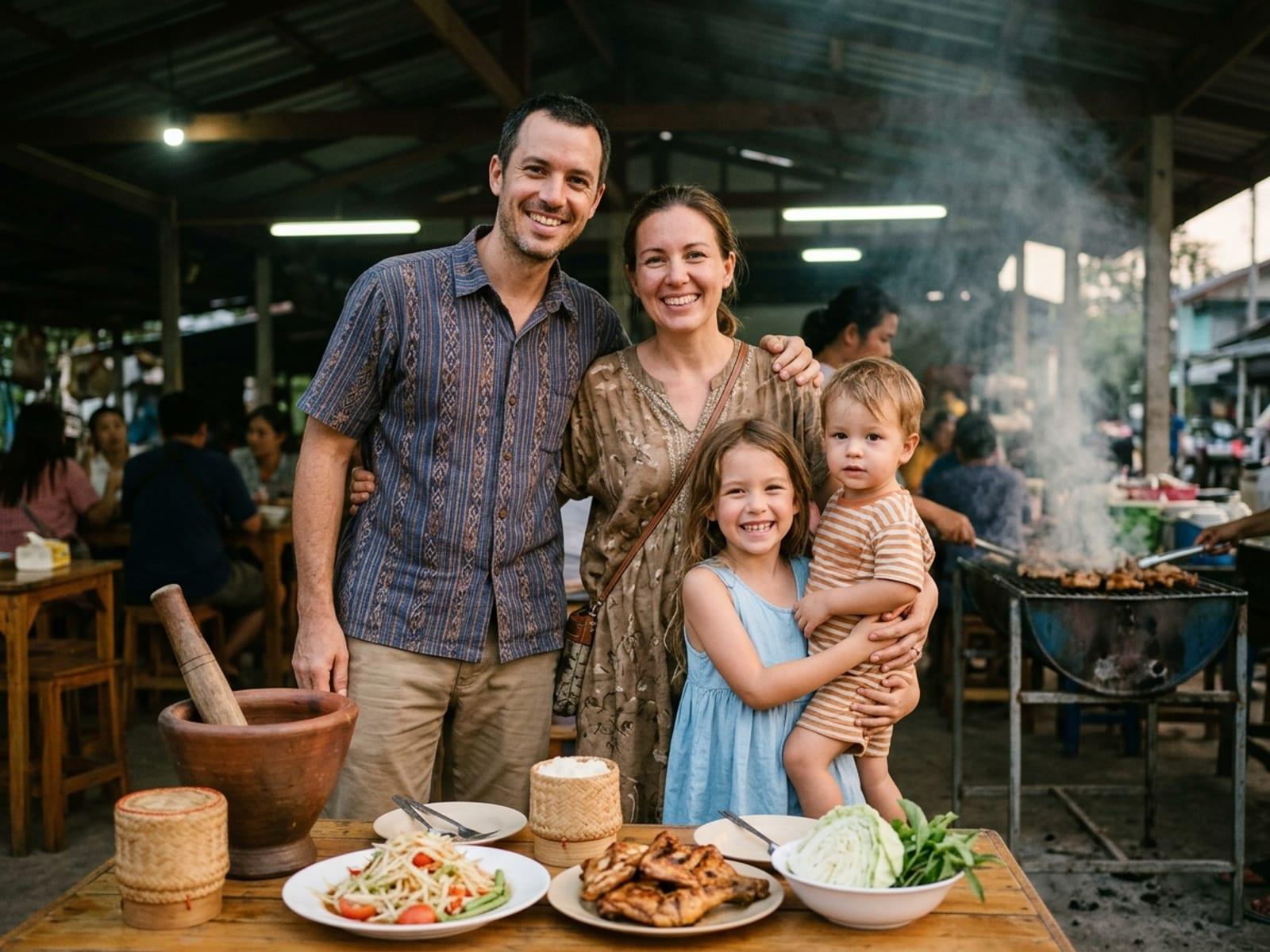
A wooden pestle thuds into a clay mortar, and a green papaya salad comes together in front of you. On the charcoal grill next to it, a flattened chicken cooks slowly. At eateries serving food from Isan, the northeast of Thailand, the most common order is this trio: som tam, the green papaya salad; gai yang, grilled chicken; and khao niao, sticky rice. You'll find Isan canteens and stalls all over Bangkok. The food has a reputation for heat, but with a little planning children can sit down to it too.
A northeastern table that runs into Laos
Isan is the northeastern region of Thailand, bordering Laos across the Mekong River. Most of its people are ethnic Lao, and the food is closely tied to that of Laos. Som tam is believed to have been created by the Lao, who call it tam mak hung ("pounded papaya") and count it among their national dishes. In Thailand it spread from Isan to the rest of the country and is now a fixture of Thai food everywhere.
Across most of Isan the everyday staple is sticky rice rather than ordinary rice. The rice is soaked in water for several hours, steamed in a bamboo basket, and brought to the table in a small woven basket called a kratip. The same bamboo steaming basket turns up at the Phi Ta Khon festival in Loei, worn on top of the ghost masks.
Som tam is made in the mortar
To make som tam, unripe, hard green papaya is shredded and pounded and tossed in a clay or wooden mortar with chilies, garlic, lime, fish sauce, palm sugar, tomatoes and yard-long beans. Rather than mixing chopped ingredients, the cook lightly bruises them so the flavors soak in. Sour, hot, salty and sweet all land on one plate.
There are several kinds. In Bangkok and central Thailand the usual one is som tam Thai, sweeter and made with crushed peanuts and dried shrimp. Closer to the original Isan taste are som tam Lao, made with pla ra, a cloudy fermented-fish seasoning, and som tam pu, with salted paddy crabs pounded in whole, shell and all. Both are far stronger in smell and heat. If it's your first time, som tam Thai gives you the clearest idea of the dish.
Pla ra is not like clear fish sauce: it is murky, sometimes has bits of fish in it, and smells strong. You can usually choose whether it goes in, so asking for it without pla ra is one option until you're used to it.
Green papaya isn't the only base. There are versions with cucumber, green mango or banana blossom, and tam sua, which adds thin rice noodles. They're all pounded the same way, and deciding at the counter which one to order is a fun thing to talk over with kids.
The chilies that give som tam its heat are, as it happens, a crop from the Americas. They reached Southeast Asia in the 17th century and were taken up first in central Thailand, then later in Isan and Laos.
Som tam often comes with raw cabbage or morning glory. These are there to soften the heat; a bite between mouthfuls of salad calms things down.
Charcoal-grilled chicken and sticky rice rolled by hand
For gai yang, a chicken is split and flattened, marinated in fish sauce, garlic, turmeric, coriander root and white pepper, and grilled slowly over a low charcoal fire. The skin turns fragrant and the meat stays moist. Sauces usually come on separate small plates, and the usual one is jaeo, a hot chili dip. Without the sauce there's no heat at all, which makes gai yang the easiest dish on the table for children.
Sticky rice is eaten with the hand. With your right hand, take a bite-sized piece from the basket, roll it lightly between your fingertips into a small ball, and dip it into the gai yang sauce or the juices of the som tam. That's how it's done in Isan. Freshly steamed sticky rice doesn't cling much to your fingers and is pleasantly firm, so children can copy it straight away. Close the basket lid when you're not eating from it so the rice doesn't dry out.
Add larb, minced meat tossed with herbs, or nam tok, sliced grilled meat dressed the same way, and you have a proper Isan spread. Both contain khao khua, toasted ground sticky rice, which gives them a nutty aroma. Be aware that larb and nam tok are usually quite spicy too.
With children, decide on the zero-heat dishes first
At Isan places, the heat of som tam is set by the number of chilies. When ordering, say "mai phet" (not spicy) or "phrik nueng met" (one chili), and the cook may go easy. Even so, som tam is almost always too hot for children, so have an adult taste it first. Since the chilies are pounded in the mortar, heat from the previous order can linger in it.
The surest approach is to build children's meals around gai yang and sticky rice, eaten without sauce. Some places also serve grilled pork (moo yang) or fried pork. Ask for cucumber or cabbage on the side and they get some vegetables too.
Watch for allergies: peanuts and dried shrimp in som tam Thai, crab in som tam pu, and fish sauce or pla ra in nearly every dish. If anyone is allergic to peanuts or shellfish, show a card written in Thai. Som tam made with raw crab or fermented fish is best avoided by young children or anyone feeling unwell.
Most of these eateries have outdoor or semi-outdoor seating, and it gets very hot near the grill. Go in the early evening, once the sun is down and things have cooled a little, and bring plenty to drink. You'll be eating with your hands, so wet wipes come in handy.
Where to eat, when to go and how to get there
Isan food is everywhere in Bangkok: alley stalls, dedicated canteens and shopping mall food courts. Look for charcoal smoke and listen for the thud of the pestle. To go deeper, consider a trip to one of Isan's main cities, such as Khon Kaen, Udon Thani or Ubon Ratchathani, all linked to Bangkok by domestic flights. Around Ok Phansa in October, you could time a trip to the northeast for the illuminated boats of Nakhon Phanom on the Mekong.
The food is available all year. Bangkok's main international gateway is Suvarnabhumi Airport (BKK). Many low-cost flights and domestic flights to Isan leave from Don Mueang Airport (DMK).
To see what a family photo around the mortar, reaching into a basket of sticky rice, might look like, you can try pokesta's AI-generated photos ($1 per photo, with your first one free). The same sticky rice becomes a dessert with coconut milk and ripe mango in mango sticky rice. Entry requirements for Thailand depend on your nationality, so check your own government's official information before you travel.
References