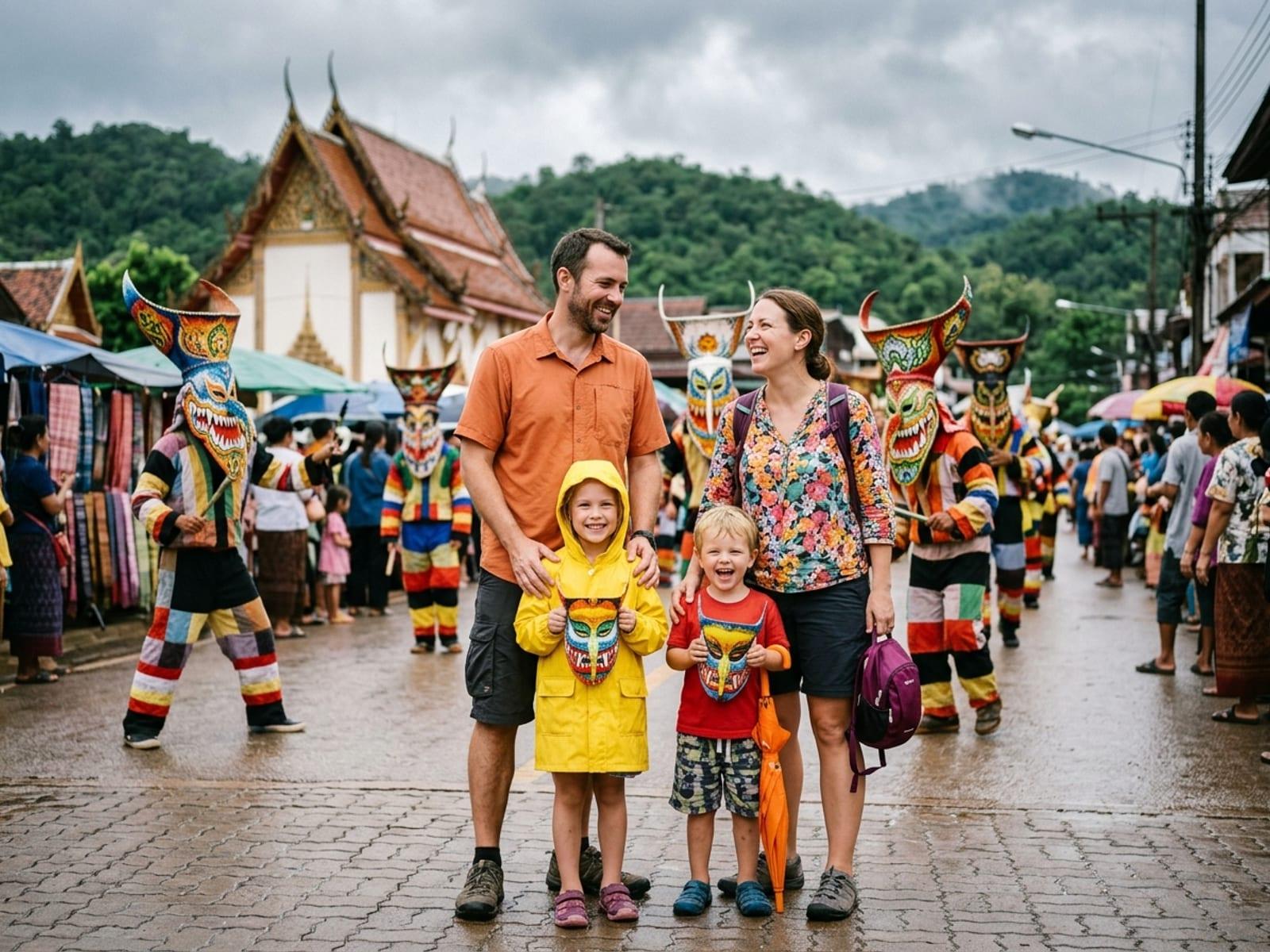
A long, upturned nose, a row of jagged teeth, and on top of the head a bamboo basket of the kind used to steam sticky rice, worn like a hat. At the Phi Ta Khon festival in Dan Sai district, Loei Province, in northeastern Thailand, "ghosts" in these brightly painted masks dance through the streets, bells clanking. The festival lasts three days, somewhere between late June and early July. The town's spirit mediums pick the dates from the days after the full moon of the sixth lunar month, so they shift every year: June 28 to 30 in 2025, June 20 to 22 in 2026. The grand mask parade is on the second day, and there's no mask dancing on the last. The masks may look a little scary, yet underneath it all are a Buddhist story and a farming community's prayers for rain and a good harvest.
The dates move every year; the big parade is the middle day
Phi Ta Khon is always held after the 15th day of the waxing moon (the full moon) of the sixth lunar month. Which three days, exactly, is up to Dan Sai's mediums. The last three festivals fell like this:
| Year |
Festival days |
Grand mask parade |
| 2024 |
Sun July 7 to Tue July 9 |
Mon July 8 |
| 2025 |
Sat June 28 to Mon June 30 |
Sun June 29 |
| 2026 |
Sat June 20 to Mon June 22 |
Sun June 21 |
The parade landed on a Sunday in 2025 and 2026, but as 2024 shows, it can fall on a weekday. The dates are announced by the Tourism Authority of Thailand's Loei office and the province, so hold off on non-refundable rooms and flights until they're out.
It gets busy. For 2026, organizers expected more than 100,000 visitors and a parade of over 1,000 Phi Ta Khon. That year Dan Sai police closed sections of Kaeo Asa Road, which runs past the festival grounds, on the first two days, and made nearby streets one-way with no parking on either side. If you're driving, use the designated parking areas and allow time to walk in.
A homecoming so loud it woke the dead
Phi Ta Khon is part of a Buddhist festival known in Dan Sai as Bun Luang. Its origin is usually traced to one of the stories of the Buddha's past lives, that of Prince Vessantara. The endlessly generous prince set off on a long journey and was thought to have died, and when he came home, people celebrated so noisily that even the spirits of the forest woke up and joined the procession. The masked "ghosts" represent those spirits. Even the name is said to have drifted from an older one, "phi tam khon," the ghosts that follow people.
The other pillar of the festival is a prayer for rain. Bamboo rockets are fired, just as at the rocket festivals held across the northeast at the start of the rainy season, to ask for plenty of rain and a good harvest. On the last day, the story of Prince Vessantara, divided into thirteen chapters, is preached in full at the temple. Raucous masks and quiet sermons: the festival needs both.
The three days: a river ritual before dawn, the grand parade, then sermons
Day one starts before sunrise. In the 2026 program, a procession went from Wat Phon Chai, the temple at the heart of the festival, to the bank of the Man River, which flows through town. There Phra Upakut is brought up out of the water and enshrined at the temple, and guns are fired toward the four directions. Upakut, a Buddhist monk believed to ward off storms and evil spirits, is invited to protect the festival. (In 2025 the ritual began at 4 a.m. Some English sources call the river the "Mun," but the Thai program and Thai sources name it the Man, Mae Nam Man.) The morning brings alms for the monks and a baci (bai si su khwan) ceremony for Chao Pho Kuan and Chao Mae Nang Tiam, the man and woman who lead the festival's rites; in 2025 it was held at Chao Pho Kuan's house at 8:30 a.m.
Day two is the main event. An opening ceremony takes place in the morning in front of the district office, followed by the procession of Prince Vessantara entering the town, which is the grand Phi Ta Khon parade. It's led by two giant ghosts, a pair found only in Dan Sai. Chao Pho Kuan's party circles the ordination hall of Wat Phon Chai three times and lights the rain rockets. Afterwards the performers throw their masks into the Man River. The idea is to cast misfortune away with them, and the costumes of the giant ghosts must not be taken into the house.
Day three is for the Kan Lon procession and the thirteen sermons. There is no Phi Ta Khon dancing that day. If it's the masks you want to see, go on day one or two; mix this up and you'll arrive to find only a quiet temple ceremony.
Masks and patchwork: look, choose, take one home
The mask is carved from the thick base of palm leaf stems, with a bamboo sticky-rice basket sewn on top so it can be worn on the head. Sticky rice is the daily staple of the northeast, and this is the basket it's steamed in, the same rice that's rolled by hand and eaten with som tam and gai yang. It's painted with fine patterns in red, green and yellow and finished with a long nose and ear-like decorations. The costume is a big patchwork robe of colorful fabric, with bells hung at the waist that rattle with every dance step. There are two kinds of mask: the big ones made with bamboo, and the small ones anyone in town can make and wear.
During the festival a market springs up in town, selling food and local crafts. You'll find miniature Phi Ta Khon masks among the souvenirs, and letting each child pick one in a color they like changes how they watch the parade. The dancers send their masks down the river, while your child carries one home, which is worth talking about together. In the grounds of Wat Phon Chai there's a folk museum devoted to the festival. It gets crowded during the festival itself, so TAT suggests visiting a day or two before.
There's no dress code for spectators. June and July are the rainy season, though, so sudden showers and mud splashes are a given. Quick-dry shirts and trousers, a light hooded rain jacket and shoes that can get wet are the practical choice. For the temple rituals, carry a layer that covers shoulders and knees.
Small children: one step back, up in an adult's arms
Teasing the crowd is part of the ghosts' job. When a huge mask leans in close, toddlers sometimes burst into tears. Start a little back from the parade, watching from an adult's arms, and move closer bit by bit if your child is enjoying it. The river ritual on day one happens before dawn, so with little ones it's more realistic to skip it and focus on the day-two parade.
Something else worth knowing in advance: some dancers carry wooden phallus-shaped objects as a symbol of fertility and a good harvest. They have long been used in rural festivals and aren't meant as a crude joke. Decide beforehand how you'll answer if your child asks, and you won't be caught off guard.
The area in front of the district office, where the opening ceremony takes place, draws a crowd, so with kids it's better to wait a little further along the route, where you can watch without being jostled. You'll be walking through the closed streets, so a baby carrier is likely to be easier than a stroller. If you'd like a photo with a masked dancer, ask with a gesture first. The masks and costumes are handmade; check with the wearer before anyone touches them, and make sure children don't tug on noses or bells. Stay well away from the rocket launch site and hold hands in crowds. The dancing goes on even if rain starts mid-parade, but if your child is getting wet and cold, head for shelter, and keep everyone drinking water in the muggy spells between showers. Temple grounds have spots where you take your shoes off, so slip-ons make life easier.
Getting there: stay in Loei, and stop at the riverside stupa
From abroad, fly into Bangkok and take a domestic flight from Don Mueang Airport (DMK) to Loei Airport. Dan Sai is in the west of Loei Province, reached by car from Loei town. Phitsanulok Province borders it to the west, and you can also come in overland from that side. Dan Sai is a small town with limited rooms at festival time, so consider staying in Loei town and making day trips.
If you have time, visit Phra That Si Song Rak, a stupa on the same Man River. Work began in 1560 and it was finished in 1563. Tradition holds that King Maha Chakkraphat of Ayutthaya and King Setthathirath of Lan Xang built it as a pledge that neither kingdom would encroach on the other. On the full moon of the sixth lunar month, the people of Dan Sai hold a festival for the stupa, and Phi Ta Khon follows after that same full moon, so seeing both helps the town's calendar make sense.
For another festival in the northeast, the illuminated boats of Nakhon Phanom mark the end of the rainy season in October. You can also see what a family photo at the mask festival might look like with pokesta's AI-generated photos ($1 per photo). Entry requirements vary with nationality, so check official information from your own government and the Thai government.
References