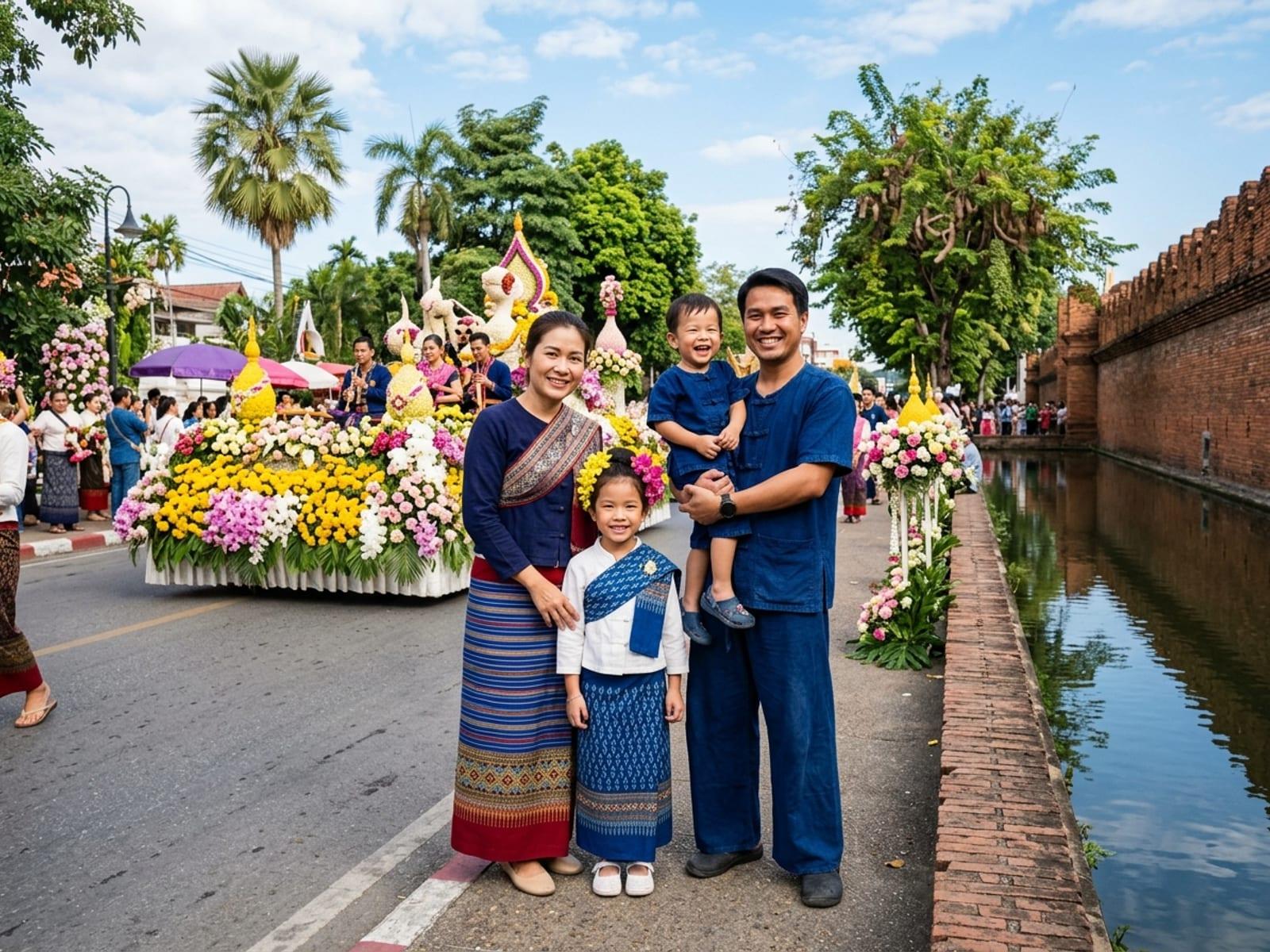
The Chiang Mai Flower Festival runs for three to five days every February, built around a flower parade on Saturday morning. The 49th edition in 2026 ran from Friday, February 13, to Sunday, February 15, and the parade left Nawarat Bridge at 7:30 a.m. on Saturday the 14th. Some years it falls on the first weekend of February, some years on the second, so for 2027, the 50th edition, wait for the dates from the organizer, Chiang Mai Municipality. Floats covered in tens of thousands of flowers roll slowly past with Lanna (northern Thai) performers, and the gardens fill Nong Buak Haad Park at the southwest corner of the old city. It's the dry season, the air is clear and mornings and evenings are cool, which makes this an easy festival to enjoy with children.
Celebrating the flowers of the cool, dry season
Chiang Mai, the old city of northern Thailand, was once the capital of the Lanna Kingdom. February falls in the dry season: rain is unlikely, and some mornings and evenings feel chilly. The Flower Festival gathers the flowers that bloom at this time of year and turns them into floats and gardens.
There is no fixed date; Chiang Mai Municipality sets it each year. Look at the last three: in 2024 the festival ran from Thursday, February 1, to Monday, February 5, with the parade on Saturday the 3rd. In 2025 the parade was on Saturday, February 8, and the floats stayed on display in the park until the 9th. In 2026 it ran from the 13th to the 15th, with the parade on Saturday the 14th. Sometimes that's the first Saturday of the month, sometimes the second, so don't assume "the first weekend of February" and wait for the announcement.
Each year's theme shapes the design of the floats and the gardens at the venue. In 2026 the theme was "flowers bearing royal names," and the festival was held in remembrance of Queen Sirikit, the Queen Mother. Local media published the dates and program details on February 4, nine days before it opened. A sensible approach is to book your hotel around the likely dates, then wait for announcements from Chiang Mai Municipality or the Tourism Authority of Thailand (TAT) before fixing the rest of the plan.
Saturday morning: from Nawarat Bridge to the park
The high point is the opening ceremony and flower parade on Saturday morning. In 2026 the procession set off at 7:30 a.m. and the opening ceremony began at 8:00. In 2024 and 2026 the starting point was Nawarat Bridge over the Ping River. In 2024 the parade headed west along Tha Phae Road to Tha Phae Gate, then followed the outside of the moat around the old city clockwise, finishing at Nong Buak Haad Park (Suan Buak Haad) in the southwest corner. In 2025, 25 floats set off from in front of the Chiang Mai Governor's Residence and made their way to the park. Both the start and the route change from year to year, so check that year's announcement.
Each float is covered in tens of thousands of cool-season flowers. Traditional Lanna performances travel with the procession. The floats move very slowly, so there's no need to chase them: you'll have plenty of time to look as each one passes.
Pick a viewing spot within walking distance of your hotel. It all happens before the sun gets strong, so a light breakfast, the parade, and then a rest somewhere cool before noon makes for a relaxed day.
The park: a flower garden by day, a garden of light by night
After the parade, the floats are lined up in and around Nong Buak Haad Park, where you can see them up close throughout the festival. Inside the park, gardens and flower beds are planted with tulips, orchids and more, and they draw plenty of people taking photos. The 2026 displays used more than 170,000 flowers of 52 species, split into areas that included a Kids & Family Garden with dinosaurs and lanterns of the 12 zodiac animals, a lily and lotus garden lit up at night, and a garden with a flower tunnel and tulips. In 2024 the festival was billed as flowers by day and illuminations by night.
The park also has stalls selling plants grown by local farmers and community workshops, along with OTOP ("One Tambon One Product") goods from around Thailand. In 2026 there were drawing and photo contests for children, and a choir performance at Tha Phae Gate. The program changes every year, so check the announcements before you go.
The best time for the park is not straight after the parade but later, when the sun is lower. Under harsh midday light, flowers and faces tend to look washed out. In slanting late-afternoon light the colors deepen, and children aren't squinting. Stay until dark and you'll see the gardens switch over to their illuminations.
For photos in front of the flower beds, have an adult crouch so the camera is at the child's eye level, and the flowers will seem to surround them. In front of a float, don't try to fit the whole thing in. Move close enough to show the floral detail and keep the family small in the foreground. That composition tends to work better.
Stand among the flowers in Lanna dress
Northern Thailand (Lanna) has its own distinctive way of dressing. Women wear the pha sin, a tube-shaped wrap skirt woven with horizontal stripes, with a fitted long-sleeved blouse. Men wear loose indigo-dyed cotton shirts and trousers. If you can find a child's pha sin or an indigo shirt locally, simply changing into them before walking the park transforms your family photos. A small fresh flower tucked into the hair suits a flower festival perfectly.
February days in Chiang Mai bring strong sun, while mornings and evenings can be cool enough to want a jacket. Carry a light cardigan or something to throw on, and use hats and sunscreen in the middle of the day. The same dry season is also the time to visit Doi Inthanon, Thailand's highest peak, about 60 km southwest of Chiang Mai; if you head up the mountain, pack a much warmer layer such as a down jacket.
A carrier for the parade, shade first in the park
Crowds gather along the route on parade morning. Strollers can get through in places, but they're hard to maneuver in a crush, so a carrier is safer for babies and toddlers. Agree on a meeting point at a landmark such as Tha Phae Gate in case anyone gets separated.
Small children can get bored waiting by the roadside for the whole parade. Once the floats have gone past, there's no need to stay to the very end. Switching to the park to see the floats again at leisure is plenty.
The park is large, and wandering between the flower beds adds up. Find a shady place to rest early on, and drink water often. The flowers are on display, so remind children before going in not to pick or touch them.
You can see what a family photo in front of a flower float might look like with pokesta's AI-generated photos ($1 per photo). If you're traveling around Chiang Mai, comparing seasons is part of the fun: the Bo Sang umbrella festival in January and Loy Krathong in November.
When to go: fly into Chiang Mai International Airport
The festival is held every February, and the parade is usually on Saturday morning. Arrive in Chiang Mai by Friday and get a night's rest, watch the parade on Saturday morning, nap at the hotel in the afternoon and visit the park in the evening, then see the flowers again on Sunday morning while it's still cool. With children, a relaxed three-day, two-night plan like this works well. For lunch after the parade, try khao soi, northern Thailand's curry noodles, in an old-town noodle shop; many close by mid-afternoon, so go early. Dates change from year to year, so confirm them with Chiang Mai Municipality or TAT.
Chiang Mai International Airport (CNX) handles domestic flights from Bangkok as well as international flights to and from China, South Korea, Taiwan, Hong Kong, Singapore, Malaysia, Vietnam and elsewhere. Staying in the old city or near Tha Phae Gate the night before the parade lets you walk to the route early in the morning. Hotels in the old city fill up on festival weekend, so book ahead. Entry requirements vary with nationality, so check official information from your own government and the Thai government.
References