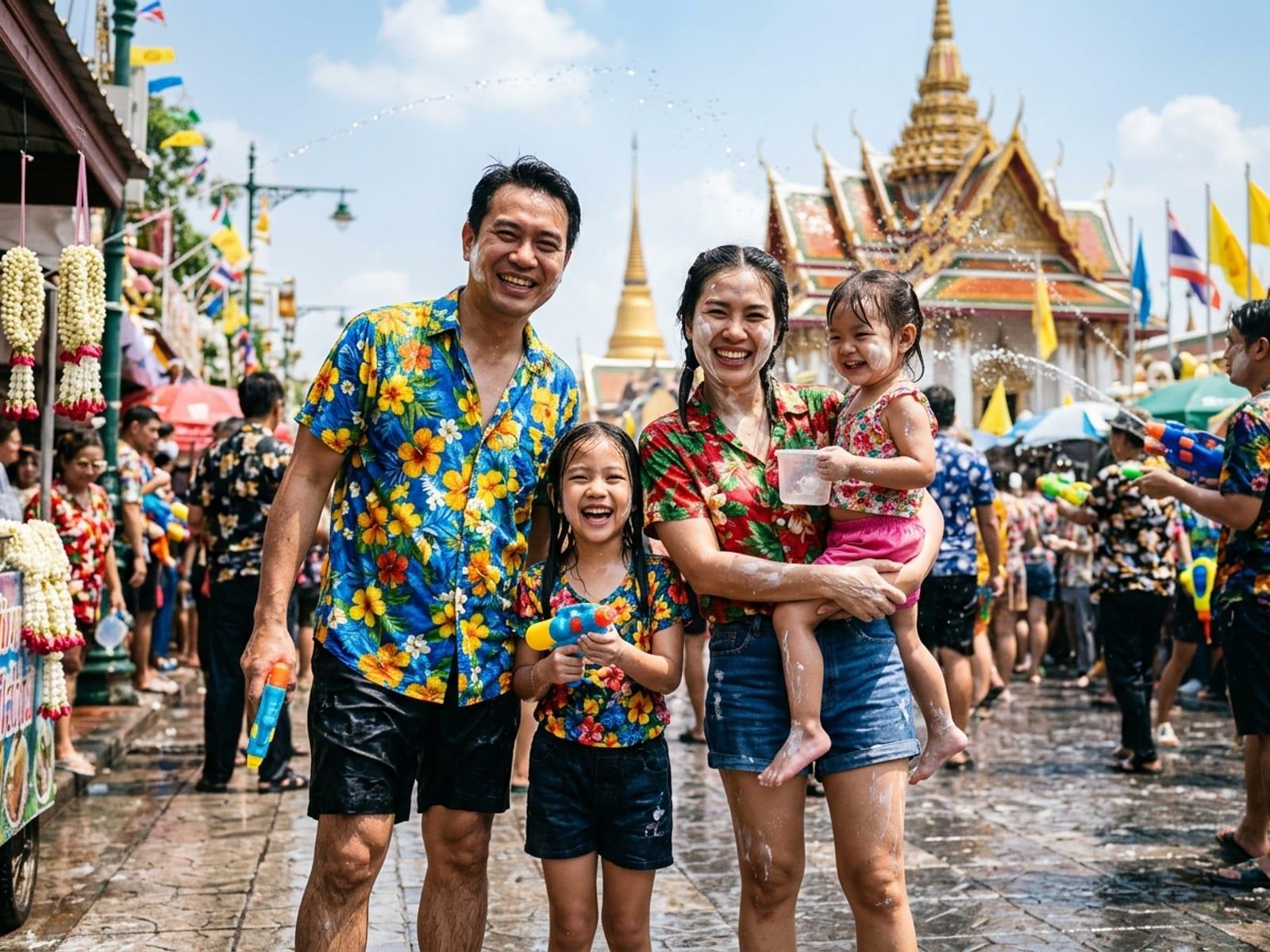
Songkran is the traditional Thai New Year, and April 13 to 15 are public holidays every year. On streets like Bangkok's Silom Road and along the moat of Chiang Mai's old city, everyone douses everyone with water, but at heart the festival is about gently pouring scented water over Buddha images and the hands of elders to welcome the year. With small children, watch the water rituals at a temple first, then keep your own water fight to a quiet side street or your hotel grounds.
A new year that begins when the sun enters Aries
Songkran celebrates the new year at the time the sun completes its annual cycle and enters Aries. According to the Tourism Authority of Thailand, the official holiday runs for three days, April 13 to 15, and in some regions the celebrations last about a week. Although it's a "traditional new year," it follows the movement of the sun rather than the phases of the moon, so the dates are nearly the same every year. In December 2023, "Songkran in Thailand, traditional Thai New Year festival" was inscribed on UNESCO's list of Intangible Cultural Heritage. It was Thailand's fourth inscription, after Khon masked dance drama, Nuad Thai traditional massage and Nora, a dance drama from the south. In 2024 tom yum kung followed as the first Thai dish on the list.
The festival comes just after the rice harvest, when people return to their hometowns to spend time with family and pay respect to elders, ancestors and Buddha images. The water cleanses, and pouring it is a way of showing respect and wishing someone good fortune.
There are two traditional rituals. One is Song Nam Phra, in which scented water is poured over Buddha images at temples to cleanse them. The other is Rot Nam Dam Hua, in which younger people prepare scented water and pour it over the hands of their parents and elders to receive their blessing. With elders it's a gentle gesture, the water poured little by little into the cupped hands they hold out. The boisterous water fights in the streets are said to have grown out of this cleansing water.
Two faces of the festival: temples and streets
Many families begin Songkran morning with a visit to the temple, making merit by offering food to monks and pouring water over Buddha images. Visitors may also come across people pouring water over Buddha images in temple grounds. Watch quietly, and if you're invited to join, simply follow what others do.
As the sun climbs, the streets become the stage for water fights. In Bangkok, Silom Road is among the best-known hubs. In Chiang Mai, people line the moat around the old city with buckets and hoses and soak anyone who passes. Chiang Mai's Songkran is known as one of the liveliest in Thailand, and the Tourism Authority of Thailand features it as a highlight.
In Chiang Mai, look for the procession and sand pagodas
For a side of Songkran beyond the water fights, look to the traditional events in Chiang Mai in the north. In one example described by the Tourism Authority of Thailand, on the afternoon of April 13 a procession carrying the Phra Buddha Sihing, a Buddha image regarded as Chiang Mai's guardian, made its way through the old city to Wat Phra Singh. That same morning there was also a parade of women riding bicycles while holding parasols. Just outside the city is Bo Sang, the village of hand-painted parasols.
On the 14th, the grounds of a temple near Chiang Mai Gate hosted an event where people piled up sand into small pagodas. It's presented, along with almsgiving at temples, as a way of keeping northern traditions alive. It may look like playing in the sand, but it takes place at a temple, so even if children are itching to join in, they shouldn't touch anything without permission from the people building.
Dates, times and locations vary from year to year. Check announcements from Chiang Mai Province and the Tourism Authority of Thailand before you plan.
Floral shirts and clothes that dry fast
Around Songkran, markets and street stalls all over the country sell loud floral "Songkran shirts." Picking out a matching print for the whole family is part of the fun, and it gives your photos a nicely unified look.
Choose quick-dry fabrics. A practical setup is a swimsuit under a T-shirt and shorts. Jeans and thick fabrics get heavy when wet and take ages to dry. Keep your phone, wallet and a copy of your passport in a waterproof pouch around your neck. Wear sandals with straps that won't slip off, because wet pavements are slippery and children running around fall easily.
The April sun in Thailand is fierce, and because getting splashed keeps you cool, it's easy not to notice you're getting sunburned. Pack hats and sunscreen. April is also the start of mango season, so for a break between water fights, look for mango sticky rice.
Water-fight etiquette that also protects kids
Songkran has its etiquette, and much of it doubles as a way to keep children safe. The Tourism Authority of Thailand and others list the basics: don't throw water at monks or police officers; go easy on elders and anyone who clearly doesn't want to join in; use clean water; and don't splash people roughly in ways they dislike. Visitors are also often reminded not to use ice water or dirty water.
Aiming a strong jet at someone carrying a baby or small child is also considered bad manners, but in a crowd not everyone respects that. A hard splash in the face can frighten a small child into tears or get water in their eyes and ears. With babies and toddlers, stay away from the main water-fight zones and keep it to a family splash in a quiet side street at a less busy time, or on your hotel grounds.
Traffic accidents are the other serious risk. Throwing water at people on motorbikes is extremely dangerous, and people are injured every year. Set the rule from the start that children never aim their water guns at motorbikes on the road.
Water guns are sold at stalls all over town. Agree with your children that they'll check with a look ("Is it okay?") before firing, and everyone will have a better time.
Before you fly: dates, airports and the TDAC
Songkran's public holidays are April 13 to 15 every year, and in some regions the celebrations stretch before and after. The main gateway is Suvarnabhumi International Airport (BKK) in Bangkok, where the Airport Rail Link reaches Phaya Thai Station in the city in about 30 minutes. Many low-cost carriers use Don Mueang Airport (DMK) instead, and Chiang Mai is a little over an hour from Bangkok on a domestic flight.
Whether you can enter visa-free, and for how long, depends on your nationality. Before arrival you must register online for the TDAC (Thailand Digital Arrival Card); registration is free and opens three days before arrival.
Thailand's entry rules have changed several times in recent years, so confirm the current requirements before you leave, using your own government's travel information and the Royal Thai Embassy or the Tourism Authority of Thailand. Dates and venues for Songkran events around the country are also announced each year by the tourism authority and local governments. Because so many people travel home for the holiday, book domestic flights out of Bangkok and accommodation in Chiang Mai early.
References