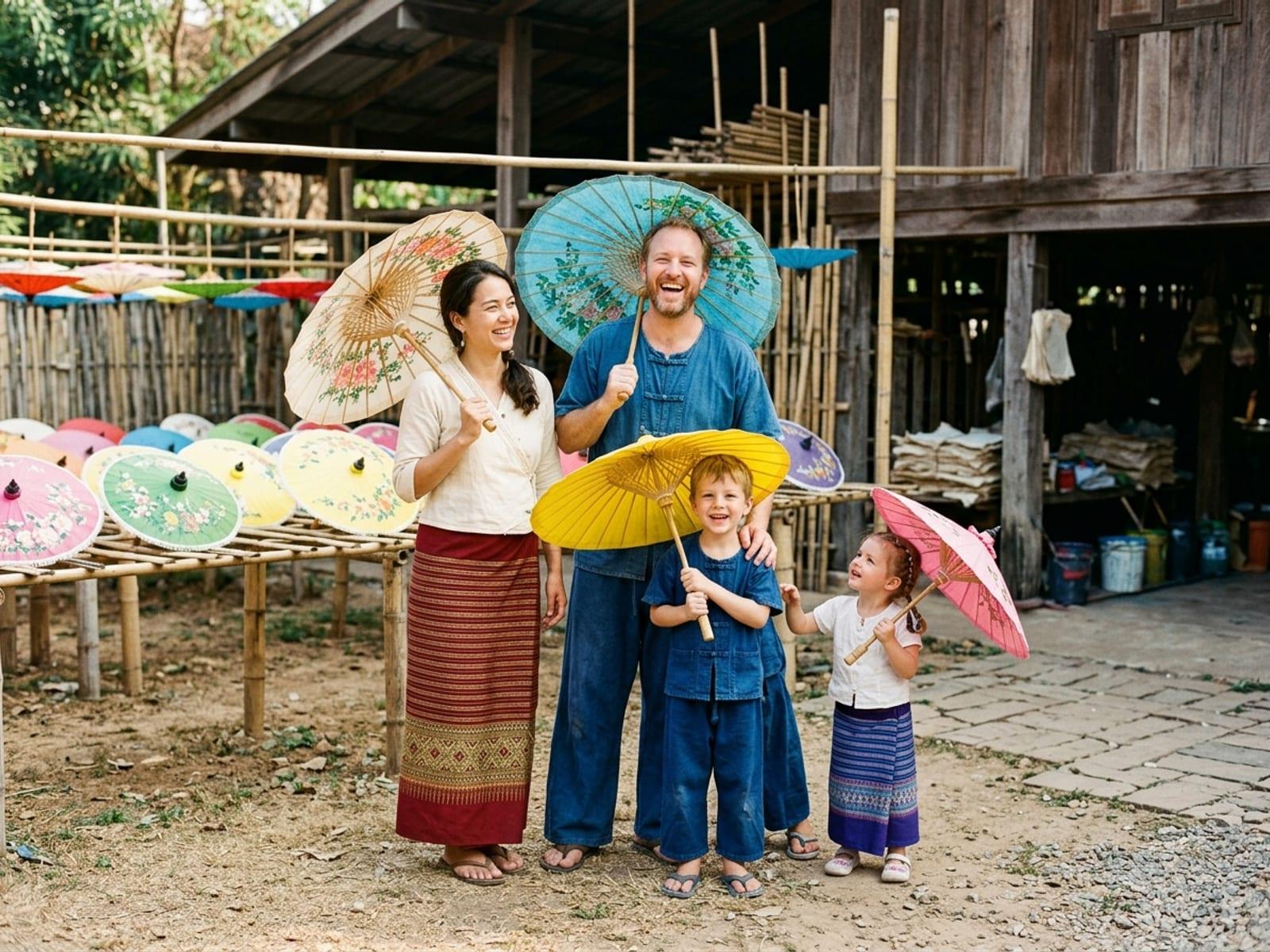
Round parasols of mulberry-bark paper stretched over bamboo ribs, painted by brush with flowers and elephants. Bo Sang, about 8 km east of Chiang Mai, is a craft village known for these handmade umbrellas. In its workshops you can watch every step up close, from shaving the ribs to painting the canopy. Each January a three-day umbrella festival fills the village streets with color. For a family visit, the best plan is to combine a workshop tour with some custom painting and take home an umbrella of your own.
The craft a monk brought home
Bo Sang lies in Ton Pao subdistrict, San Kamphaeng district, Chiang Mai Province. Many of the villagers are said to descend from Tai Lue people who migrated from Sipsongpanna in southern China. The village name is said to come from a well dug long ago beside a clump of bamboo.
There's a legend about how the umbrella making began. A monk named Phra Inta, traveling in Burma (today's Myanmar), saw people making umbrellas from mulberry bark. He brought one back to the village and taught the villagers how to make them. In 1941 the craftspeople formed a cooperative, and it has helped keep the skills alive.
Split the bamboo, stretch the paper, lacquer, paint
The traditional Bo Sang umbrella is covered with sa, a handmade paper from mulberry bark. Cotton and silk umbrellas are also made today, but the basic method is the same.
There are four main stages. First, bamboo is split and shaved to make the handle and the thin ribs. Next, the paper is stretched over the frame as it's turned, and coated with lacquer several times to make it strong and water-resistant. Then a painter adds the design, and finally the tip fitting goes on and the umbrella is left to dry. Besides flowers, the motifs are distinctly Thai: elephants, rice fields, sunsets and animals.
In the past, villagers made the umbrellas in the space beneath their stilt houses and laid them out open in the yard to dry. When you visit a workshop today, you may still find rows of umbrellas drying.
Workshop visits, and getting your own things painted
The village streets are lined with umbrella workshops and shops. The Umbrella Making Centre, featured by the Tourism Authority of Thailand (TAT), is on San Kamphaeng Road about 8 km east of Chiang Mai city. In its open-sided wooden workshop you can walk past people shaving bamboo, stretching paper and painting, one station after another. When TAT wrote about it, it was open daily from 8:30 a.m. to 5:00 p.m., but hours can change, so check before you go.
Painting is the souvenir everyone remembers. The painters will decorate not just umbrellas and fans but bags, shoes and clothes you bring along, right there on the spot. Have a small flower or elephant painted on a child's T-shirt or cap, and it becomes something that brings back the trip every time they wear it. Large umbrellas are hard to carry home, so you can also ask to have them shipped. Prices and how long the painting takes vary by shop, so ask before you order.
If you can't decide what to have painted, let your child choose. Flowers, elephants, birds, butterflies: after watching the painter's hands for a while, most children know what they want. Ask whether they can add a name, too.
Lacquer makes them water-resistant, but these are still handmade paper umbrellas. They'll last much longer as decorations at home or props for sunny-day photos than as everyday rain gear.
January's festival: famous for umbrella-carrying cyclists
The Bo Sang Umbrella Festival (officially the Bo Sang Umbrella and San Kamphaeng Handicraft Festival) is held for three days around the third week of January. The 37th edition, in 2020, ran from January 17 to 19. That year there was a cultural parade with umbrellas every day from 10 a.m., and in the afternoon a parade of women riding bicycles while holding umbrellas. From evening, a walking-street night market and a Lanna lantern festival filled the village streets with lights and umbrellas. There's also a Miss Bo Sang pageant and a painting contest for umbrellas and fans.
As the official name suggests, the festival isn't only about umbrellas. In 2020 there were demonstrations of woodcarving, basketry and weaving, as well as traditional Indonesian umbrella making, and a sa paper festival ran at the same time. On the second day, the Bo Sang Umbrella Run set off through the village at 5 a.m. Children who like handicrafts will stop at the other demonstrations, too.
The umbrella parades are easy for children to enjoy. A street full of colorful umbrellas moving past looks great in photos, and you can watch the bicycle parade safely from the roadside. A parasol-and-bicycle parade has also been part of Songkran in Chiang Mai in April. The program and dates change from year to year, so check TAT's announcements.
Choosing an umbrella to take home often comes down to size. Large-diameter umbrellas look impressive on display but are a hassle to bring on a plane. A small umbrella a child can carry or a fan that folds into a bag won't weigh down the rest of the trip.
Visiting with children
Workshops have umbrellas with fresh lacquer or paint that hasn't dried. Before going in, agree that children won't touch them or open them to play. Ask before photographing craftspeople at work. Blades are used for shaving bamboo, so keep a safe distance from the workbenches.
If you've ordered painting, use the waiting time to tour the workshop. It takes a while for the paint to dry, so confirm when and how you'll pick things up to avoid a last-minute rush. If you're heading back to town for lunch, go early for khao soi, the northern curry noodles: many noodle shops close by mid-afternoon.
What would a family photo look like with hand-painted parasols and Lanna clothes? You can try it with pokesta's AI-generated photos ($1 per photo). If you're in Chiang Mai in February, add the Flower Festival; for the northern hills in December and January, consider the tea gardens of Mae Salong.
When to go: workshops all year, festival in January
Workshop visits and painting are available year-round. For the festival, go in January. The drier months from November to February are the most comfortable for walking around.
From abroad, the gateway is Chiang Mai International Airport (CNX). To reach Bo Sang, join a tour or take a songthaew (shared pickup truck) or a ride-hailing car. The area gets crowded during the festival, so sort out your ride back in advance. Entry requirements vary with nationality, so check official information from your own government and the Thai government.
References