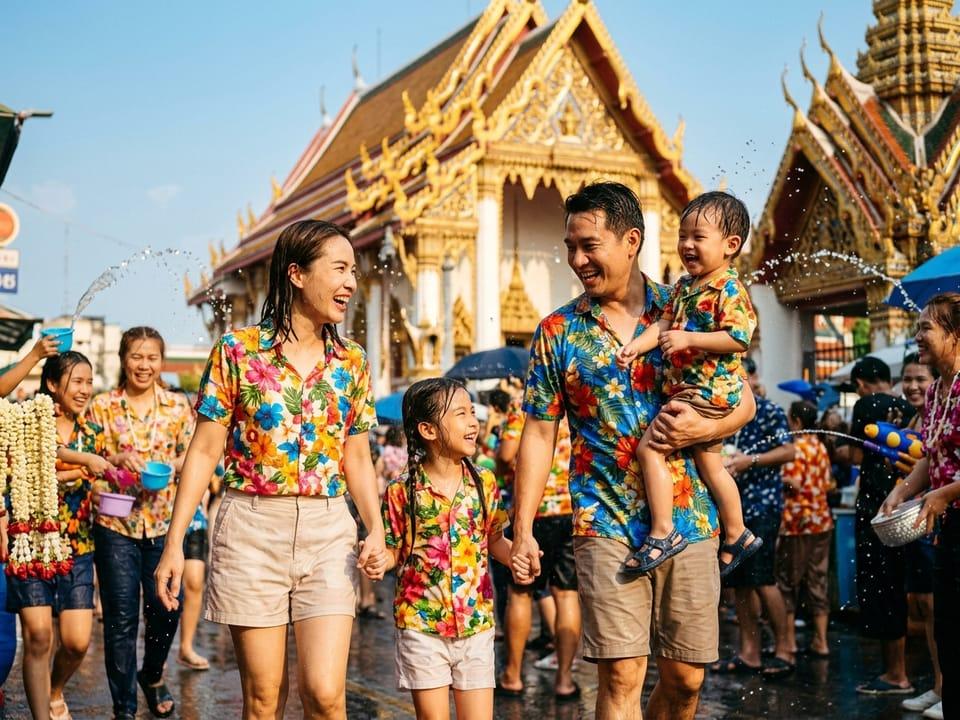
Songkran runs from 13 to 15 April, at the hottest point of the Thai year: Bangkok's average daily high in April is 35.7°C. With a baby or toddler, build the holiday around cool mornings at home and at the temple, let the adults take short turns on the splashing streets, and take the photos you care about before the water starts and before the long drive. The road home deserves as much planning as the heat, because the holiday is known in Thailand as the "seven dangerous days".
Heat, water and the road are the three real risks
April is the peak of the hot season, which is mostly dry: Bangkok averages about five rainy days in April, with the odd storm, so there's little cloud to soften the midday sun. The World Health Organization's advice for protecting infants and children in heat is simple: keep them out of the peak sun, in shade or indoors; dress them in light, loose clothes that cover the skin, with a wide-brimmed hat; never leave them in a parked vehicle, even briefly; and don't drape dry fabric over a stroller, which traps heat. A thin, wet cloth, re-wetted as it dries, is the better cover.
The water fights are the part that's hardest to control. In Bangkok, streets such as Khao San Road, Silom Road and Siam Square are closed to traffic and the party runs day and night. A bucket of iced water in the face, or a squirt into the ears, can frighten a baby who has no idea what's happening. Rules differ by area, and in 2026 Bangkok tightened its rules for Thawi Watthana Road, so check what your district or province has announced.
Then there's the drive. Between 2009 and 2013, road deaths averaged about 52 a day over Songkran, compared with about 27 on ordinary days, and 70 to 80 percent of accidents during the long holiday involve motorcycles.
Mornings at home and the temple, streets in short turns
The rhythm that suits babies is the opposite of the party. Go to the temple early, when monks receive food offerings and families bathe Buddha images and build sand chedis, and be home before the heat peaks. Hold rod nam dam hua, the pouring of scented water over elders' hands, at home in the shade, ideally before lunch.
Make midday a nap in the coolest room in the house. In the late afternoon, if someone wants the water fight, one adult goes out for an hour while the other stays with the baby, then they swap. If you take a toddler, choose a quiet side street or your own front yard with a bowl of water, carry them facing you so the splashes hit your back, and come home at the first sign of tears. Pack a full change of clothes and a towel for everyone, because a wet child cools quickly in an air-conditioned car, plus a bag for the wet things.
The drive home: leave early and travel by day
If you're heading back to your hometown, travel in daylight, ideally before the main exodus. Load the car the night before, so the morning is just a matter of carrying the baby out, and nobody feels the need to make up time on the road. Fit the car seat properly and stop regularly so a baby can feed and stretch; a toddler strapped in for a long drive in the heat will make that clear soon enough. Never leave a child in the car while you run into a shop or a temple, even with the engine off for a minute. A motorbike with a baby on it is not worth the risk, given how many holiday accidents involve motorcycles.
Photos worth taking, and keeping the phone dry
Take the photos that matter early. Before you set off, get a family picture in your Songkran floral shirts at the front door. At the grandparents' house, shoot the group photo while everyone is still dry, then rod nam dam hua, then water play last. Our guide to Songkran family photos at home covers the order and the shot itself.
For a baby, the best pictures are often small ones: a hand in the bowl of scented water, a grandmother pouring a little water over tiny fingers, a sleepy face in a floral shirt. Shoot in morning shade, close and at the baby's eye level. For rod nam dam hua, sit the baby on an adult's lap facing the elder and shoot from the side, so you get the elder's smile and the baby's hands together.
Before going near the water, put the phone in a waterproof pouch and test it at home in the sink with a tissue inside. Keep a dry cloth in your pocket for the lens, and set the volume button as the shutter, since touch screens work poorly through a wet pouch.
With a baby, your own phone usually beats a booked shoot
|
Studio before the holiday |
Photographer at the family home |
Your own phone |
| How the cost works |
Package; check costumes, files, prints |
Session fee plus travel |
Nothing extra |
| Baby's comfort and health |
Air-conditioned, short session |
Familiar place, but holiday crowds |
Shoot whenever the baby is happy |
| Changing the date |
Rebook before the rush |
Hard over a fixed holiday |
Any time |
| Result |
Polished, in Thai silk if you like |
Everyone in the frame |
Real moments |
| Suits |
A formal portrait for the wall |
Big multi-generation reunions |
Families with a baby or toddler |
A professional is worth it when the whole extended family gathers in Thai silk and you want everyone, the usual photographer included, in one sharp picture. Otherwise, a phone in the right light gets the moments that matter.
If the baby sleeps through the whole thing
Plenty of babies nap through the water fights, and some families skip the trip altogether in a hot year. pokesta can turn the phone photos you already have into a Songkran family portrait with AI, in floral shirts or Thai silk, with the splashing street or the elders' blessing behind you. It's an image the AI creates, not a record of the day. Each photo costs $1 and the first one is free, so try it with a recent photo of your baby before deciding how much of the street party you really need, and see what other families posted on the Songkran page.
References