Baby Crying at the Kon Phom Fai Hair-Shaving? Timing Feeds Around the Auspicious Time and Photographing It Calmly

pokesta Editorial Team · Updated October 28, 2026

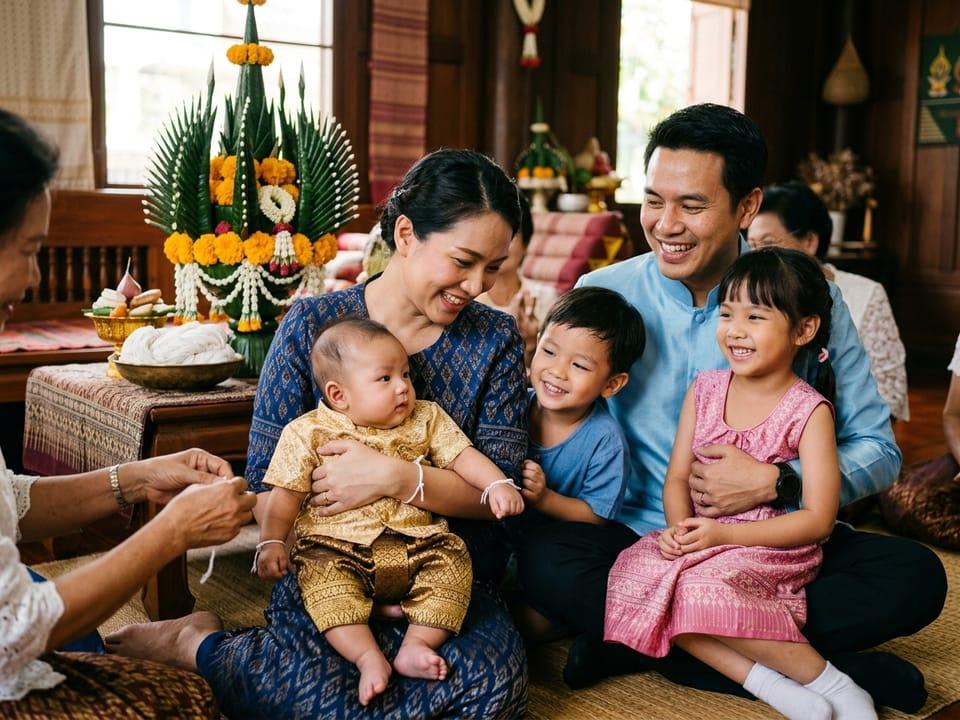
Baby's first month (Tham Khwan) family photo (AI-generated image)

At kon phom fai (โกนผมไฟ), the first hair-shaving held as part of the one-month Tham Khwan Duean, everything is timed to the auspicious moment, the roek (ฤกษ์), so plan the baby's feed and nap backwards from that time instead of hoping for luck. A one-month-old who cries when the scissors touch is completely normal, and that photo is worth keeping. Decide where the photographer sits and turn off the flash before the monks begin, and leave the calm family portrait until after the ceremony.

The ceremony runs on the auspicious time, not the baby's

Tham Khwan Duean (ทำขวัญเดือน) is held when a baby is one full month old. Details differ by region and by family, and many households now hold a much smaller version, sometimes no more than tying white thread on the wrists. The full form combines Buddhist and Brahmin elements. Families who invite monks, often five or eight, traditionally have chanting the evening before and offer the monks food in the morning. When the auspicious time arrives, the baby is brought before the monks; Sanook's encyclopedia entry notes that the child is usually brought out a little before the astrologer's chosen moment so guests can admire them.

Water is poured from a conch shell over the baby's head, Brahmin officiants blow the conch, and as the monks chant the Chayanto verse the first cut is made, often three snips with scissors, by a monk or the honoured guest presiding. Respected elders and relatives then take turns. The hair goes into a small krathong lined with a lotus or taro leaf, to be floated on water, and white sacred thread (สายสิญจน์) is tied on the baby's wrists. The roek is chosen in advance and the guests, monks and food are arranged around it. If it falls at 7 a.m. or in the middle of the usual nap, the baby has to adapt, not the ceremony.

Work feeds and naps backwards from the roek

Ask the elder or officiant running the ceremony two things: the exact time, and how long before it the baby needs to be ready. Then plan the morning from there. Aim to finish a feed, a burp and a fresh nappy shortly before the baby is carried in, so hunger isn't the reason for tears. If the baby falls asleep, that is fine; a sleeping baby is often the easiest to shave and still looks lovely in the photos.

Keep a quiet room ready for a feed in between. During the rite the baby is often held by a grandmother or grandfather, so give that person time to hold the baby beforehand and get comfortable sitting with them. Dress the baby in something light that opens easily, because the head will be wet and the room may get warm with guests and candles. If you have any worries about your baby's health on the day, ask your doctor before the ceremony rather than during it.

Crying is part of the record, so fix the angle first

Talk to the family about where the photographer may sit. The best spot is usually to one side at the baby's eye level, and never between the monks and the baby. Stay low, as you would anywhere near seated monks. Switch off the flash: a sudden burst of light can startle a baby, and the candles and room light give a warmer picture anyway. Use burst mode as the scissors and razor come close rather than asking anyone to pause or repeat a step, since the shaving happens only once.

Candles need care. In the blessing, three candle holders are raised over the baby and then passed around the circle three times. Keep your phone and elbows out of the way, and make sure the person holding the baby isn't leaning towards the flames. The moments to look for are the conch water, the first snip, each elder's turn, the hair on the lotus leaf, the white threads on the wrists, and the baby's face afterwards, crying or asleep.

A hired photographer, a relative or both

A hired photographer lets both parents be in the ceremony rather than behind a phone. The marketplace ennxo lists rough rates for ceremony photography, such as ordinations and funerals, at about 4,000 to 5,000 baht before travel (checked October 2026), which gives a sense of scale for a one-month ceremony. It is worth it when the house will be full of relatives or when you want video as well. A relative with a phone is fine for a small gathering, as long as that person has no other job during the rite.

A studio is a separate option for a quieter portrait on another day. Little by Little Studio's baby sessions start from one month at 9,900 baht for baby-only photos, as of October 2026. Prices vary by photographer and package, so check the current rate on the photographer's own page. For a role-by-role plan for family photographers, see who shoots what at the one-month ceremony.

Save the family portrait for after the candles are out

When the rite ends, feed the baby, let everyone eat, and take the group photo once the baby has settled, with the white threads still on the wrists. If a grandparent couldn't travel, pokesta can turn the phone photos you have into a Tham Khwan family portrait with AI for $1 per photo, with the first one free. It's a created image, not a photo of the day, so it adds to the real record rather than replacing it. Make one with a photo from the ceremony, and see what other families have shared on the Tham Khwan page.

References