
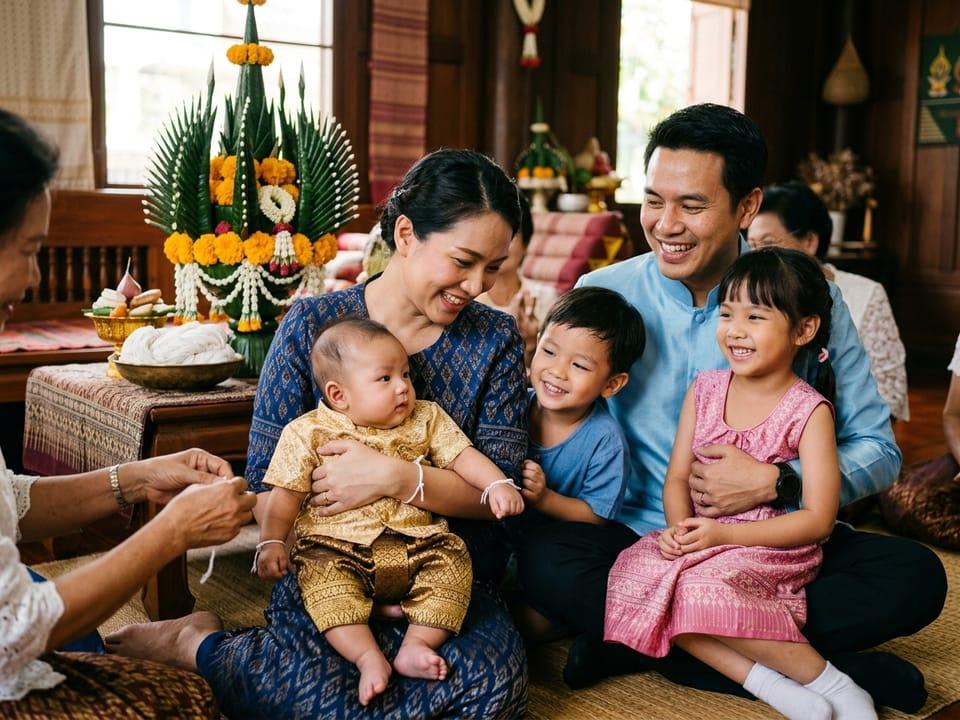
For most families in Thailand, newborn photos in the first month work best at home, either with a photographer who comes to you or with your own phone. Professional newborn sessions are timed for the first two weeks (one Thai service books them only up to 14 days old and recommends 5 to 10 days), which is exactly when many mothers are recovering, doing yu fai and being told by their own parents to stay in. The sensible split is to pay a professional for the wrapped, posed shots that need real skill, and to keep the everyday pictures, such as the sleeping face, tiny hands and grandparents leaning over the cot, for yourself.
The first month is built around the mother's recovery
Postpartum care in Thailand often means yu fai (อยู่ไฟ), the traditional practice of keeping the mother's body warm after birth, along with staying close to home for the month. A record of birth customs from Kamphaeng Phet Rajabhat University describes the older form: the mother lay beside a fire for about one to three weeks, with herbs such as phlai and turmeric sprinkled on it, and avoided certain foods. What most families meet today is gentler. Siriraj Hospital's Institute of Applied Thai Traditional Medicine describes a few hours a day over 5 to 10 consecutive days, with herbal compresses and hot salt pots, starting 7 to 10 days after a vaginal birth, or after about 30 to 45 days, once the wound has healed, after a caesarean.
How closely a family follows this varies a lot. Some mothers do the full routine at home with a grandmother in charge, some book a hospital clinic, and some skip it altogether. Whichever applies to you, a studio booking in the first fortnight means a car seat, traffic, a hot car park and a body that is still healing. For many families, that alone settles the question in favour of a home visit.
The risky-looking poses should be composites, and you can say no
Many of the striking newborn images you see online, such as a baby who seems to prop its chin on its own hands, are not a single photograph. A WCPO report explains that many of these poses are made in Photoshop, and a photographer who used to be a NICU nurse describes an assistant holding the baby, for example under the chin, for each frame. The same report sets out the real risks: a neonatologist warns that a newborn who drops its head can block its own airway, babies on baskets or raised surfaces can fall, and too many blankets can overheat them. You are in charge of your baby's safety, as that photographer puts it, so you can always ask for a simpler pose. The report also notes that no overarching body requires newborn photographers to be certified, so it is fair to ask about safety training.
If you shoot at home yourself, keep it simple. Lay the baby on a firm, flat surface close to the floor, keep one hand within reach, and don't improvise props to hold up the head or chin. Safe-sleep advice from the American Academy of Pediatrics still applies when a baby dozes off mid-shoot: on the back, on a flat surface, with no pillows or loose blankets around. Clear the props away once you're done.