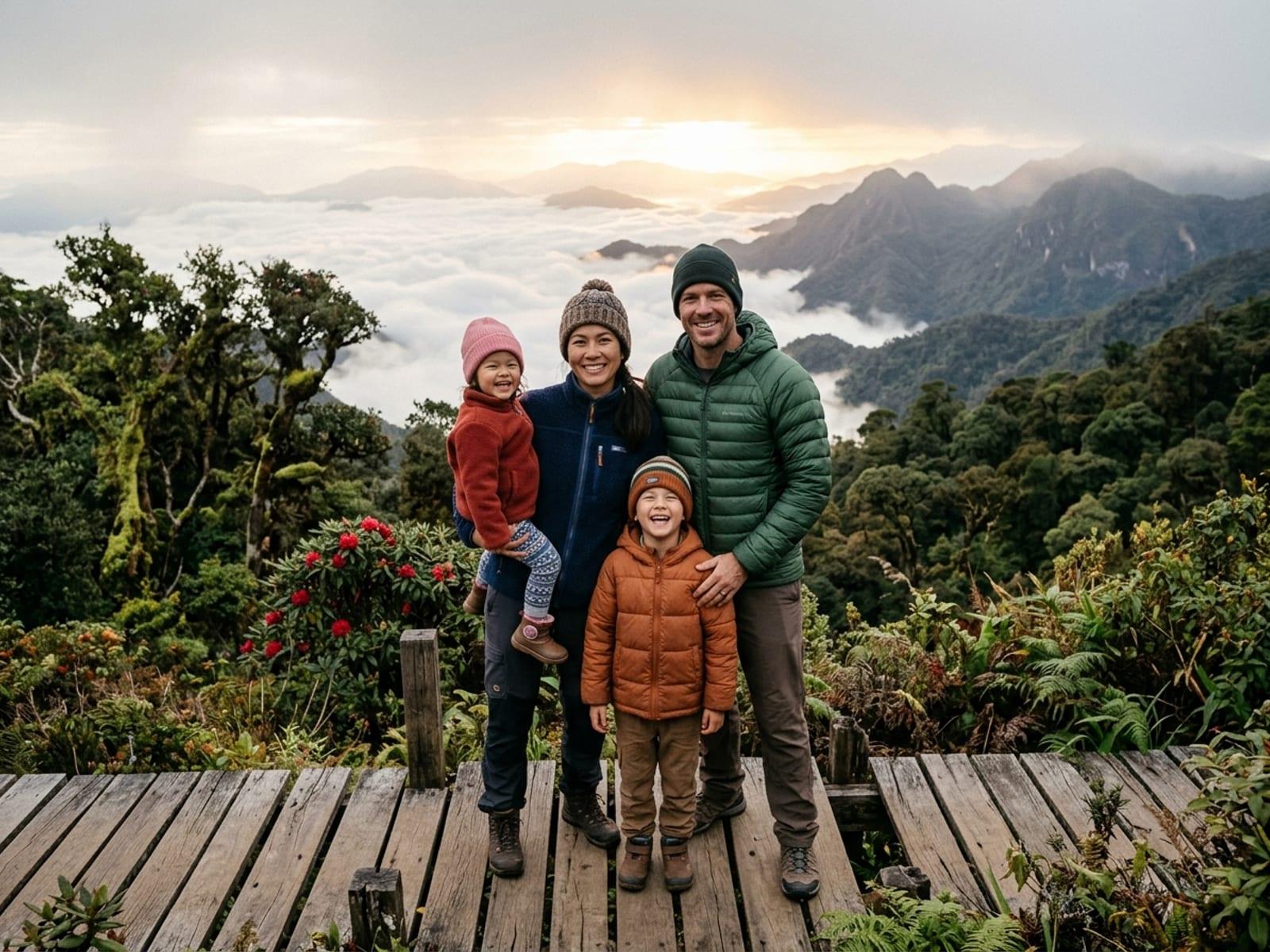
Thailand may have a reputation for endless summer, but there is a place where, on winter mornings, you can see your breath. About 60 km southwest of Chiang Mai, Doi Inthanon rises to 2,565 m, the highest point in the country. A road runs almost to the summit, so even with small children you can see moss-draped cloud forest, seas of cloud and big waterfalls. The best time to go is roughly November to February, when there's little rain and the air is clear. Up on the mountain the temperature is nothing like the city's, so here's what to wear and how to plan the day.
A mountain named for a ruler who protected the northern forests
Doi Inthanon is in Chom Thong district of Chiang Mai Province, part of a range that continues into Myanmar's Shan Hills. It was once called Doi Luang Ang Ka, but it was renamed in honor of Inthawichayanon, a ruler of Chiang Mai who worked to preserve the forests of the north. A small chedi on the summit holds his ashes.
The mountain is protected as Doi Inthanon National Park, established in 1972, covering about 482 km². In 2024 more than 850,000 people visited. From the foothills to the summit, the forest changes with altitude. Higher up are evergreen cloud forests wrapped in near-constant mist and sphagnum moss bogs. The park has recorded 383 bird species, the second-highest count among Thailand's national parks, and it's well known for birdwatching.
Karen and Hmong villages lie within the park, home to around 4,500 people in all. The mountain is part of a granite range extending into the Shan Hills, and the summit hosts a Royal Thai Air Force weather station and the Thai National Observatory.
Winter mornings can drop below freezing
The main thing to prepare for on this mountain is cold. Even when Chiang Mai is sweltering during the day, it can fall below 0°C on winter mornings near the top. In December 2017 a temperature of minus 5°C was recorded. Even at the Royal Agricultural Station at 1,280 m, the average daily low in December is 11.5°C.
With children, be sure to bring layers you can pile on: fleece, a light down jacket, hats and gloves. Drive up in clothes chosen for the heat at the bottom and everyone will get chilled fast at the summit. Back at the foot of the mountain it's hot again, so layers that come on and off easily are the way to go. The northern hills are just as chilly in the oolong-growing village of Mae Salong in Chiang Rai, so the same warm layers will serve you there too.
The rainy season runs roughly from May to October, and the park gets more than 1,800 mm of rain a year. In those months there's a lot of rain, more days when fog blocks the view, and slippery mountain trails. The dry season, November to February, is the best time for the scenery. The New Year holidays, though, bring huge crowds, and on New Year's Day more than 10,000 people may gather at the summit. If you'd rather avoid the crush, plan around the year-end holidays.
The summit, two chedis and a boardwalk through the forest
A paved road runs all the way to the summit. Near the top is Ang Ka, a short boardwalk nature trail through the forest. It shares its name with the mountain's old name and lets you see moss-covered trees and bog plants up close. Even small children can walk it.
On the way up are two large chedis, Naphamethinidon and Naphaphonphumisiri, built to honor King Rama IX (Bhumibol Adulyadej) and Queen Sirikit. They're surrounded by flower gardens, and on clear days you can see far across the ranges.
If you can walk a little farther, there's the Kew Mae Pan nature trail along a ridge, through grassland and forest. On a clear morning you may see a sea of cloud. The trail closes for several months every year, mainly over the rainy season, to let nature recover. It is generally open from about November to May, and walkers must go with a local Hmong guide. Closure dates and rules can change from year to year, so check the national park's information before you go. There are steps and steep sections, so it's best for children who are used to walking.
The park has several big waterfalls, including Wachirathan, Mae Klang and Siriphum. Many can be seen just steps from the car, and standing in the spray looking up at the falls is fun for children. The rocks around the falls are wet and slippery, so keep children behind the railings and don't let them walk on the rocks.
With so many birds about, a pair of binoculars adds to the fun. The boardwalk in the morning is a good time to hear birdsong, so stop and listen with your children.
Planning the climb with children
For a day trip from Chiang Mai, set off early. If you want to catch a sea of cloud or the sunrise from the summit or Kew Mae Pan, you'll need to leave before dawn. The mountain road has many bends, so bring motion-sickness medicine for children who get carsick. At high altitude, walk slowly rather than letting children run about. The summit before dawn is bitterly cold, so a blanket or lap throw for waiting in the car is a good idea. Temperatures rise gradually once the sun is up, so a bag to stash discarded jackets is handy too.
Public transport is limited, so for families the realistic options are hiring a car for the day or joining a tour from Chiang Mai. There's an entrance fee for the park, with different prices for foreign visitors and Thai nationals. Fees can change, so check the national park's information.
There are a few shops and food stalls on the mountain, but not many. Bring drinks and snacks for the children. Take your rubbish home with you.
To see what a family photo on a boardwalk above a sea of cloud might look like, you can try pokesta's AI-generated photos ($1 per photo, with your first one free).
Best November to February, 60 km from Chiang Mai
The best season is the dry season, roughly November to February. The New Year period is crowded, and December and January are the coldest months near the summit. The gateway is Chiang Mai International Airport (CNX), and the park is about 60 km southwest of Chiang Mai. Even after you enter the park, it's a long mountain road to the summit, so allow plenty of travel time.
If you're staying in Chiang Mai, you can build a trip around the city's signature khao soi or, in February, the Chiang Mai Flower Festival. Entry requirements for Thailand depend on your nationality, so check your own government's official information before you travel.
References