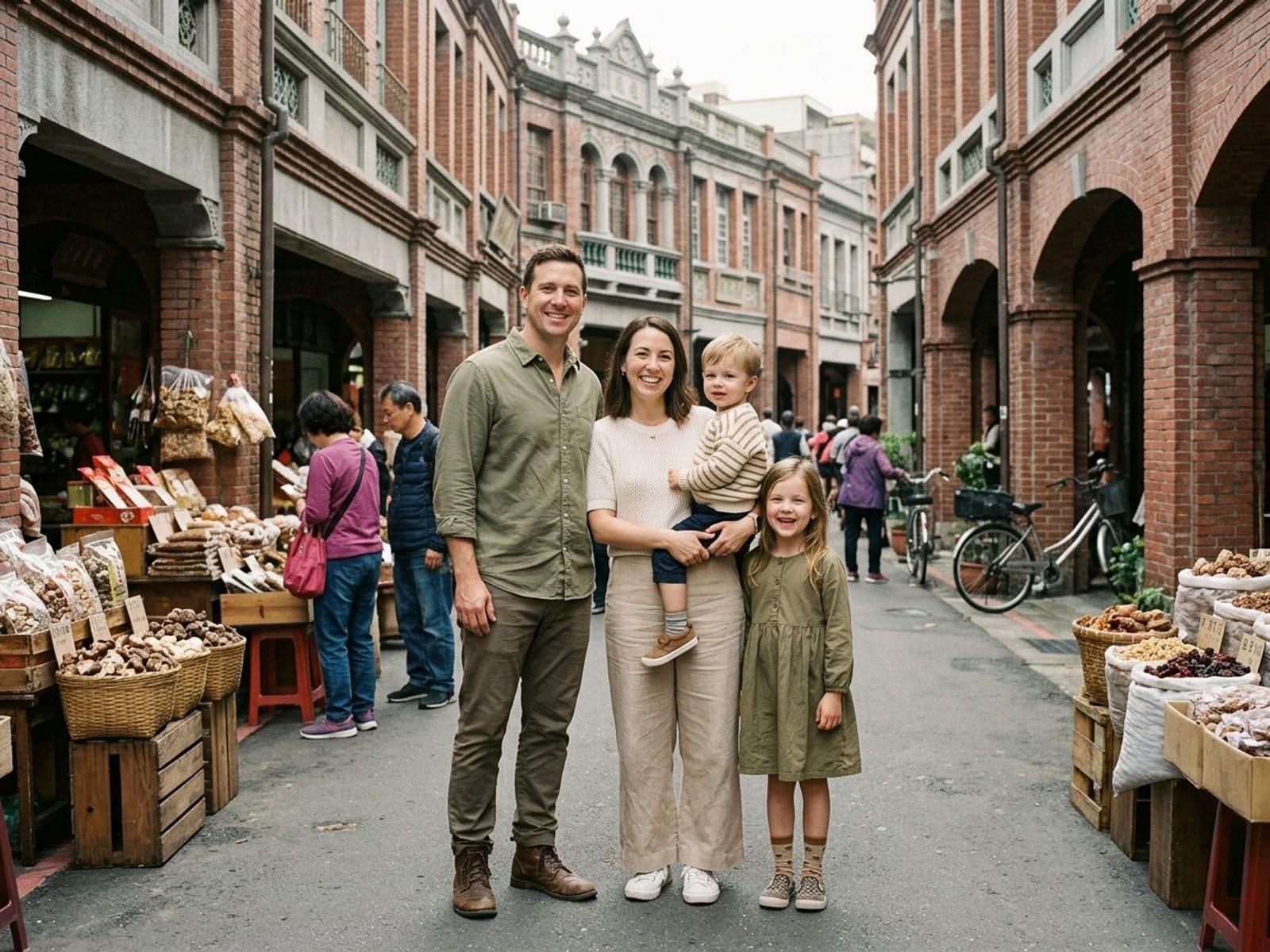
Old red-brick and stone shophouses line the street, their fronts piled with sacks and baskets of dried shiitake, dried fruit, nuts and the roots and barks of Chinese herbal medicine. Dihua Street, in Taipei's Dadaocheng district, is said to be the oldest street in the city. Amid the traces of a river port that grew rich on tea, long-established dried-goods and herbal shops are still in business. It's a walk from Beimen MRT station and about the right size for a half-day stroll. With kids, watch for cars and scooters on the narrow street, and either skip the packed Lunar New Year market season or walk it briefly in the early morning.
A Tamsui River port made rich by tea
Dadaocheng lies along the Tamsui River in Taipei's Datong District. In the mid-19th century, as tea exports from northern Taiwan took off, merchants flocked here. The district's commerce is traced to 1851, when the merchant Lin Lan-tian opened a shop here, and in 1869 a foreign trading house moved its base to Dadaocheng as well. By 1886 there were 252 tea merchants, and the trade brought great wealth and prosperity to the district.
Dihua Street began in the 1850s as Zhong Jie, "Middle Street." In the 19th century it became a center for herbal medicines, cloth, incense materials and the final processing of Taiwanese tea. The present name, Dihua, was given in 1947, after the Second World War. Dadaocheng led the way in transport as well. When the railway between Taipei and Keelung opened in 1891, Taipei's station was built here in Dadaocheng. Later, silt built up in the Tamsui River and river shipping declined, but when the North-South Railway running the length of Taiwan opened in 1908, the wholesale trade in dried goods, herbs and cloth actually grew strongly. Even as goods switched from boats to trains, the district kept its identity as a wholesalers' quarter.
During the Japanese colonial period, about 70 percent of all of Taiwan's cloth wholesalers are said to have been concentrated at the southern end of the street, and there's still a fabric market nearby.
Buying dried goods by weight at the nanbeihuo shops
What fills the shopfronts on Dihua Street are dried goods known as nanbeihuo ("goods from north and south"). They're dried farm, sea and livestock products, broadly divided into things from the sea, things from the mountains, and dried fruit, nuts and similar snacks. Taiwan's tourism authority notes that the area is packed with shops selling Chinese medicine and herbs, deity statues and incense for temples, spices and dried goods, colorful fabrics, and bamboo and wooden crafts.
More than 100 herbal medicine shops are concentrated in Dadaocheng, and about 90 percent of them are wholesalers. Many have been passed from master to apprentice or from parent to child, and the rows of old wooden drawers at the back of the shops are worth seeing for their own sake.
At dried-goods shops, many items are sold by weight, and prices in Taiwan are often given per jin (1 jin = 600 grams). If you only want a little, ask for half a jin, or show the amount with your hands. Some shops also stock small pre-packed bags, which are easier to take home if you're watching your luggage. Dried mango and other dried fruit and nuts make good snacks to choose together with the kids.
If you're taking food home, pay attention to the import rules of the country you're returning to. Many countries don't allow meat, fresh produce or certain plants. Dihua Street is a place to feast your eyes and nose in the dried-goods and herbal shops, and to buy only what you know you can legally carry home.
The matchmaking god, and the rush before Lunar New Year
Halfway along Dihua Street stands the Taipei Xiahai City God Temple. The people of Dadaocheng pooled their money to start building it in 1856, and it was completed in 1859. It's a designated Taipei City monument, with grounds of only about 46 ping (roughly 150 square meters). Worshippers come in a steady stream anyway, because the temple enshrines Yue Xia Lao Ren, the Old Man Under the Moon who ties people together in marriage. His statue, enshrined here since 1971, is now the temple's most popular. On the 13th day of the fifth lunar month, a festival honors the City God, and there's an old saying that on that day "people come to look at people," so packed does it get.
Dihua Street is at its busiest before Lunar New Year, when a New Year shopping market (nianhuo dajie) is held for people buying for the holiday, and waves of shoppers after dried goods and sweets fill the street. It's fun for the atmosphere, but the crowds are hard going with children. With little ones, skip this period, or limit yourselves to a short walk early in the morning. The dates of the market change every year to follow the Lunar New Year, so check Taipei City's announcements.
With kids, watch the road and the shopfronts
Dihua Street is narrow, and cars and scooters use it. The ground floors of the old buildings have a continuous covered walkway (tingzijiao) that doubles as the sidewalk, but goods from the shops are sometimes set out there too. Hold small children's hands, and if you have a stroller, go slowly and keep it from drifting into the road.
The dried goods and nuts outside the shops are sometimes displayed right at the height where children reach out without thinking. They're for sale, so agree with the kids from the start that they'll ask the shopkeeper before touching anything; everyone's happier that way. Many shops handle nuts and dried shellfish, so children with allergies should also be careful around the powder and shells near the displays.
Once you've walked the length of the street and are getting tired, carry on to Dadaocheng Wharf on the bank of the Tamsui River. A bike path runs along the river, and according to Taiwan's tourism authority, the wharf has in recent years become the venue for a large fireworks show. There's sometimes a market of food stalls in shipping containers, and you can take a break in the river breeze.
To see what a family photo peering into baskets of dried goods on a street of old shops might look like, you can try pokesta's AI-generated photos ($1 per photo, and your first one is free).
Getting there, and pairing it with the rest of Taipei
Taipei's gateway is Taiwan Taoyuan International Airport (TPE). Dihua Street is about 600 meters on foot from Beimen Station on the Taipei Metro, and Daqiaotou Station is also within walking distance. It isn't far from Taipei Main Station either, which makes it a good half-day walk. Opening hours differ from shop to shop, so if you're going to buy things, daytime is the safest bet.
Dihua Street has its seasonal moments: the New Year market before Lunar New Year and the City God festival in the fifth lunar month. Once you've done the dried-goods shops, it's a natural time to go and choose pineapple cakes to take home. If you want to keep eating, the MRT will take you on to xiaolongbao at Din Tai Fung or Shilin Night Market. Entry requirements for Taiwan depend on your nationality, so check your own government's and the Taiwanese authorities' official information before you travel.
On Dihua Street, what you come across matters more than what you buy. Take one bag of something weighed out by the shopkeeper, and walk the street slowly as a family.
References