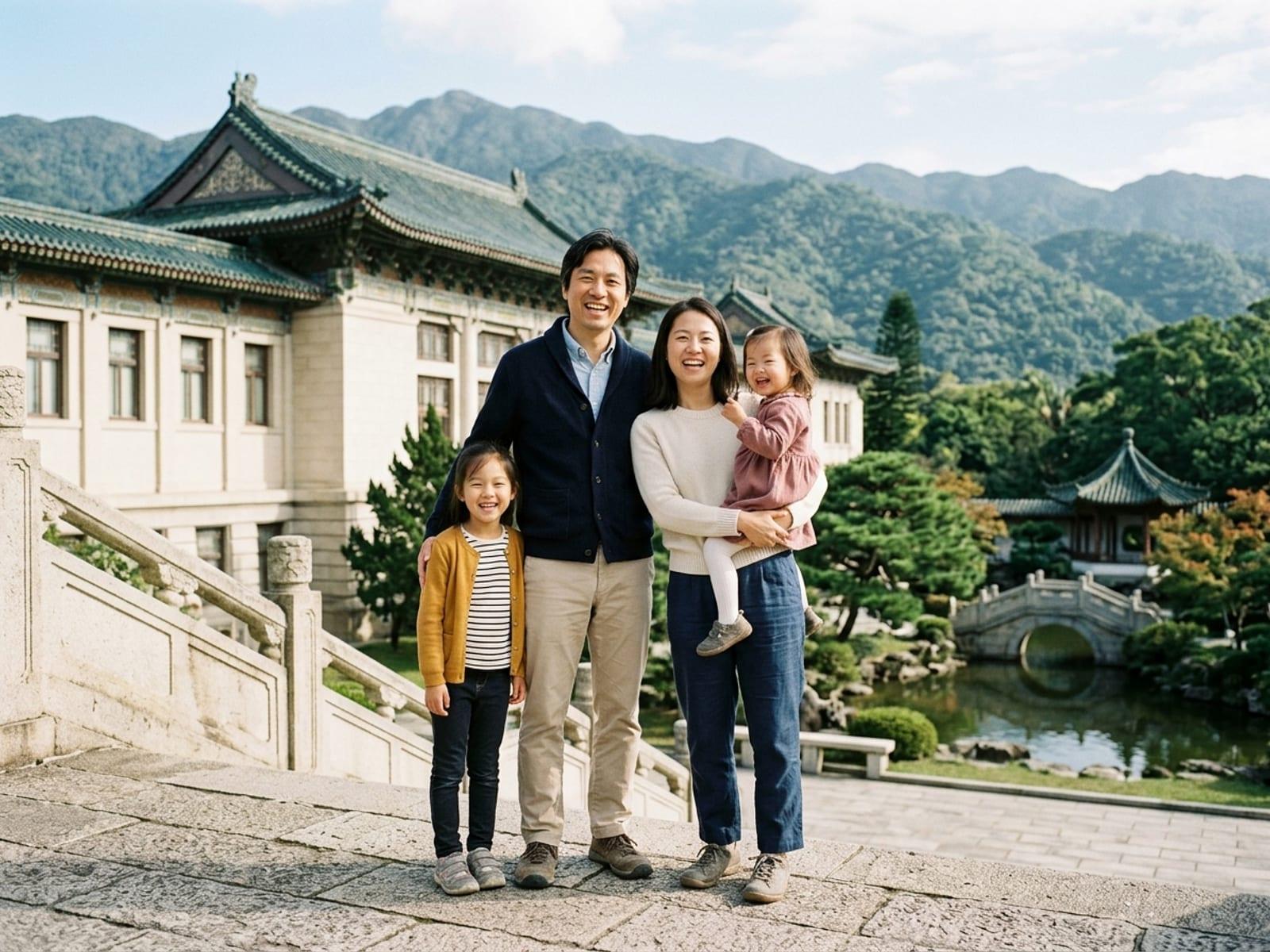
A palace-like building roofed in green glazed tiles stands at the foot of the hills on Taipei's northern edge. The National Palace Museum holds around 700,000 objects, centered on the imperial treasures that once filled the Forbidden City in Beijing. Some exhibits, like a piece of jade carved into a head of cabbage or a stone that looks exactly like braised pork belly, make children lean right in. But the museum is large, and just wandering through it will tire out adults and kids alike. Narrow down what you want to see, add the children's gallery and an audio guide, and a family half day here becomes a lot more fun.
Treasures that crossed the sea from the Forbidden City
The National Palace Museum began in October 1925 as a museum opened in Beijing's Forbidden City, built around the treasures left behind by the Qing imperial family. To escape war, the collection was later moved from place to place across mainland China, and between 1948 and 1949 it was shipped from Nanjing to the port of Keelung in northern Taiwan in three batches. Of the crates evacuated south, only about 22 percent are said to have reached Taiwan.
The current building in Taipei was completed in August 1965 and opened to the public that November. As of December 2025, the collection numbered 699,119 items: bronzes, ceramics, jade, painting and calligraphy, rare books and more, spanning thousands of years. On either side of the Northern Branch are the Zhishan Garden and Zhide Garden, laid out in 1985 and 1994 in the style of classical Chinese gardens, which make a pleasant stroll after the galleries.
Since it's impossible to show everything at once, displays rotate. Objects generally change every six months to two years, and painting, calligraphy and books every three months. If there's a particular piece you want to see, check on the official website before you go that it's currently on display.
See the Jadeite Cabbage and the Meat-Shaped Stone first
With children, head first for the museum's two most famous works.
The Jadeite Cabbage is a piece of jadeite carved into the shape of a napa cabbage in the 19th century, and it's said to have been part of the dowry of Consort Jin, a consort of the Qing Guangxu Emperor. The carver used the natural boundary between green and white in the stone to make green leaves and white stalks. On the leaves sit a katydid and a locust, said to carry a wish for many descendants. Stand in front of it and ask the kids, "Where are the bugs?" and the small carving suddenly feels much closer.
The Meat-Shaped Stone is a piece of jasper carved in the 17th century and stained on the surface so that it looks like a chunk of braised pork belly, layers of fat and lean and all. The adults may be more amazed than the children that carving and coloring a stone could make it look so much like food.
The two pieces are often displayed together, and because they're so popular, crowds tend to gather in front of them. See them first thing after opening and you can take your time with the rest.
For slightly older children, the Mao Gong Ding bronze is worth a look as well. It's a three-legged vessel made toward the end of the 9th century BCE, with an inscription of about 500 characters cast inside. The text is said to record how King Xuan of Zhou, soon after taking the throne, entrusted important state duties to his uncle, the Duke of Mao, and urged him to serve loyally. Tell the kids it's "a bit like a letter written nearly 3,000 years ago" before they peer inside, and it will stop looking like an old cooking pot.
A Children's Gallery downstairs, and an audio guide for ages 7 to 12
On basement level 1 of Exhibition Area I is the Children's Gallery. Entry is free, and it keeps the same hours as Exhibition Area I. It's designed for visitors of any age, but children under 10 must be accompanied by an adult. Stopping here before or after the real galleries is a good way to spark children's interest in the museum's treasures.
For primary school-age children there's also a children's multimedia guide. It's aimed at ages 7 to 12, comes in Chinese and English, and costs NT$150 to rent (as of October 2026). The adult guide is NT$200 and comes in many languages, including Chinese, English, Japanese and Korean. Both can be rented at the counter on the first floor of Exhibition Area I, and according to the official website you don't need to leave a passport or other ID as a deposit. Just giving a child a guide of their own turns the visit into their own expedition.
Admission, hours and a half-day route
According to the official website (as of October 2026), general admission to Exhibition Area I is NT$350, and visitors aged 17 and under get in free regardless of nationality. The museum is open Tuesday to Sunday from 9 a.m. to 5 p.m., with ticket sales ending at 4:30 p.m. It's normally closed on Mondays, though it opens on some Mondays as a special case. There are also occasional free-admission days; in 2026, Exhibition Area I is free for everyone on October 17, Taiwan Culture Day. Prices and opening days can change, so always check the official website before you go.
Large bags go into the cloakroom or lockers when you enter. For a half-day visit, arrive for the 9 a.m. opening, see the two famous pieces first, then the Children's Gallery downstairs, then one or two bronzes or ceramics while the kids can still concentrate, and head out before lunch. That's a comfortable sequence. Eating and drinking aren't allowed in the galleries, so take breaks in the museum's rest areas or, in good weather, in the Zhishan Garden. The galleries are air-conditioned, so even in summer bring a layer for the children.
For a family photo on the stone steps in front of the palace-style building, you can also try pokesta's AI photos ($1 per photo, and your first one is free).
Getting there, and pairing it with Shilin
Taipei's gateway is Taiwan Taoyuan International Airport (TPE). The National Palace Museum is at No. 221, Section 2, Zhishan Road, Shilin District, Taipei, and you get there by city bus or taxi from a Taipei Metro station such as Shilin. Bus routes and stops can change, so check the transport information on the official website.
The museum is open all year and is a reliable option on rainy days or in the heat of midsummer. Shilin Night Market is in the same district, so you can spend the morning at the museum and the evening at the night market. In between, you could fit in a pineapple cake baking class at Kuo Yuan Ye's pastry museum, also in Shilin (check the official website for class details and booking). In southern Taiwan, there's also the Southern Branch in Taibao City, Chiayi County, which opened on December 28, 2015. It has different exhibitions from the Taipei museum, so if your itinerary takes in Tainan or Kaohsiung, visiting the Southern Branch is another option. Its hours and admission may differ from the Northern Branch, so check the Southern Branch's official website. Entry requirements for Taiwan depend on your nationality, so check your own government's and the Taiwanese authorities' official information before you travel.
There's no need to see all 700,000 objects. If you find one of the insects on the cabbage, that's a day well spent.
References