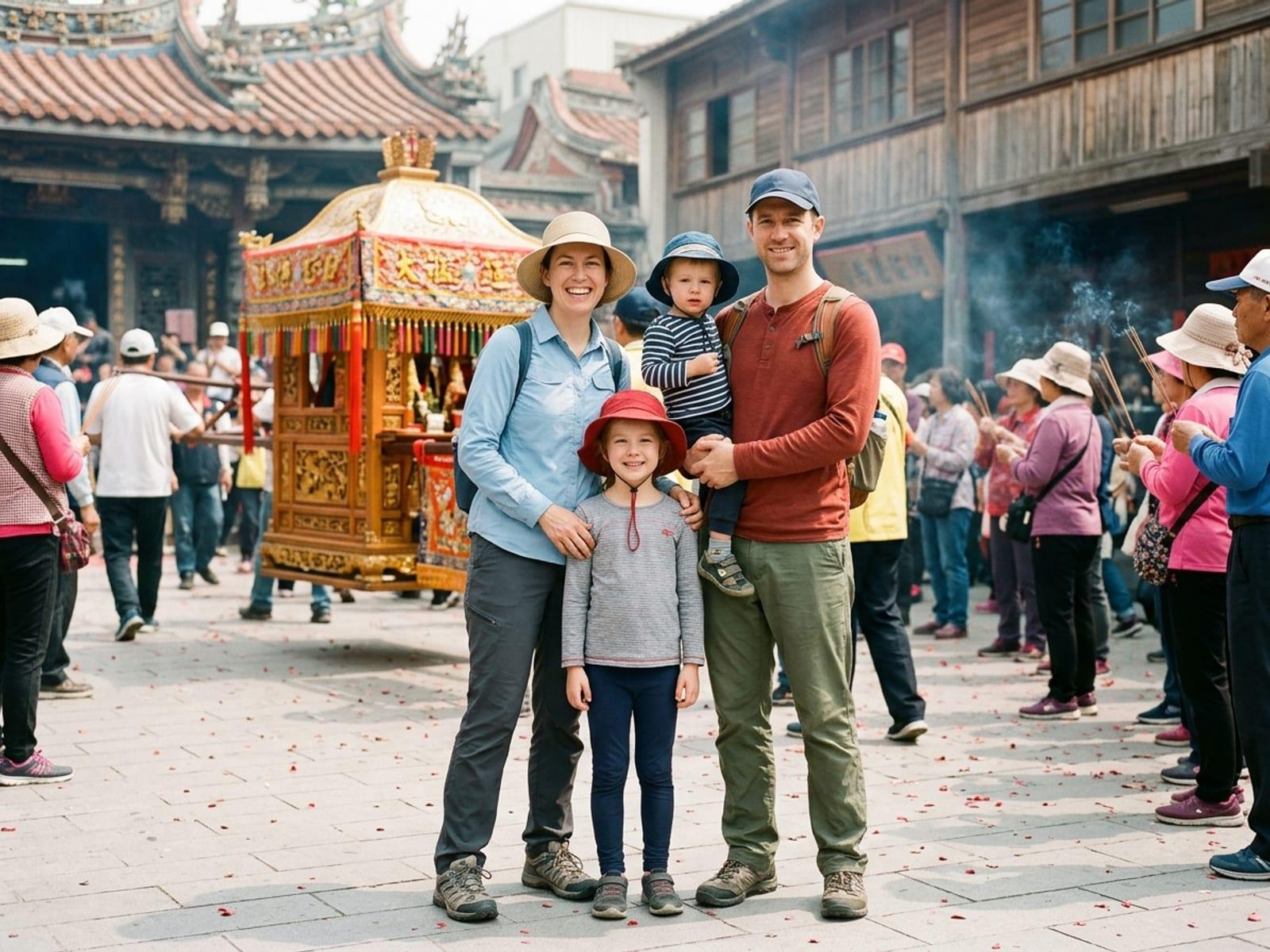
Every spring, a palanquin carrying Mazu, goddess of the sea, leaves Dajia Jenn Lann Temple in Taichung and spends nine days on foot crossing four cities and counties: Taichung, Changhua, Yunlin and Chiayi. The route is roughly 340 km. Only a small share of people walk the whole way; most join for a weekend or simply step out for a few hours when the procession passes through their town. With children, the easiest way to take part is to greet Mazu by the roadside in daylight, not on the night of departure.
A sea goddess walks across central Taiwan
Mazu is the deified form of Lin Moniang, a woman said to have lived on Meizhou Island in Fujian around the 10th century. Settlers from Fujian brought her worship to Taiwan in the 17th century. She began as a protector of sailors and fishermen and over time became a guardian of everyday life as a whole.
The Dajia pilgrimage began in the 18th century as a journey to Meizhou carrying a statue of Mazu. When crossing the strait became difficult during the Japanese colonial period, the pilgrimage turned into a journey within Taiwan. After a long period of heading to Beigang in Yunlin, the route has turned around at Fengtian Temple in Xingang, Chiayi County, since 1988. Taiwan's cultural authorities have designated the pilgrimage a national important folk custom.
Inside the palanquin sits a statue of Mazu, carried on the shoulders of eight bearers. Ahead of it and behind come troupes dressed as guardian generals, beiguan bands, lion and dragon dancers, and floats from schools and companies. The whole column takes a long time to pass.
The date is set at the Lantern Festival, by asking Mazu
The departure day and time change every year. On the Lantern Festival, the 15th day of the first lunar month, the temple asks Mazu by casting poe, a pair of crescent-shaped wooden blocks, and the answer decides the schedule. In 2026 the palanquin set off at 10:05 p.m. on Friday, April 17, and returned to Dajia on April 26, a journey of nine days and eight nights.
In 2026 the overnight stops were, in order, Nanyao Temple in Changhua City, Fuxing Temple in Xiluo, Fengtian Temple in Xingang (two nights), Xiluo again, Dian'an Temple in Beidou, Tianhou Temple in Changhua City and Chaoxing Temple in Qingshui. In Xingang, a ceremony celebrating Mazu's birthday is held at 8 a.m. the morning after arrival. The route and times change from year to year, so check the 2027 plan once it's announced at the Lantern Festival (February 20, 2027).
During the pilgrimage, an official GPS app and website have tracked the palanquin on a map, and the temple has streamed the procession live on YouTube and Facebook. If you're waiting by the road, these let you judge how many minutes away it is, so the kids don't have to stand in the hot sun for long.
Greeting Mazu by the roadside, and crawling under the palanquin
There's no registration and no fee. Stand by the road, put your palms together as the palanquin approaches and watch it go by, and you've welcomed Mazu just as the locals do.
The custom people remember most is zuan jiao jiao, crawling under the palanquin. People kneel in a long line along the route and wait for the palanquin to pass over them. Having Mazu pass overhead is believed to ward off misfortune for the year and bring her protection. On the final day in 2026, so many people lined up to do this near Dajia that the palanquin arrived more than two hours behind schedule.
Children can join the line, but it's long, and you spend a lot of time kneeling and waiting. Crowds can surge from the front and back, so with kids in the early grades of primary school or younger, it's safer to watch from a little farther back, over an adult's shoulder.
Homes and shops along the route hand out free drinks and vegetarian snacks to pilgrims. This is goodwill meant to keep the walkers going, so families who are only watching should go easy on it.
Dress for a long time on your feet
There's no set costume. Most pilgrims wear a hat, comfortable shoes and clothes they can move in. Central Taiwan in April can be sunny enough to make you sweat at midday, and sudden showers are common too. A sun hat, a light long-sleeved top and rain gear cover both.
This is a religious event, so skip revealing clothes and very loud prints. The palanquin and pilgrim flags use a lot of red and yellow, and one red accessory per family member helps you blend into the procession's colors in photos.
The 2026 guidance also mentioned some old rules: people with a recent death in the family or who have just given birth don't join the pilgrimage, and participants eat vegetarian from the departure until the birthday ceremony. Nobody will hold onlookers to these, but knowing about them helps you understand how local people behave around the procession.
Protecting kids from firecrackers and crowds
When the palanquin enters a temple or passes in front of shrines along the way, people set off firecrackers and fireworks to welcome it. The noise is louder than most people expect, and the smoke gets thick. Earmuffs or earplugs are worth bringing for babies and noise-sensitive children. Spent firecracker debris can litter the road, so wear closed-toe shoes rather than sandals.
Crowd size varies hugely by section. Departure night in Dajia and the final return to Dajia draw crowds in the hundreds of thousands, and it can be hard to move at all. With children, watch those high points on the livestream and instead wait for the procession to pass through a quieter suburban stretch in daylight. You'll see it up close and feel far less rushed.
Put a card with a parent's phone number in your child's pocket, and agree that if you get separated, you'll wait in front of the nearest temple. If you want a family photo with the floats or costumed generals in the background, take it from the roadside just after the procession has passed. You can also try out what your family might look like in this spring scene with pokesta's AI photos ($1 per photo, and your first one is free).
Plan around one day by the roadside
Dajia Jenn Lann Temple, the starting point, is on the coast in northern Taichung, and the nearest airport is Taichung International Airport (RMQ). If you fly into Taoyuan International Airport (TPE), take Taiwan High Speed Rail to Taichung, then a conventional coast-line train or a bus from the city to Dajia.
With kids, the simplest plan is to stay in Taichung or Changhua and step out to the roadside for a single day when the procession passes through that town. Based in Taichung, you can also rest at a teahouse that claims to have invented bubble tea, or take the bus from the high-speed rail station to Sun Moon Lake. Hotels along the route fill up during the pilgrimage, so book as soon as the dates are announced. Entry requirements for Taiwan depend on your nationality, so check official information from your own government and the Taiwanese authorities before you travel.
The Lantern Festival night when Mazu is asked for the date is also the night the lanterns go up at the Pingxi Sky Lantern Festival in the hills of northern Taiwan. Sky lanterns at the end of winter, Mazu's procession in spring: both are events where onlookers are allowed to stand beside the people who pray. Don't cross in front of someone with their hands together, and don't block the palanquin's path. Do that, and your children can join the people welcoming the pilgrimage.
References