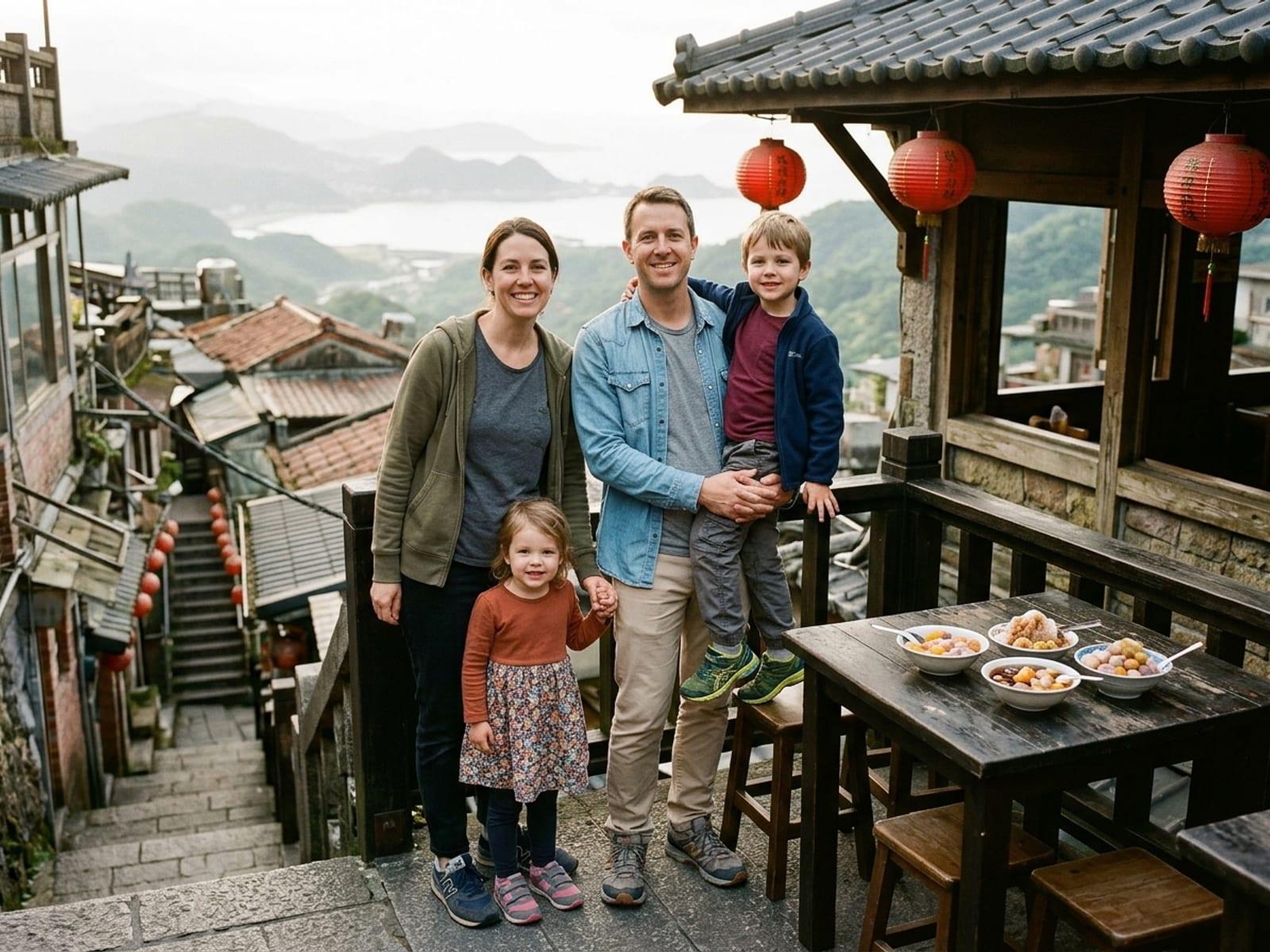
Purplish gray, yellow, green: a bowl of small colored dumplings arrives with sweet syrup or a pile of shaved ice. Taro balls (yuyuan) are made by kneading taro with starch and boiling the little pieces of dough. They're eaten all over Taiwan, but the place they're famous for is Jiufen, northeast of Taipei, where houses stack up a mountainside overlooking the sea. A bowl after a long climb through the town's slopes and stone stairways is one of the pleasures of a visit. Jiufen is also a town of steps and crowds, though, and with children a little planning about how to eat and how to walk makes the day much easier.
Born in Ruifang, at the foot of Jiufen
Taro balls are said to have been invented in 1946. Tsai Lin Pao-yun, who had married into a family in Ruifang, the town below Jiufen, helped out in her in-laws' general store, selling a cold plum drink out front. She later opened a shaved ice stall, and that's where she started making taro balls. In her grandchildren's generation, the shop was renamed Pao Yun Taro Balls after her.
Taro balls became a Jiufen specialty from the 1970s. A woman known as Auntie A-Gan, who ran a shaved ice stall near Jiufen Elementary School, began adding taro balls at customers' request, and as visitor numbers grew they became the town's signature snack. Lai Ah-Po Taro Balls, in business on Jiufen Old Street since around the same period, is another well-known name.
The basic ingredients are taro (yutou), sweet potato flour, potato starch and water. The yellow balls made with sweet potato are called fanshu yuan, and a single bowl often mixes several colors. In Jiufen, some shops also make balls flavored with matcha, sesame or Chinese yam.
From gold town to tourist town
Tell the kids a little about how Jiufen came to be before you sit down to eat, and the view from the slopes takes on a new meaning.
In the Qing dynasty, Jiufen was a tiny village of nine households, and the name is said to come from the way they always ordered "nine portions" whenever supplies arrived. In 1890, gold dust was discovered during construction of a railway nearby, and in the 1890s gold-bearing veins were confirmed. The gold rush peaked during the Japanese colonial period, and houses spread across the mountainside.
After the Second World War, gold mining gradually declined, and when the mine closed in 1971 the town emptied out. It came back into the spotlight in 1989, when it was used as a location for Hou Hsiao-hsien's film A City of Sadness. Visitor numbers grew from the early 1990s, and teahouses, cafes and souvenir shops opened in the old buildings.
If you want to show children more of the gold-mining history, you can also visit the New Taipei City Gold Museum, in the hills of the same Ruifang District. It's a New Taipei City facility that opened in 2004 as the Gold Ecological Park. On the second floor of the Gold Building, a large gold ingot weighing 220.3 kg and 99.99 percent pure is on display, while the first floor covers the history of the tunnels, old mining tools and the prisoner-of-war camp that stood here during the war. On the grounds you can also walk through a real mine tunnel at Benshan Fifth Tunnel. Opening hours, admission and tour details can change, so check the official website before you go. Buses run there from Ruifang Station.
Hot or cold?
Taro balls can be served in warm sweet soup or with cold syrup and shaved ice. On a hot summer day or after climbing the steps, cold is the obvious choice; on a day when the sea wind is chilly, or in winter, a warm bowl hits the spot. If you can't decide, order one of each and compare.
The balls themselves aren't very sweet. The taro ones have a faint aroma of taro, and the sweet potato ones a gentle sweetness. Their defining quality is a strong, bouncy chew; each bite pushes back a little.
Most taro ball shops are along the busy main street of Jiufen Old Street or partway down the stone stairs beyond it. At shops with tables you can eat looking out over the mountainside and the sea. Many other places are little more than a counter where you eat standing up, so if you want to sit down and rest with the kids, choose a shop with seats.
Cut the bouncy balls small first
That chewy, springy texture also makes taro balls easy for young children to choke on. For little ones, cut each ball in half or quarters with a spoon, and remind them to chew well as they eat. Don't feed them while walking; wait until everyone is seated and settled. And if they've been running around and are out of breath, let them rest first.
As for allergies, the main ingredients are taro, sweet potato and starch, so taro balls often contain no wheat or egg, but recipes vary between shops. It's also hard to know what goes into the sweet toppings, so if there are foods you need to avoid, show a note written in Chinese and ask.
Dodge the steps and the crowds with timing
Jiufen's busiest street is Jishan Street, a narrow lane lined with shops, where the flow of people never stops on weekdays or weekends. From there, Shuqi Road runs down the slope as a stairway of more than 300 steps, with teahouses overlooking the view gathered on both sides.
With all the steps and crowds, assume that a stroller is close to useless here. Carry small children in a baby carrier, and hold hands firmly with those who can walk. Put the kids in shoes with good grip, and watch for wet steps after rain. The wind can be strong up on the mountain, so bring a light layer even in summer.
The town is especially crowded when day-trip tour groups are in. Arrive in the morning and have your taro balls first, then head down as it starts to fill up; or stay a night in or near Jiufen and walk in the morning and evening. Either way, it's far easier going with children.
To see what a family photo around bowls of taro balls on a hillside teahouse terrace might look like, you can try pokesta's AI-generated photos ($1 per photo, and your first one is free).
From Taipei to Jiufen
The gateway airport is Taiwan Taoyuan International Airport (TPE). From Taipei, take the Taiwan Railway Yilan Line to Ruifang Station, then a bus for about 15 minutes. The mountain road is steep and winding, so if your child gets carsick, have motion sickness medicine ready before you board. Bus routes and fares can change, so check the operator's information before setting out.
Nearby Pingxi holds the Pingxi Sky Lantern Festival in spring, and in late summer the port city of Keelung has its Ghost Festival, so you can build a trip around northeastern Taiwan that fits the seasonal events. Entry requirements for Taiwan depend on your nationality, so check your own government's and the Taiwanese authorities' official information before you travel.
You reach the top of the steps and stop for a break in front of a steaming bowl or a mound of ice. Taro balls are the reward for legs that have climbed a hillside town. Cut them small, chew slowly, and look out at the sea.
References