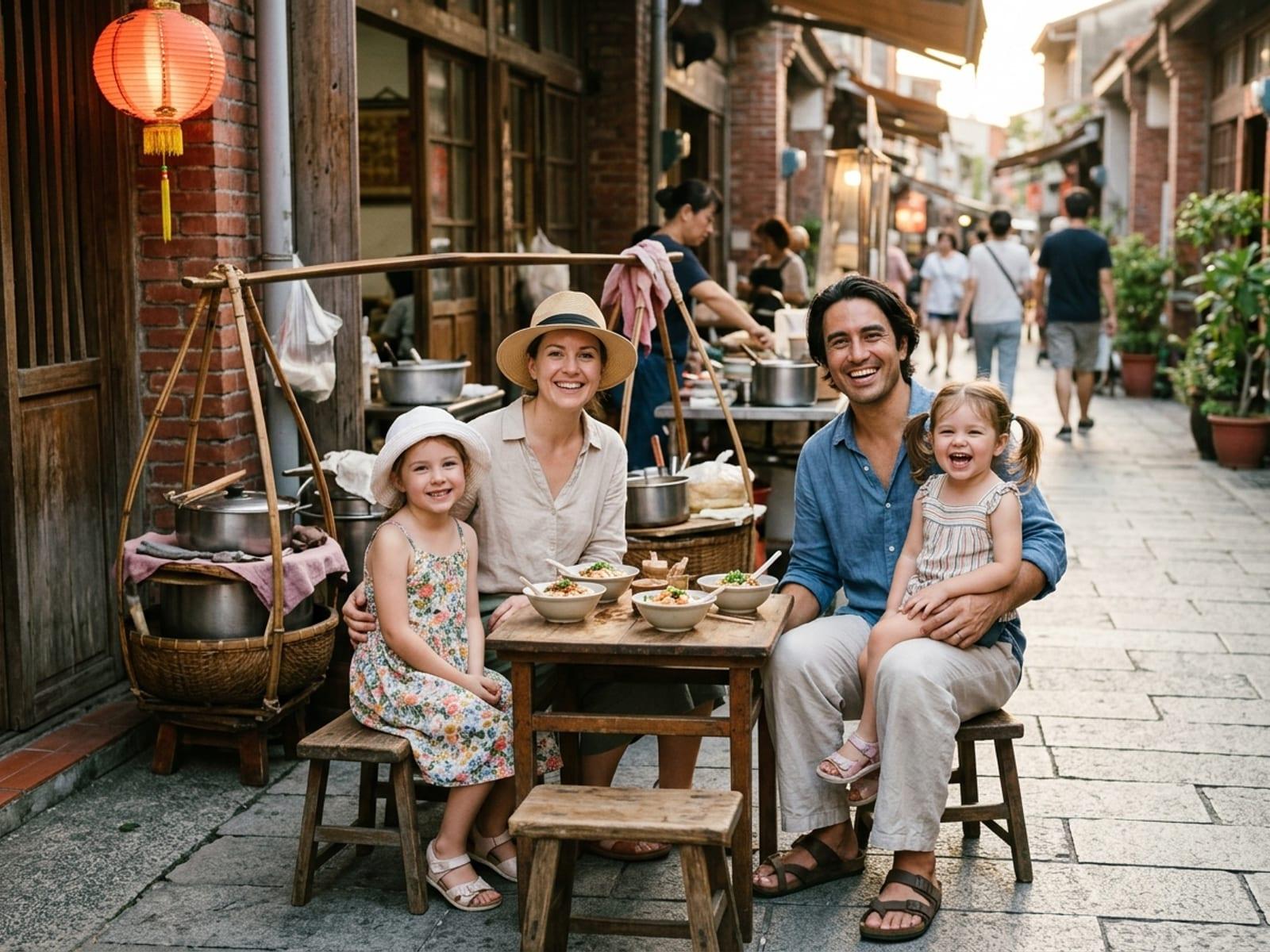
A small bowl holding a splash of shrimp broth and a mouthful of noodles, topped with sweet-savory minced pork, a single shrimp, coriander and garlic. Tainan's danzai noodles (danzai mian) are a dish an adult can finish in about two bites. They aren't meant to fill you up. They're one of the best-known xiaochi, the small snack dishes you eat bit by bit as you wander. If you're exploring Tainan as a family, that small size is exactly what makes a food walk work.
Getting through the "small months" when the boats stayed in
Danzai noodles are thought to date back to Tainan in the late Qing dynasty. From spring into summer, storms and typhoons churn up the sea off Tainan, and for days at a time fishermen can't go out. In Taiwanese, these lean, low-income periods are called the "small months" (xiao yue).
Hong Yu-tou, a Tainan fisherman, got through these months by hanging his tools and ingredients from both ends of a carrying pole (dan) and walking the streets selling noodles. Eventually he set up a stall in front of Tainan's Shuixian Temple. The name written on the stall's lantern was "Du Xiao Yue Danzai Mian," roughly "carrying-pole noodles to get through the small months." Du Hsiao Yueh, the business that carries on from that stall, gives 1895 as its founding year.
Shuixian Temple, where the stall stood, honors the water deities known as the Shuixian Zunwang, and a stone inscription and old county gazetteers date its founding to 1715. It's now a designated city monument, at No. 1 Shennong Street in West Central District. The temple is surrounded by the buildings of Shuixian Temple Market, and together with Shennong Street, where rows of old houses survive, it's an easy stop on a food walk. It's close enough to show children the kind of place where danzai noodles were born.
Tainan locals sometimes call this bowl a "national treasure" flavor. In 2017, when the Tainan City Cultural Affairs Bureau ran an online vote for the words that best represent Tainan's culture, danzai noodles came first.
Shrimp broth, minced pork and garlic
The basic bowl is boiled noodles (or rice vermicelli at some shops) with bean sprouts and a little broth, topped with braised minced pork (rou zao), shrimp, coriander, grated garlic and vinegar. The broth is built on shrimp stock, and the seasoning and mix of the minced pork is treated as a secret recipe at each shop.
For an adult, it's barely two mouthfuls. It was never meant as a meal but as a snack or late-night bite, a kind of dianxin. If it leaves you wanting more, order a second bowl or pair it with other dishes. Tainan has many shops serving danzai noodles, and the long-established ones cluster around Zhongzheng Road.
Wa gui, milkfish and a table of small plates
Tainan is considered Taiwan's oldest city, and from the Dutch period through the Qing dynasty it was the island's center until the provincial capital moved in 1887. As a city where people and goods gathered for centuries, it's known for a huge variety of xiaochi, and its cooking is said to be generally sweeter than elsewhere in Taiwan. Some streets, Guohua Street among them, are lined with snack shops. Hanlin Tea Room, one of the two teahouses that claim to have invented bubble tea, is a Tainan shop too, and it has long disputed the title with Chun Shui Tang in Taichung.
The way to enjoy a food walk in Tainan is to treat danzai noodles as one plate among many and build a meal from small dishes.
One to try is wa gui (wan guo in Mandarin), a savory steamed rice pudding. Rice is ground into a batter, poured into a bowl and steamed, and the name means a rice cake in a bowl. The savory kind is steamed with toppings such as dried radish, pork, dried shrimp and half a braised egg, then eaten with a soy-based sauce. Depending on the region it's finished brown with soy sauce or left white. It's soft and easy to cut into little pieces with a spoon, so it's good for small children.
Another is milkfish (shi mu yu). Tainan farms more milkfish than anywhere else in Taiwan, and fish ponds stretch along the coast on the city's western side, in Qigu, Annan and Beimen. Milkfish belly porridge, made with the rich belly meat, is a much-loved everyday dish that tastes good with very little done to it. Milkfish is full of fine bones, though. Many shops serve it deboned, but when feeding children, flake the flesh and check for bones.
Other Tainan specialties include eel noodles in a thick sauce (shan yu yi mian), oyster omelet (o-a-tsian), gua bao (braised pork belly in a steamed bun) and run bing (thin wrappers rolled around vegetables and meat). Children often like the look of oyster omelet, but for little ones who aren't used to oysters, it's safest to share just a bit of the egg and sauce.
With kids, share one dish at a time
Both danzai noodles and wa gui are small, so the best approach is for the family to order one dish at a time, share it, and visit several places. Rather than one dish each at the first stop, start with about one dish for every two people, so there's still room for the next shop.
The sweeter seasoning goes down well with most children, but the garlic and coriander on danzai noodles divide opinion. Say bu yao xiangcai (no coriander) or bu yao suan (no garlic) when you order, or show it written on a note. Many dishes use crustaceans, such as the shrimp on danzai noodles and the dried shrimp in wa gui, so take extra care if anyone has a shrimp or crab allergy.
Tainan is a southern city with strong sun all year. Eat slowly indoors during the hottest part of the day and save the walking for mornings and late afternoons. Many snack shops have low stools and small tables, and space for a stroller is limited. A baby carrier makes it much easier to get into shops in narrow lanes.
With pokesta's AI photos you can also make a picture of your family leaning over little bowls in a shop that recalls the old carrying-pole stalls ($1 per photo, and your first one is free).
Getting to Tainan, and what to pair with the season
The gateway airport for southern Taiwan is Kaohsiung International Airport (KHH). If you arrive at Taiwan Taoyuan International Airport (TPE) in the north, Taiwan High Speed Rail takes you to Tainan. The high-speed rail station is some distance from the city center, so transfer to a Taiwan Railway conventional train to Tainan Station, from where the old-town shops are within walking distance.
In summer, combine a visit with a trip out to Yujing for mango shaved ice. Head south to Kaohsiung and you can add Pier-2, the arts district in the old harbor warehouses. Entry requirements for Taiwan depend on your nationality, so check your own government's and the Taiwanese authorities' official information before you travel.
A small bowl of noodles, started with a single carrying pole in the season when the boats couldn't go out. Its two-bite size reflects the ingenuity of the man who sold it. Don't fill up on one bowl; walk on to the next shop. That's the most delicious way to see Tainan.
References