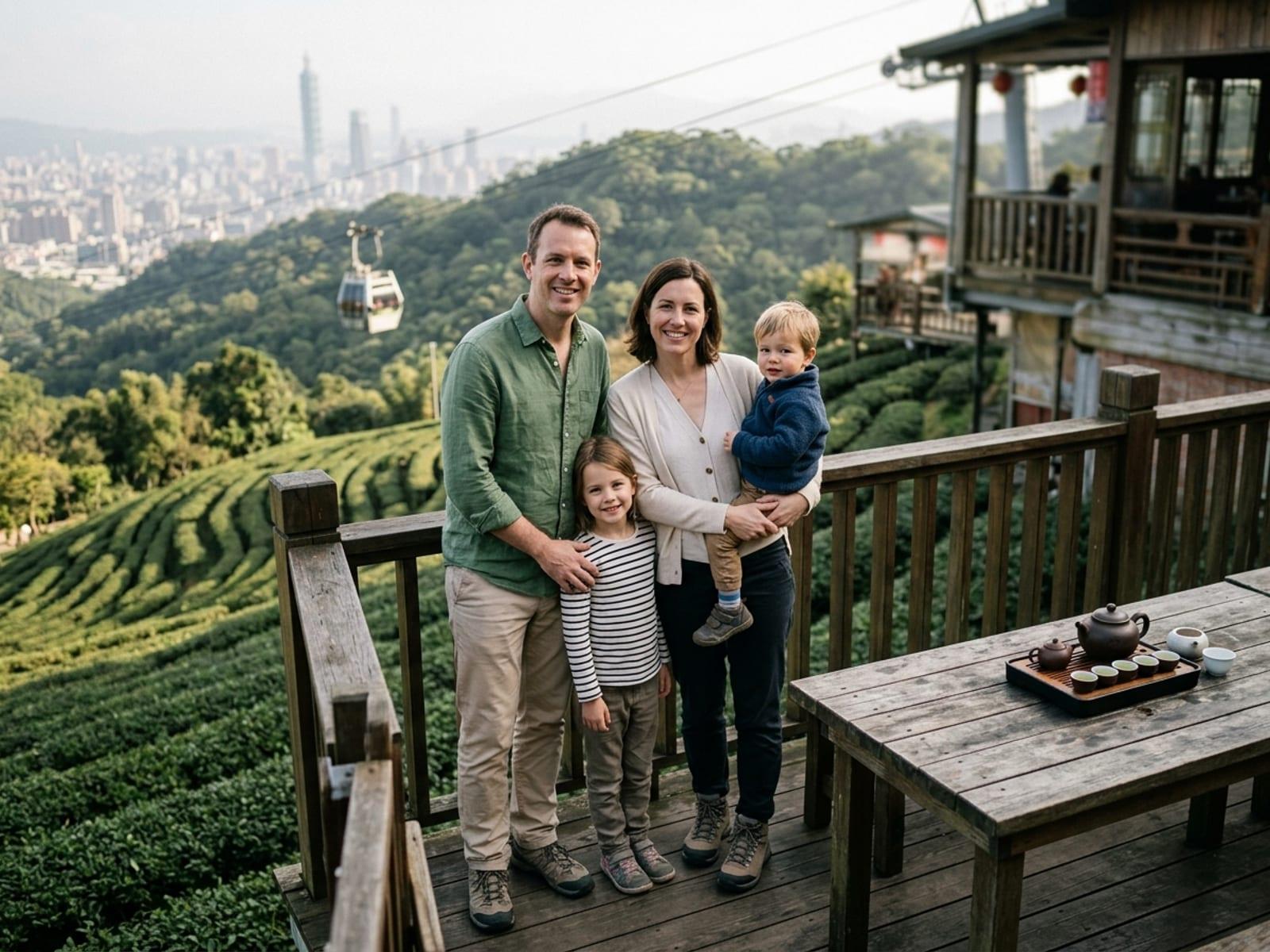
Take the metro from central Taipei, change to a gondola, and within the hour you are looking down on tea bushes planted across the hillsides. Maokong, in the city's Wenshan District, was once Taipei's largest tea-growing area, and Tieguanyin tea is still made here. You ride up in a cabin with a glass floor, then sit on a teahouse terrace brewing tea while the city spreads out below. That is the appeal of Maokong: a working tea district right on the edge of a capital. The gondola normally doesn't run on Mondays, so with kids, pick another day and pair the Taipei Zoo in the morning with the ride up in the afternoon.
The hills where Muzha Tieguanyin began
Tieguanyin is a type of oolong that originated in Anxi in Fujian, China. In Taiwan, the tea is said to have first been made around Muzha in Taipei, which is why it has long been known as Muzha Tieguanyin. Maokong sits in the Muzha hills. Production later spread to Pinglin, Shenkeng and Shiding in New Taipei.
What sets Muzha Tieguanyin apart is the way it is made. The leaves are wrapped in cloth and rolled into a tight ball, again and again, and during this process a second, slow fermentation takes place inside the leaves. That extra work gives the tea its characteristic flavor. Even so, Tieguanyin from different areas and different makers can vary a lot in aroma and color, so at a teahouse the simplest approach is to ask the staff what they recommend.
The Taipei Tea Research and Promotion Center, which works on tea research and on promoting the city's tea, is also located in Maokong.
There are a few theories about the name, which literally reads "cat's hollow." One says the characters were chosen to match an older Taiwanese place name describing potholes worn into the riverbed rocks. Another says civets once overran the valley. It isn't a place for spotting cats, so it can be fun to tell kids beforehand to find out where the name came from.
The Maokong Gondola, and the glass-floor cabins
The way up is the Maokong Gondola, which opened in 2007. From Taipei Zoo station, a short walk from the zoo stop on the MRT Wenhu line, it runs via Taipei Zoo South and Zhinan Temple to Maokong station, a line of about 4 kilometers. Zhinan Temple, partway up, is an old Taoist temple on the mountainside.
Besides the standard cabins, there are "Eyes of Maokong" crystal cabins with a glass floor. Each takes up to five people, 31 were put into service, and one comes by roughly every two to four minutes. Kids love watching the tea fields and forest pass under their feet. Note that the operator asks anyone with heart or blood vessel disease, high blood pressure or a fear of heights, or who feels unwell, not to ride the gondola at all.
Fares on the official site in 2026: a one-way full fare is NT$180, a concession fare NT$50, and a one-day unlimited pass NT$300 (NT$100 concession). A crystal cabin costs an extra NT$50 per person per ride. Children aged 6 to under 12 qualify for the concession fare, and children aged 0 to 5 ride free, up to two per paying adult. Fares can change, so check before you go.
The gondola runs from 9:00 to 21:00 on weekdays and from 9:00 to 22:00 on weekends and public holidays. As a rule it closes on Mondays for routine maintenance (a few Mondays, such as some holidays, are exceptions), and once a year there is a longer closure of a few weeks for inspection. Weather and other conditions can also change the hours or stop service, so check the official site on the morning you plan to go.
In the teahouse, brewing is half the fun
The hilltop is lined with teahouses and restaurants that serve meals alongside tea. At most of them, you choose a tea and are brought a tea set and hot water. You put the leaves in a small pot, pour the water yourself, and share the tea out into tiny cups. The same leaves can be steeped many times, and the idea is to take your time and notice how the taste changes from one round to the next. For a long time, this was how Taiwan drank its tea: hot, brewed in a pot. Shaking tea cold over ice caught on in 1980s Taichung, which is where bubble tea came from.
Give the kids jobs: one pours the water, another fills the cups. The water is very hot, though, and so are the teapot and the pitcher, so an adult should stay close and keep a hand on anything hot. Tieguanyin contains caffeine, so for small children a sniff of the aroma is plenty. Order a juice or a dish cooked with tea leaves for them, and everyone gets something they enjoy.
Maokong is also known for its night views, and on a clear day you can see across the whole Taipei basin. Arrive before sunset and grab a terrace seat, and you get both the tea fields in daylight and the city lights coming on. Just make sure you know the time of the last gondola down.
Dress for a hill walk, and for both rain and sun
Maokong is hill country on the rim of the Taipei basin. Getting from the gondola station to a teahouse can mean slopes and steps, so sneakers or other comfortable shoes are best. It is windier up there than in the city, and it can feel chilly after late afternoon, so bring a light layer.
There are walking paths through the tea fields, and trails climb all the way up from around National Chengchi University at the foot of the hill. Plenty of people hike up on weekends, but with young children it makes more sense to take the gondola to the top and wander a little around the station.
The hilltop roads have lots of slopes and steps, which makes pushing a stroller hard work. A baby carrier is the easier way to bring a small child.
If you want to see how a family photo with cups of tea and the tea fields behind you might look, you can try pokesta's AI photos ($1 per photo, and your first one is free).
Half a day from central Taipei
The main airport is Taoyuan International Airport (TPE), and some international flights also use Songshan Airport in the city. The gondola's Taipei Zoo station is a short walk from Taipei Zoo station on the MRT Wenhu line. If you're staying in Taipei, setting out after lunch and coming back in the evening is plenty of time.
The gondola starts right next to Taipei Zoo. With kids, you can spend the morning at the zoo, ride up after lunch, rest in a teahouse, watch the evening view and head back down. Children worn out from the zoo get to sit and look out of the window the whole way up, so the ride doubles as a break. Lines can build at the boarding station on weekend afternoons, so leave some slack in your schedule.
The tea gardens can be visited all year. Just plan around the Monday maintenance days and the annual inspection closure. Entry requirements for Taiwan depend on your nationality, so check official information from your own government and the Taiwanese authorities before you travel.
If you found a tea you liked, buy a small bag of it. Pick up some pineapple cakes in the city too, and you have everything for another tea break at home. Brew it the teahouse way, in a small pot with several rounds from the same leaves, and see for yourselves how the second and third infusions change.
References