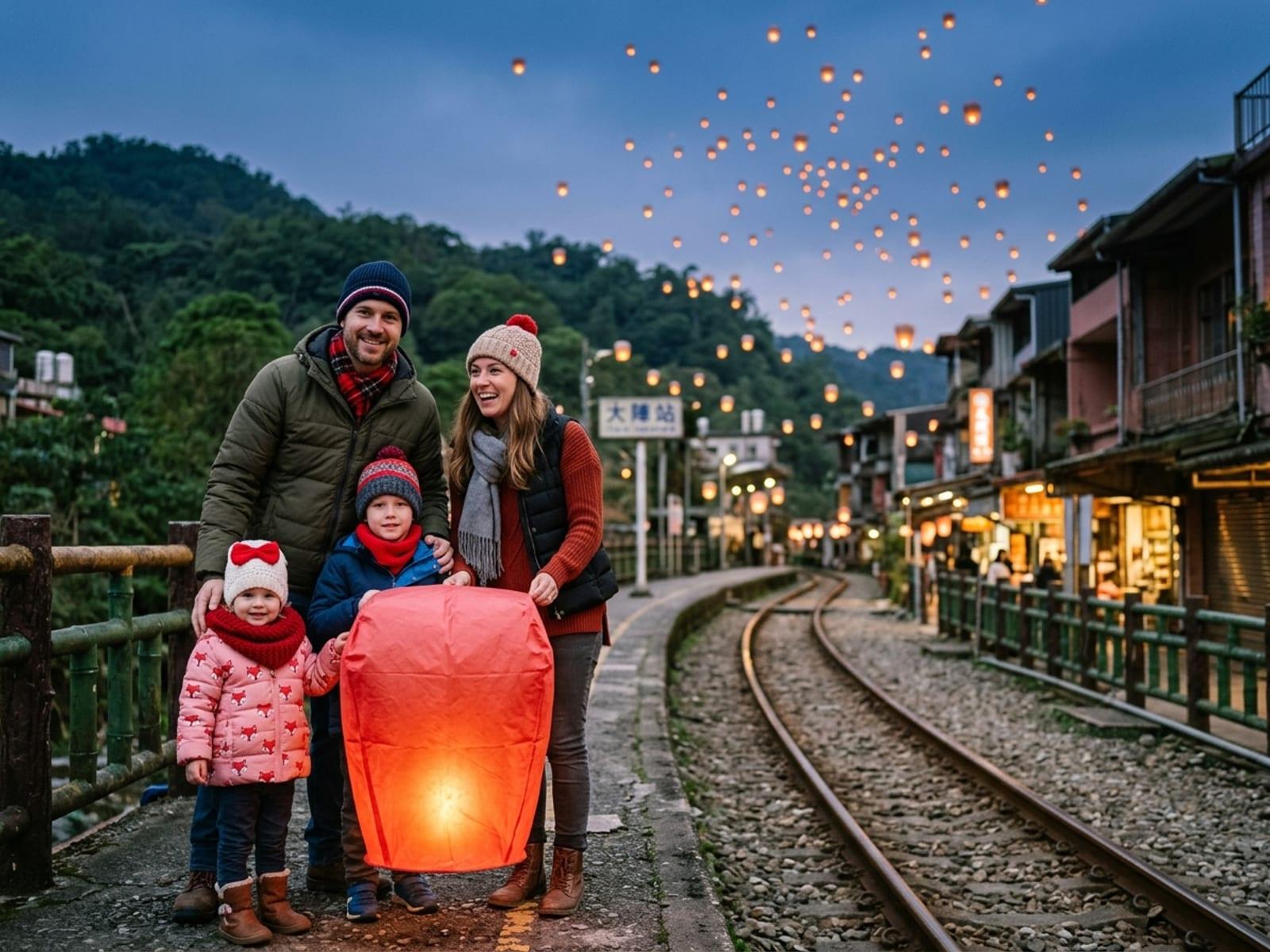
In Pingxi, a hill district of New Taipei east of Taipei, the sky lantern festival is timed to the Lantern Festival on the 15th day of the first lunar month, which falls on Saturday, February 20, in 2027. Recently it has run on two evenings, the Lantern Festival and a few days before, at venues in Pingxi and Shifen, with nine mass releases between about 6 and 9 p.m. New Taipei City usually announces the dates and venues in January, so wait for that before you book. To launch your own lantern on festival night you need a ticket; the alternative is to buy one from a shop in Shifen on an ordinary day. With kids, that choice shapes the whole day.
Dates follow the Lantern Festival and come out in January
The Pingxi Sky Lantern Festival celebrates the Lantern Festival (Yuanxiao) on the 15th day of the first lunar month. Because it follows the lunar calendar, the Gregorian date changes every year: the Lantern Festival fell on February 12 in 2025 and March 3 in 2026, and will be on February 20 in 2027.
In recent years the event has had two nights at different venues: February 8 at Pingxi Junior High School and February 12, the Lantern Festival, at Shifen Square in 2025, and February 27 and March 3 at the same two venues in 2026. Both years, the first night came four days before the Lantern Festival. The 2027 pattern won't be known until the announcement.
The organizer, New Taipei City's Tourism and Travel Department, announced the dates at mayoral press conferences on January 7, 2025, and January 30, 2026; the 2026 briefing also covered the number of waves and how tickets would be handed out. No date has been set for the 2027 announcement, and the timing varies. Watch New Taipei City Travel, the festival's site and the department's "新北旅客" (New Taipei Travelers) Facebook and Instagram pages before confirming flights.
On the same Lantern Festival night, Dajia Jenn Lann Temple in Taichung asks Mazu to choose the start date of the spring Dajia Mazu Pilgrimage.
Lanterns go up from about 6 p.m., in nine waves
Festival evenings start at around 6 p.m., and between then and about 9 p.m. there are nine mass releases. There were nine waves in both 2025 and 2026; according to New Taipei City, each wave in 2026 sent up 100 lanterns at the Pingxi venue and 150 at Shifen. A giant 20-foot (about 6-meter) main lantern also appears, shaped after that year's zodiac animal.
Between waves come projection-mapping shows and live music. Staying for all nine means about three hours standing outdoors on a winter night; with children, plan to watch the first few waves and then head for the bus line. Exact wave times appear in each year's guidelines.
The lanterns began as an "all clear" signal
Sky lanterns are said to trace back to a legend that Zhuge Liang, the Three Kingdoms strategist, flew paper lanterns to send military messages. That's why they're also called Kongming lanterns in Taiwan, after his courtesy name.
In Pingxi, the custom is tied to the lives of settlers who arrived from Fujian in the early 19th century. Bandit raids were common, and villagers would flee into the mountains to hide. When the danger had passed, the men who stayed behind launched lanterns to signal that it was safe to come home. Over time the lights that once meant safety became prayers for family happiness and good harvests, and today everyone sends their own wishes skyward. At the summer Keelung Ghost Festival, by contrast, water lanterns are set adrift to guide the spirits of those lost at sea.
Geography helped too. According to New Taipei City, Pingxi is the only place in Taiwan where outdoor lantern releases are permitted, because the humidity and surrounding mountains reduce the fire risk from fallen lanterns, and the city organizes cleanups in the hills after the festival.
The organized festival dates from 1999, and New Taipei City says 2027 will be its 28th edition. Fodor's has listed it among festivals to see before you die, and CNN has featured it.
To release your own on festival night, get a ticket and practice first
On festival nights, only ticket holders can launch a lantern at the venue. In 2026, free tickets were handed out at the venue's service desk from 10:30 a.m. on the day until they ran out, and a paid online experience let four people release one lantern together. The method changes every year, so check that year's guidelines.
Free tickets mean queuing in the morning, so a family that wants one should arrive before noon. Even without a ticket, you get to watch hundreds of lanterns go up at once, and with small children it's sensible to decide from the start that you're only there to watch.
The Ministry of the Interior's religious-culture website explains the steps. Check the lantern for tears and write your wishes on it with a brush. Attach the oil-soaked paper fuel to the bottom and spread out the top corners. One person supports the lantern from below; once the fuel is lit, wait until enough hot air has filled it before letting go.
While the hot air builds up, a gust can tilt the lantern, so let the children hold the top corners while an adult looks after the flame, and agree on those roles before you leave. Write your wishes in whatever language you normally use; if each family member takes one of the four sides, the time before the launch becomes part of the memory.
On other days, release one in Shifen: prices and where it's allowed
You don't need the festival to send up a lantern: shops on Shifen Old Street sell them and let you release them on the spot, and a weekend or weekday away from the festival means no crowds. Prices are guide prices set by the local shopkeepers' association. A Public Television Service (PTS) report in April 2025 put the popular four-colour lantern at NT$250 and the eight-colour one at NT$350. The four-colour price was once NT$100, became NT$200 on New Year's Day 2024 and NT$250 in January 2025 as paper, paste and other materials got dearer, so expect further changes.
Where and when you may release one is set by New Taipei City regulations. According to news summaries, the permitted zone runs from the Shifen Visitor Center to Shigong Bridge, within 200 meters of the Keelung River, and releases are banned from 10 p.m. to 6 a.m. except on announced festival dates. Lantern size (60 to 70 cm across the base, 130 to 140 cm tall, at most 300 g) and fuel (kerosene mixed with soybean oil) are regulated too. Most relevant for families: children under 14 must be accompanied by a family member or legal guardian. Violations can bring a fine of up to NT$3,000 under the Fire Services Act.
Also stay off the railway. Releasing lanterns on the Pingxi Line tracks breaks the Railway Act; in August 2025 a YouTuber family of four who did so were reportedly fined NT$40,000 in total. Rules amended in January 2026 say releases on the tracks are "prohibited in principle, allowed by exception," but Taiwan Railway only takes applications from public bodies such as city or district offices, not individuals (as of a July 2026 report). Take your family photo beside the tracks, not on them.
Shuttle buses, extra trains and warm clothes
The main gateway is Taoyuan International Airport (TPE); the Airport MRT express reaches Taipei Main Station in about 35 to 40 minutes, and Songshan Airport in the city has some international flights. Visa rules depend on your nationality or region, so check your own government's official information and Taiwan's immigration authorities before you travel.
From Taipei, take the MRT and a shuttle bus, or a Taiwan Railway train to Ruifang and a shuttle from there. Ruifang is also the gateway to Jiufen, so you could spend the afternoon eating taro balls in Jiufen first. The Pingxi Line, opened in 1921, links Ruifang with Shifen, Pingxi and Jingtong and is a pleasant ride on normal days, but packed at festival time. On the two festival days in 2026, Taiwan Railway added cars and extra trains, ran every service from Ruifang, and used short runs (Ruifang–Jingtong on the Pingxi night; Ruifang–Shifen and Shifen–Jingtong on the Shifen night), posting times in advance online and at stations.
Transport is the biggest challenge. In 2026, all traffic except permitted vehicles was banned around the venue from 4 p.m. to 11 p.m. Special "Sky Lantern" shuttle buses ran on several routes, including the Muzha route (toward Taipei Zoo Station on the MRT Wenhu Line), the Shiding route and the Ruifang route, paid on the way there and free on the way back. Buses from Ruifang Station ran every 10 to 30 minutes from morning to early evening, and shuttles also left from outside Keelung Station.
Pingxi sits in the hills, and nights in February and March get chilly. You'll be outdoors from late afternoon into the evening, so pack a down or padded jacket, a scarf and a knit hat, plus a rain jacket that leaves your hands free. Something red, like a scarf or hat, helps everyone stand out in night photos.
Return-bus lines grow long once the festival ends, right when children get sleepy, and strollers struggle in the crowds and on the slopes; a baby carrier works better.
Decide before you leave your hotel whether you'll stay for the last mass release or join the bus line before it. That one decision makes the cold trip down the hill with the kids much easier.
References
- 2026 festival launch press release (New Taipei City Tourism and Travel Department, January 30, 2026, in Chinese)
- Pingxi Sky Lantern Festival wins TITAN Gold Award (press release, August 26, 2026, in Chinese)
- Lantern Festival (Wikipedia)
- 2025 Pingxi Sky Lantern Festival announcement (Storm Media, January 7, 2025, in Chinese)
- The 2025 Pingxi Sky Lantern Festival has two nights (Marie Claire Taiwan, in Chinese)
- Pingxi Sky Lantern Festival Brightens up Beautiful Sky in New Taipei City (New Taipei City Travel)
- 2026 New Taipei City Pingxi Sky Lantern Festival (New Taipei City Travel, in Chinese)
- Pingxi Sky Lantern Festival (Taiwan Religious Culture Map, Ministry of the Interior)
- 2026 Pingxi Sky Lantern Festival guide (Global Views Monthly, in Chinese)
- Sky Lantern shuttle buses are the easiest way to the Pingxi festival (New Taipei City Transportation Department, in Chinese)
- 2026 Pingxi Sky Lantern Festival traffic controls and shuttles (egoldenyears, in Chinese)
- Taiwan Railway adds Pingxi and Shen'ao line trains for the festival (United Daily News, February 24, 2026, in Chinese)
- Shifen Old Street four-colour lanterns up NT$50 (PTS News, April 4, 2025, in Chinese)
- Key rules for releasing sky lanterns in Pingxi (United Daily News / DailyView, August 23, 2025, in Chinese)
- Lantern releases on railway tracks and fines; Taiwan Railway agrees to adjust (United Daily News, July 30, 2026, in Chinese)
- Pingxi Sky Lantern Festival (Nikomaru Taiwan Travel, in Japanese)
- Taoyuan Airport MRT (Wikipedia)