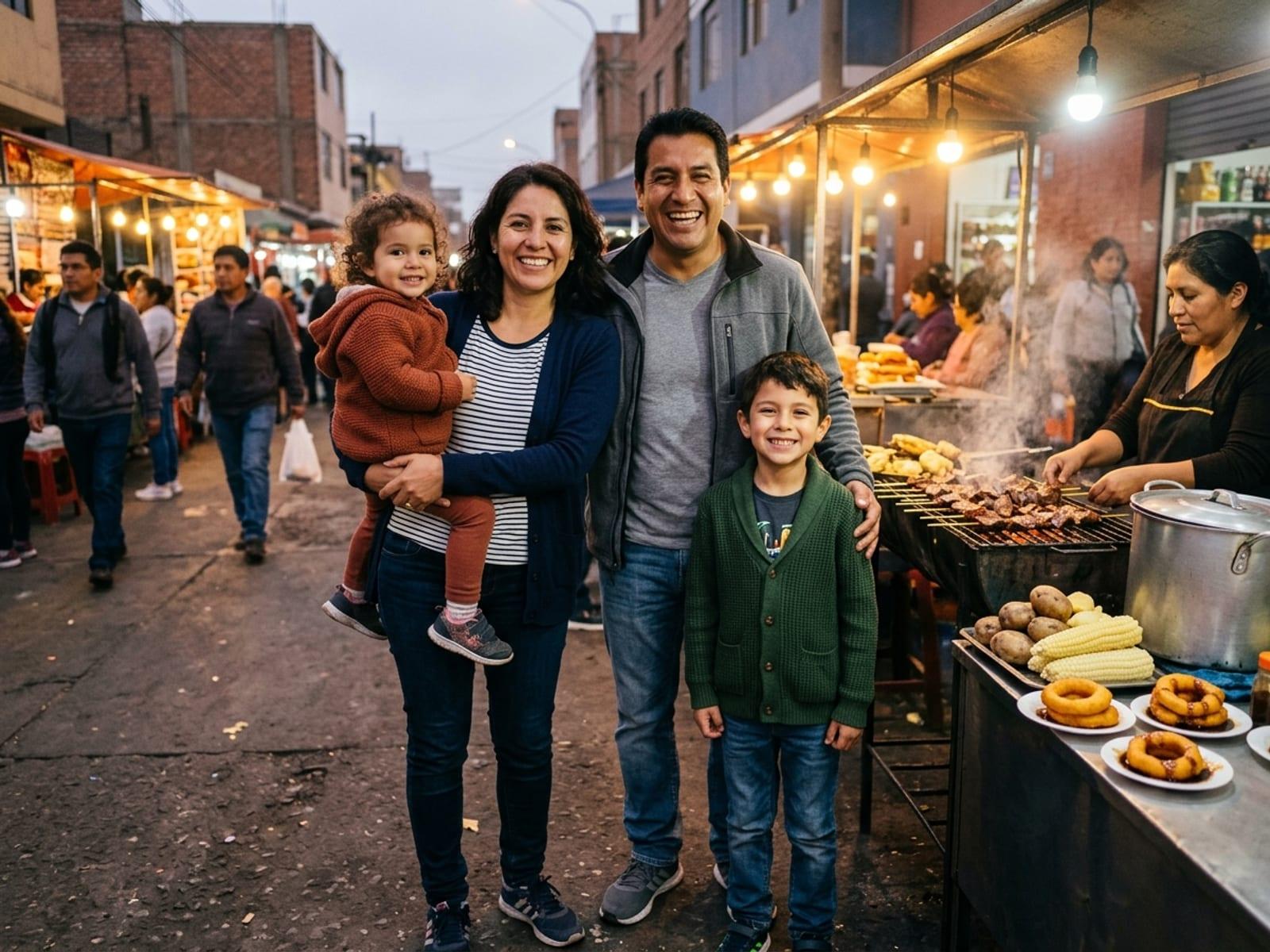
Anticuchos are beef-heart skewers marinated in chili paste and grilled over charcoal; picarones are rings of squash and sweet-potato dough, fried and drizzled with dark cane-sugar syrup. Both are fixtures of Lima's evening street stalls. You can find them all year, but the stalls multiply in October, the month of the Señor de los Milagros processions. With children, ask for the spicy sauce on the side, take the heart off the skewer and cut it small, and let the hot syrup cool before handing over the picarones.
Anticuchos: beef heart grilled over charcoal
Anticuchos are Peruvian skewers, traditionally made with beef heart. The heart is cut into bite-sized pieces and marinated in oil, garlic, cumin, a paste of ají panca (a Peruvian red chili), vinegar, oregano and other seasonings, then threaded onto thin skewers and grilled over charcoal. The old way is to keep basting with the marinade as they cook, using a brush made from a bundle of corn husks.
They come with boiled potatoes and choclo, a large-kernel corn, plus chili sauce or salsa criolla, red onion dressed with lime juice. At the stalls you'll often see other offal on the same grill: rachi (tripe), choncholí (small intestine) and a cut called mollejas.
The name is said to come from Quechua, the Andean language. One theory traces it to a word meaning "cut," another to a word containing uchu, meaning chili. Anticuchos in their current form spread during the colonial period, and people of African descent living in Lima and along the southern coast are thought to have played a big part, finding inventive ways to cook beef offal. In the mid-19th century the Afro-Peruvian painter Pancho Fierro made watercolors of anticucho sellers, and the writer Ricardo Palma, in his 1883 "Tradiciones peruanas," mentioned anticucho vendors making their rounds at about three in the afternoon.
In Lima, anticucho stalls have long set up around the Acho bullring and outside sporting events at the national stadium. In July 2005 the Lince district of Lima grilled a giant anticucho 56 meters long. It used 450 kg of beef heart, with 200 kg of potatoes and 150 kg of corn on the side, numbers that tend to impress children. Anticuchos later spread to Bolivia, Chile and Argentina, where each country eats them a little differently. In Bolivia they are sold at night with potatoes and a peanut chili sauce, and in Chile they appear at the food stalls of the September independence celebrations.
Picarones: fried rings of squash and sweet potato
Picarones are made from a dough of boiled sweet potato and squash mixed with wheat flour and yeast, left to rise, then shaped into rings and fried. The dough takes its scent from anise seed simmered in the water the vegetables were boiled in.
Poured over them while they're hot is miel de chancaca. Chancaca is unrefined cane sugar, and the syrup is made by cooking it down with fig leaves, cinnamon, anise, cloves and orange peel until it turns dark. Picarones grew out of the Spanish fried pastry buñuelo, combining Andean vegetables with European flour and sugar. During the colonial era they were made by Black and mulatto cooks, sold on the street and delivered to wealthy households. The earliest written mention is in a literary work from 1797, and Pancho Fierro and Ricardo Palma, who recorded the anticucho sellers, wrote about picarones too. They are still among the most popular sweets in Lima.
October processions and the street-stall season
Both snacks are most visible in October. Every year Lima holds the Señor de los Milagros procession, when people dressed in purple carry a sacred image through the streets, and stalls selling anticuchos and picarones lining the route are a long-standing sight. The third Sunday of October is marked as Anticucho Day. At the end of August, around the feast of Santa Rosa de Lima, many stalls also gather near the Santa Rosa sanctuary in Lima.
That said, you can eat both all year round. Stalls mostly appear around dusk, with charcoal smoke drifting along the streets of Lima's working-class neighborhoods. Locals sometimes hold an anticuchada, an event where anticuchos are grilled and sold to raise funds. Some sit-down restaurants have anticuchos on the menu too, which is the calmer option if you'd rather eat sitting down.
Ordering at a stall, and eating with kids
At a stall, tell the cook how many skewers you want and wait beside the grill while they cook. The skewers come with the potatoes and corn. Picarones are ordered by the number of rings, and the syrup is poured on as you watch.
The ají panca in the marinade is deep red but very mild; it's there mostly for color and aroma. The heat is in the sauce served on the side, so ask for none on the children's portion, or for it to come separately. Heart is chewy, so for small children take the meat off the skewer and cut it into small pieces. The bamboo skewers have sharp tips, so don't let kids walk around holding them; an adult should collect each one as soon as it's finished. The boiled potatoes and corn are a safe bet for children who won't eat offal.
Picarones arrive straight from the oil with the syrup very hot. Tear them into pieces and let them cool a little before handing them over. Hands and faces end up sticky, so wet wipes are a help. The dough contains wheat flour, so children with a wheat allergy can't eat them. Street vendors may not be able to give detailed ingredient information, and with an allergic child it's safer not to take chances.
While you wait, keep children a step back from the stall, away from the charcoal and the pot of oil. If hygiene is on your mind, choose a stall where you can see the meat being cooked through, and eat it hot on the spot. Evening stalls tend to set up in busy places, so keep an eye on your bags as well.
If you'd like to see your family lined up behind the charcoal smoke of an evening stall, you can try it with pokesta's AI photos ($1 per photo, and your first one is free).
When to go and getting there
These street flavors are around all year, and October is when the stalls are liveliest. Lima's international gateway is Jorge Chávez International Airport (LIM). Stall locations and hours change from day to day, so asking the staff where you're staying about nearby stalls is a good way to find one. For lunch, Lima's other staples include lomo saltado, the beef stir-fry, and ceviche, fish cured in lime. Entry requirements for Peru depend on your nationality, so check your own government's official guidance before you travel.
References