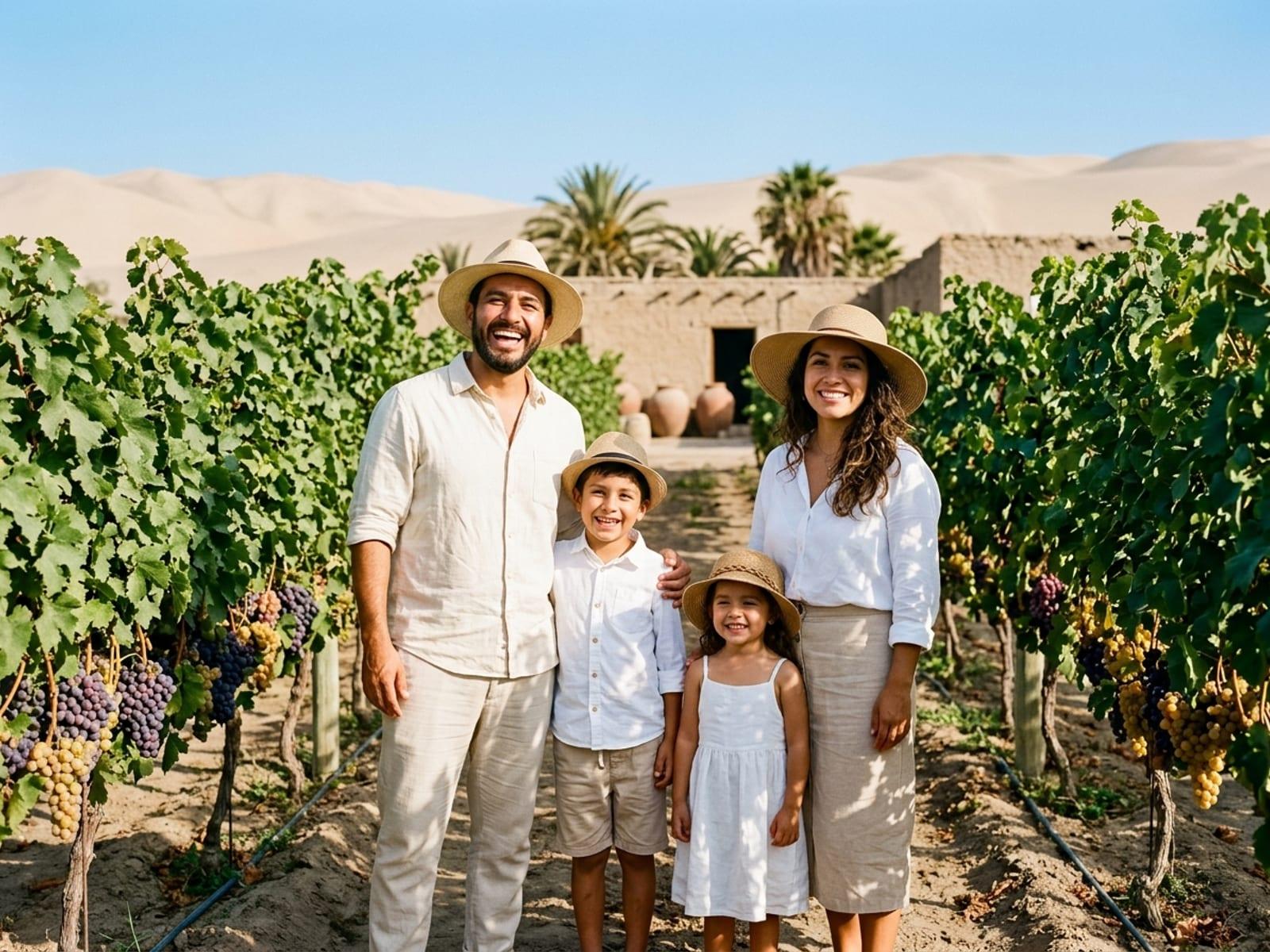
Ica, about 320 km south of Lima, is a grape-growing town ringed by desert and known as the home of pisco, Peru's grape brandy. At its Vendimia harvest festival each March, which ran from March 6 to 16 in 2026, people still climb into big vats and tread grapes by foot. Tastings at the wineries are for adults only, but children can enjoy the vineyards, the huge clay jars, the Paso horse show and the festival parade.
Vineyards since the 16th century
Grapevines are thought to have reached Peru in the mid-16th century, around 1553. The valleys of the southern coast suited them well, and by 1560 wine was already being made commercially in Peru. In 1615, Guaman Poma, a painter of Inca descent, captioned a drawing of Ica as a land with plenty of wine, the best in the kingdom.
Distilling wine into a grape brandy began toward the end of the 16th century. The spirit came to be called "pisco," after the port it was shipped from. A great earthquake in 1687 brought down the wineries of Ica and Pisco and dealt the wine industry a heavy blow. Pisco production grew in its place, and by 1764 pisco made up 90 percent of the drinks produced from grapes.
In the 19th century, though, industrialization in Europe drove up demand for cotton, and many farmers turned their vineyards into cotton fields. The shift sped up when cotton prices soared during the American Civil War. Grapes and pisco took a long time to recover, and that recovery is what shaped Ica's vineyards as you see them today. Peru and neighboring Chile disagree over where pisco began, and both are proud of it as their own.
In Peru, only spirit made in the five regions of Lima, Ica, Arequipa, Moquegua and Tacna, set as a designation of origin in 1991, can be called pisco. Peruvian pisco must be distilled in copper pot stills, and it can't be diluted with water when bottled. A regular bottle takes about 8 kg of grapes, and mosto verde, made from juice that hasn't finished fermenting, takes 12 kg.
Styles of pisco, and treading the grapes
Peruvian pisco comes in several styles depending on the grapes and the method. Puro is made from a single variety, most often Quebranta. Aromática is made from strongly scented varieties such as Muscat, Italia or Torontel. Mosto verde is distilled from juice partway through fermentation. Acholado blends several varieties. If you're an adult trying pisco for the first time, taste an aromática, where the grape's perfume comes through clearly, alongside a Quebranta puro, and you'll notice how different two piscos can be.
In the traditional method, the harvested grapes go into a large vat called a lagar, where people tread them to press out the juice. It's often done in the afternoon to avoid the dry coastal heat, with the men singing and joking as they tread again and again. The juice rests for about a day before going into fermentation vats, ferments for about a week and is then distilled in copper stills.
This pisa de uva, or grape treading, is also the high point of the harvest festival. At the 2026 festival, on the first night, the Vendimia queen danced with local officials in the lagar at the festival grounds as they trod more than a ton of Quebranta grapes.
The Vendimia in March
Ica's International Vendimia Festival (FIVI) celebrates the grape harvest, and 2026 was its 61st edition. It ran from March 6 to 16, centered on the Campo Ferial, Ica's fairgrounds.
Something happens almost every day: international folk dance shows, a show of Peruvian Paso horses, children's shows, a farm and livestock fair, and guitar and festejo performances, festejo being a traditional Afro-Peruvian music and dance. To take 2026 as an example, the 7th brought the Paso horse show and a children's show. On the 9th, a symphony orchestra of local children and young people performed, and crowds joined the "world's biggest toast," raising glasses of cachina, a local drink made from partly fermented grape juice. The 10th was the final of the contest for Afro-Peruvian traditional arts such as festejo, and the 13th saw a Mass of thanksgiving for the harvest and a food event. Near the close, on Sunday, March 15, came the Gran Corso, a parade of floats and costumed groups through town. With children, the daytime Paso horse show and the parade days are the easiest to manage. The schedule changes every year, so check the announcement for the year you plan to go.
Visiting wineries with children
There are several historic wineries, or bodegas, around Ica. Some let you see old clay jars, the lagares where grapes are trodden and copper stills, so you can follow the whole journey from grape to juice to spirit. Tastings are for adults only, of course. Decide as a family at the outset who's driving and won't be drinking. For children, the grape bunches, the huge jars and the vineyards themselves are the attraction. To drink, they can order chicha morada, the alcohol-free purple corn drink, almost anywhere in Peru.
If the adults want to try pisco, start with the classic cocktails. The pisco sour, shaken with egg white and bitters until frothy, and the chilcano, pisco topped with ginger ale and lime, can be ordered anywhere in Peru. At harvest time, just comparing the colors of the grapes on the vines is fun in itself.
Ica gets so many sunny days that it's called the "city of eternal sun." March is the end of summer in the Southern Hemisphere, with strong sun and hot afternoons. Hats, sunscreen and water are a must. Plan to spend the hottest part of the day indoors and the children will tire less easily. The Regional Museum of Ica, in town, displays finds and materials from pre-Inca times through the colonial period, a good way to take in the region's long history between vineyard visits. To see how a family photo might look against the vines and an old winery, you can try pokesta's AI-generated photos ($1 per photo, and your first one is free).
Close to town is Huacachina, an oasis surrounded by dunes. Sandboarding down the slopes and dune buggy rides are popular, but both go fast. Before deciding whether small children should join, check the operator's age and size requirements.
When to go and getting there
The vineyards and wineries can be visited year-round, but March, with the harvest festival, is the liveliest time. The nearest major international airport is Jorge Chávez International Airport (LIM) in Lima. Ica is about 320 km south of Lima along the Pan-American Highway, reached by long-distance bus or car.
Whether a winery offers tours, and its hours and prices, differ from place to place and can change, so check ahead. You can also enjoy ceviche in Lima before heading south, or stop overnight in the seaside town of Paracas on the way and take the morning boat tour to the Ballestas Islands before continuing to Ica. Entry requirements for Peru depend on your nationality, so check your own government's official information before you travel.
References