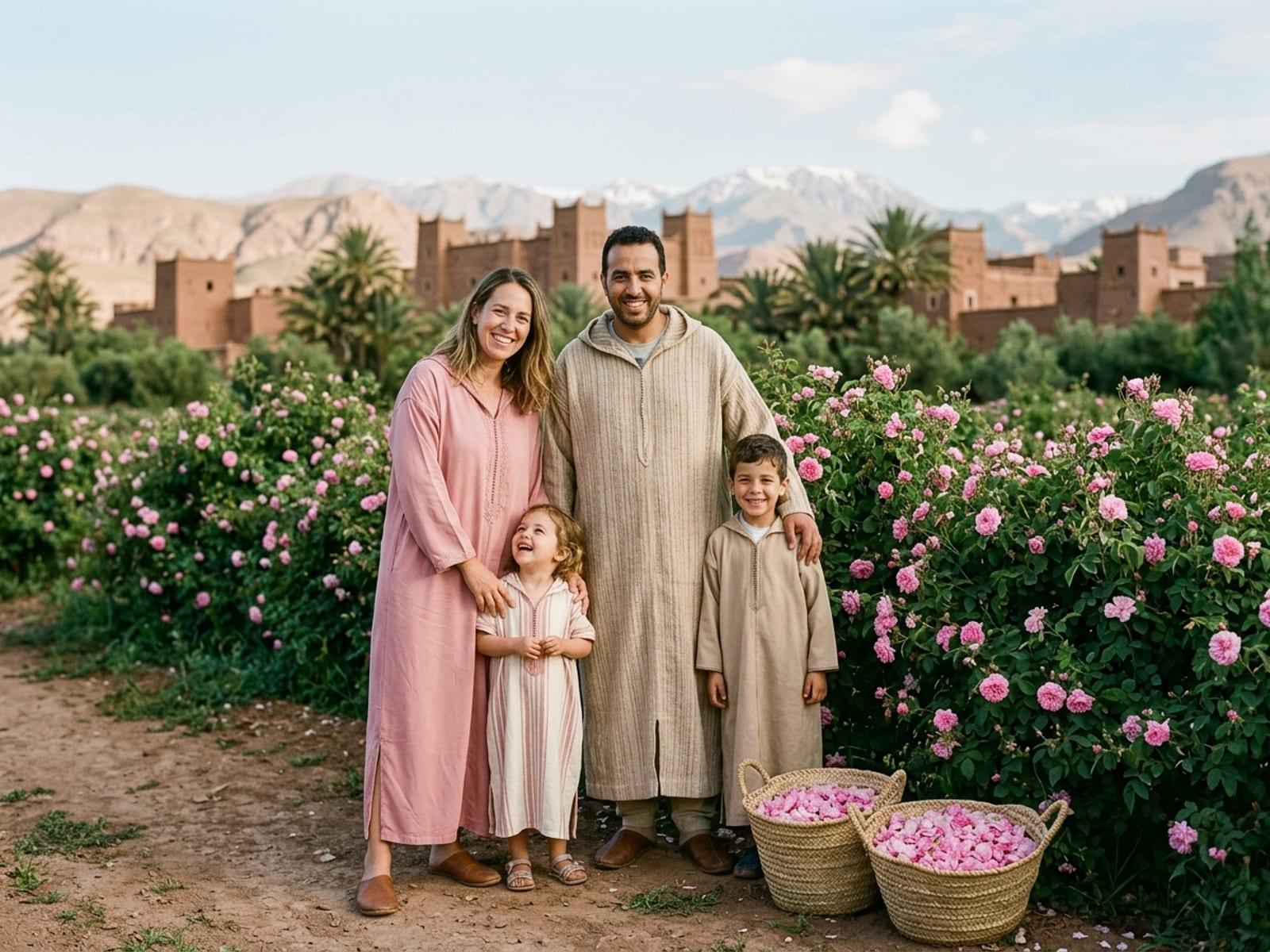
Tall rose hedges run for kilometers along the edges of fields in a dry valley. Kelaat M'Gouna, a town in the Dades Valley of southeastern Morocco, is known as the Valley of Roses, and in early May the whole town turns pink for a festival celebrating the harvest of Damask roses grown for perfume. The flowers bloom only from late April to mid-May, so getting the dates right matters more than anything else on this trip.
Field hedges that became the valley's signature
Kelaat M'Gouna lies in the Drâa-Tafilalet region at about 1,700 meters above sea level, with the High Atlas rising on one side. According to the travel company Journey Beyond, the Damask rose is thought to have reached Morocco around the 10th century. Farmers originally planted roses as hedges along the borders of their fields. Today those hedges run in long lines across the valley and define how the town looks.
The altitude brings cool nights, the Dades River supplies water, and the air is dry outside the harvest season. These conditions are said to suit the roses. A 2025 Associated Press article explains that the Damask rose likes mild temperatures, steady sunshine and low humidity, and that the authorities see it as a crop that is relatively easy to grow even through long droughts. The regional agricultural development office in Ouarzazate put the 2025 harvest at about 4,800 tonnes, and the 2026 harvest was reported to have topped 5,000 tonnes from a little over 1,000 hectares.
Four days of festival
The rose festival is held every year in early May, at the height of the harvest. The 60th edition took place in 2025, and the 61st ran for four days from May 7 to 10, 2026. More than 150,000 people were reported to have attended in 2026. The dates change each year, so check that year's announcement.
More than 100 stalls fill the festival grounds. Cooperatives sell rose water, soap and creams, and there are displays of local crafts and livestock. For children, the highlight is likely the parade through the streets. That year's Rose Queen and her two runners-up make their way through town surrounded by local bands and folk troupes. In the evenings, singers from the town and neighboring areas take the stage.
The festival is a tourist event, but it is also a gathering of the rose industry. The 2026 theme was "the perfume rose sector at the heart of integrated development in oasis areas," and there were conferences and training sessions for farmers and researchers, plus awards for the best farms and processors.
The AP article notes that the town has rose-shaped monuments, pink taxis and even a rose-themed merry-go-round for kids. Even outside the festival days, there's no shortage of things to photograph in rose season.
The picking is over by late morning
Roses are picked by hand in the early morning, when the flowers hold the most essential oil, the source of their scent. Families and women work among the thorny bushes carrying baskets. Journey Beyond says you can walk freely through the fields during the harvest, but go early: as midday approaches, the work is finished.
The fields are workplaces for the people who live here. If you'd like to photograph someone picking, ask first. Children will want to reach for the flowers, which is understandable, but these roses are for sale, so only pick when you've been given permission.
The picked petals go to distilleries in town, where they are steamed in copper stills and separated into rose water and essential oil (rose oil). Some distilleries welcome visitors, and you can watch the process and then buy on the spot. Once you hear that a liter of rose oil takes around four tonnes of petals, the price of a small bottle makes more sense.
According to AP, rose growing is sustained by small farmers using drip irrigation. A hectare of roses needs little water and creates more than 120 days of work. The same article also reports that the women who pick the flowers during the harvest earn around 80 to 100 dirhams ($8 to $10) a day. It may be worth talking with your children about how buying directly from cooperatives and distilleries helps these families.
Check the color before you buy
Journey Beyond warns that real rose water is clear and colorless, and that most of the pink-tinted bottles in the souks are synthetic. For souvenirs, buying straight from a distillery or cooperative is the safe choice, and the money stays in the area. Essential oil is expensive even in small amounts, so check the volume and the price before you buy.
You'll also find soap, creams and dried petals. If you plan to use them on a child with sensitive skin, test a small amount first.
Besides roses, the town is known for khanjar daggers and Amazigh jewelry. If you have a free day around the festival, you could drive a short way to Bou Tharar, an Amazigh village set in a gorge, or take an easy hike with views of M'Goun, the 4,071-meter mountain at the head of the valley. Climbing to the summit requires a guide, but a day walk along the valley needs no special gear.
Matching the family in pink and white
There's no dress code for the festival. If you want family photos, pale pink or ivory kaftans (long, loose dresses) and white or beige djellabas (long hooded robes) blend beautifully with the roses. If you can't find them in children's sizes, simply dressing the family in white and pink clothes you already own pulls the pictures together.
At 1,700 meters, the valley is chilly in the mornings and evenings even in May, and the midday sun is strong. Bring long sleeves to layer, hats, and shoes you won't mind getting dewy or muddy on early walks in the fields. Morocco is a predominantly Muslim country, so clothes that cover shoulders and knees help you fit in.
You can also try out a family photo in front of the rose hedges with pokesta's AI photos ($1 per photo).
Over the mountains from Marrakech
The nearest major international airport is Marrakech Menara (RAK). Kelaat M'Gouna is on the N10 road, about 85 km east of Ouarzazate and about 40 km west of Boumalne Dades, the town at the mouth of the Dades Gorge. From Marrakech it's a long journey over the High Atlas, roughly six to seven hours by bus. CTM and Supratours run buses, but Journey Beyond recommends a car with a driver if you want to stop at villages and distilleries along the way.
With children, the trip is easier if you break the journey with a night in Ouarzazate rather than driving straight through from Marrakech. Follow the N10 west from Ouarzazate instead and you reach Taliouine, where saffron flowers are picked in autumn, an idea for a return trip in another season. Head farther east and you reach Merzouga, the gateway to the Sahara, so you can combine the roses with a night at a dune camp.
Accommodation fills up during the festival, so book as soon as the dates are announced. By late May the harvest is over; if you want to see the flowers, arrive by mid-May at the latest. Entry requirements depend on your nationality, so check your own government's official information.
References