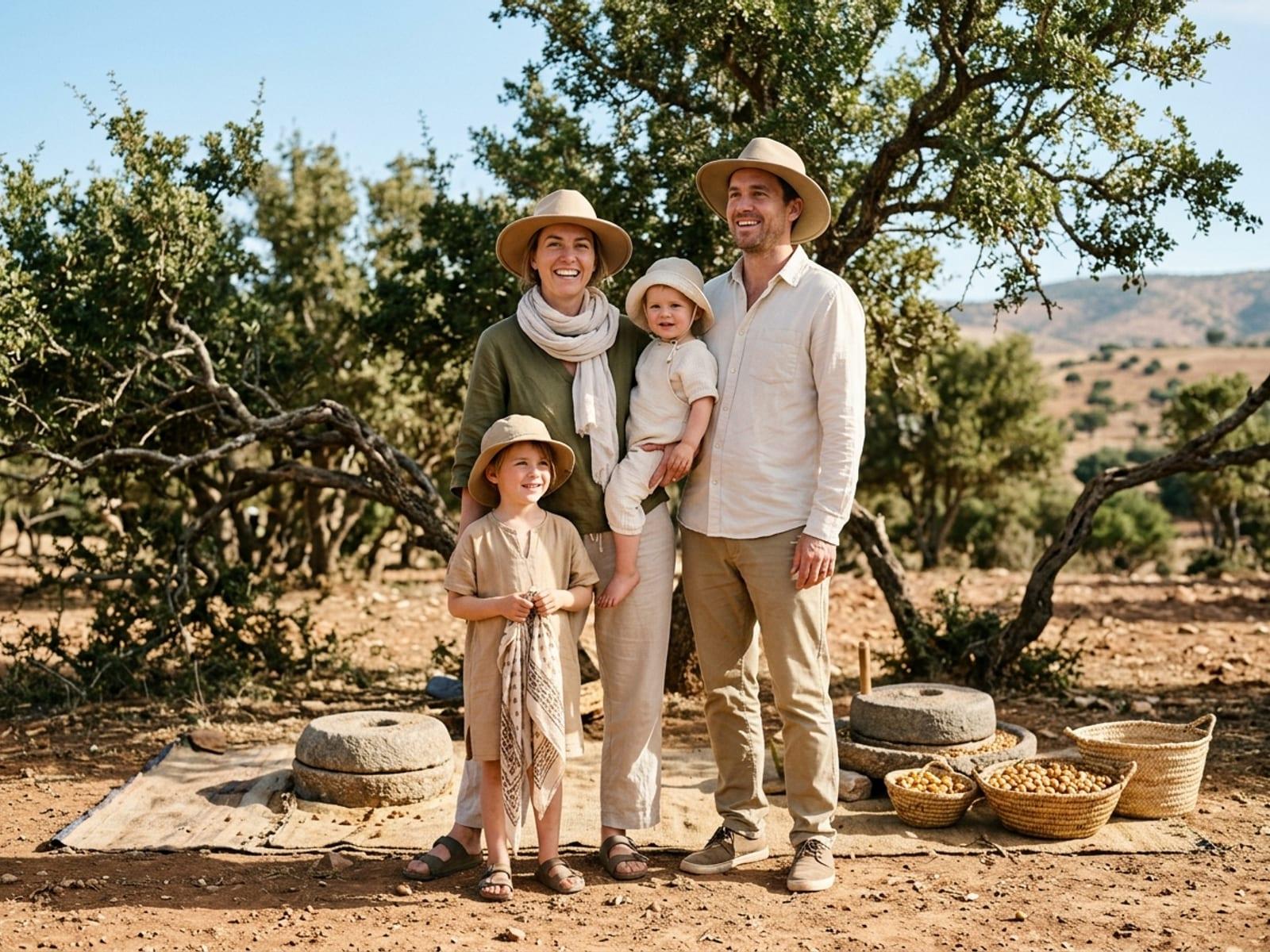
Argan oil is pressed from the kernels of the argan tree, which grows wild almost only in southwestern Morocco, and comes in two kinds: a culinary oil made from roasted kernels and a cosmetic one. About 25 kilometers inland from the Atlantic town of Essaouira, cooperatives and small workshops cluster together, and families can watch the women's handwork, taste the oil and buy it on the spot. There's no set season for visits, but each cooperative has its own hours and rules, so check ahead, and keep nut-based amlou away from children with allergies.
A tree that grows wild in very few places
The argan tree grows wild mainly in the semi-arid regions of southwestern Morocco known as Souss, Chiadma and Haha, with only small populations elsewhere, such as parts of southwestern Algeria. Morocco's argan forest covers about 8,280 square kilometers and is protected as the UNESCO Arganeraie Biosphere Reserve. The trees grow about 8 to 10 meters tall and are said to live around 200 years. In March 2021, the UN General Assembly declared May 10 the International Day of Argania.
The biosphere reserve was designated in 1998. According to UNESCO, it covers about 2.5 million hectares: a broad plain between the High Atlas to the north and the Anti-Atlas to the south, opening onto the Atlantic in the west. More than three million people live within it, herding sheep, growing fruit, and harvesting argan fruit to make oil. Beyond oil, the tree's branches have long been used as firewood for cooking and heating. These drought-resistant forests also support wildlife such as the caracal and the Barbary sheep, a wild sheep with a long mane.
In recent years, climate shifts, such as long droughts followed by heavy rain and floods, have become a concern for the forest. When you walk through it, simply telling your children that "this tree grows naturally only in a very small part of the world, mostly right around here" can change how they see an otherwise ordinary-looking tree.
The fruit takes more than a year from flowering to ripening, maturing in June and July of the following year. In July, the dark, dried fruit falls to the ground. Oil-making starts with gathering and drying it.
Handwork passed down by women
In 2014, the practices and know-how surrounding the argan tree were added to UNESCO's Intangible Cultural Heritage list. UNESCO describes the traditional method as a sequence: harvesting the fruit, drying it, removing the pulp, cracking the shells, sorting, grinding in a stone mill, and then kneading the paste while adding lukewarm water little by little and with precision. The hand-turned stone mills are made by local craftspeople.
Most of this work has been done by rural women. The skills have passed from the "argan women" to their daughters, picked up from an early age by watching and imitating. The oil is used in festive cooking, given as a wedding gift, and used in traditional medicine and cosmetics.
The hard shell inside each fruit usually holds one oil-rich kernel, occasionally two or three. According to Wikipedia, about 40 kg of dried fruit yields roughly one liter of oil. Watch someone crack the shells one by one between two stones and it's easy to see why the oil is expensive. Cooperatives that welcome visitors let you see some of these steps up close. If your child gets the chance to try cracking a shell, stay right beside them so they don't hit their fingers.
Edible oil is pressed from roasted kernels
Argan oil comes in two broad types, culinary and cosmetic. For culinary oil, the kernels are lightly roasted before pressing, which brings out a nutty aroma. People dip bread in it, pour it over salads or drizzle it over a platter of couscous. Its use in cosmetics took off in the early 2000s, and it now goes into creams, shampoos and soaps.
If you're tasting at a cooperative, don't miss amlou. Roasted almonds are ground with argan oil and mixed with honey into a brown paste with a texture rather like peanut butter. It's spread on bread at a Moroccan breakfast of msemen and baghrir, and its sweetness makes it an easy sell for children. Don't give it to children with nut allergies.
Goats in trees, and oil that's too cheap
On the roads to Essaouira and Agadir, you may see the famous sight of goats perched in the branches of argan trees. Goats do sometimes climb the trees to eat the fruit, but Wikipedia points out that the goats posed in trees for tourists have often been placed there by people. Goats climbing the branches can also damage mature trees.
When buying, watch the price. Machine-pressed oil sometimes sells for less than half the price of cooperative oil, and products mixed with cheaper oils such as sunflower oil have turned up on the market. Since 2012, the Moroccan government has spot-checked the purity of exported argan oil. If you buy while traveling, the safest choice is a cooperative where you can see the pressing being done, and check whether the oil is culinary or cosmetic before you choose.
The women who work in cooperatives are also reported to earn modest incomes, so buying directly from a cooperative helps support local livelihoods. Nothing goes to waste: the press cake left after extraction is rich in protein and used as livestock feed. Efforts to protect the forest continue; in 2002 a network of associations for the argan biosphere reserve was formed, and in 2009, 4,300 saplings were planted in Meskala in Essaouira Province.
Using Essaouira as a base
According to Wikipedia, about 300 small producers, centered on cooperatives, are clustered in the area around 25 km inland from Essaouira, and production has spread toward Agadir too. The main international airport is Marrakech Menara (RAK), and from there you travel to Essaouira on the Atlantic coast by car or bus. Essaouira Mogador Airport is 7 to 8 km from town, but its flights vary by season, so check what's operating.
There's no particular season for visiting the oil-making, but whether cooperatives take visitors, and when, varies from one to the next, so check in advance. June and July, when the fruit ripens and falls, bring strong sun, so carry hats and water. You'll be walking on dry ground, so give children long sleeves and sunscreen.
You can also try a family photo among the argan trees with pokesta's AI photos ($1 per photo). If you're there in June, you can time the visit to catch the free stages of the Gnaoua music festival in town. Entry requirements depend on your nationality, so check your own government's official information before you travel.
References