
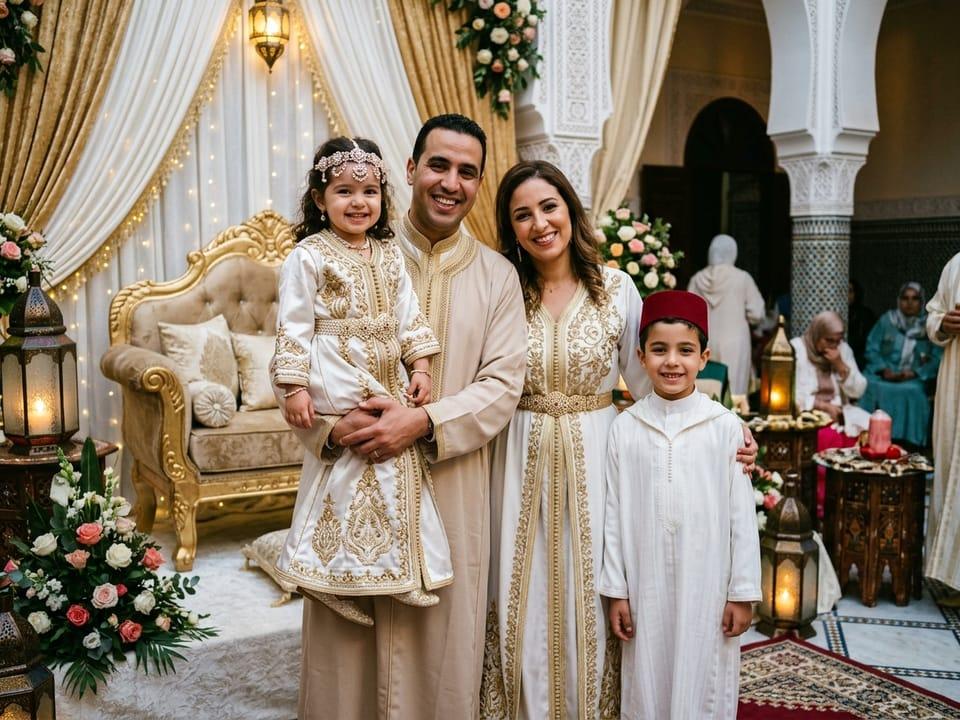
In Morocco, the 27th night of Ramadan belongs partly to the children. A child who has just completed a first full day of fasting is celebrated by the whole family: girls are dressed like little brides and have henna painted on their hands, while boys wear a djellaba and a red tarbouche (fez). The classic photo of the night shows the child seated on an amariya, the decorated litter a bride is carried in.
You can have that photo taken on a studio set or take it yourself at home with the family gathered round. Both have their advantages, and you can combine the two.
What happens on the 27th night
Laylat al-Qadr, the Night of Power, commemorates the night Muslims believe the Quran was first sent down. It falls on one of the odd-numbered nights of the last ten of Ramadan, and the 27th is the most widely observed. In the Islamic calendar the day begins at sunset, so the "27th night" starts after sunset on the 26th day of fasting. Children fast during that day and are celebrated in the evening.
Children who haven't reached puberty aren't required to fast, and in Morocco this is the day many of them try a full fast for the first time. Girls go to a negafa, the woman who dresses and makes up brides, for makeup, fine traditional clothes and gold jewelry. Boys wear a djellaba or a jabador, a red tarbouche with a black tassel and soft leather belgha slippers. Some children ride a decorated horse, with a parent walking alongside, for a commemorative photo.
The fast is broken with dates and harira, the Moroccan soup with chickpeas. After the meal comes mint tea with sellou, a sweet made with flour, almonds and sesame, and then night prayers.
Ramadan 2027 is expected to begin in early February, which puts the 27th night around 5 or 6 March. In Morocco the start of each month is set by sighting committees of the Ministry of Habous and Islamic Affairs, so dates can differ by a day from Saudi Arabia's. Once Ramadan begins, you'll know the exact night.
At a studio: costume and amariya ready to go
Around this time, photo studios set up decorated amariyas, and some run special packages together with a negafa. With costumes, accessories and lighting all in one place, you're sure to come away with the amariya portrait that's hard to recreate at home.
The catch is that every family with the same idea turns up on the same night, and your child has gone all day without food. Long waits rarely end well. Before you book, ask:
- Are children's costumes and accessories included, and do they have your child's size?
- Can parents and siblings be in the photos?
- Is it by appointment, and how long is the wait on the night?
- How many finished photos, in what format, and how soon?
- Can they do makeup or henna, and can you bring your own outfit?
Prices vary from studio to studio, so list what's included and what costs extra before you compare.