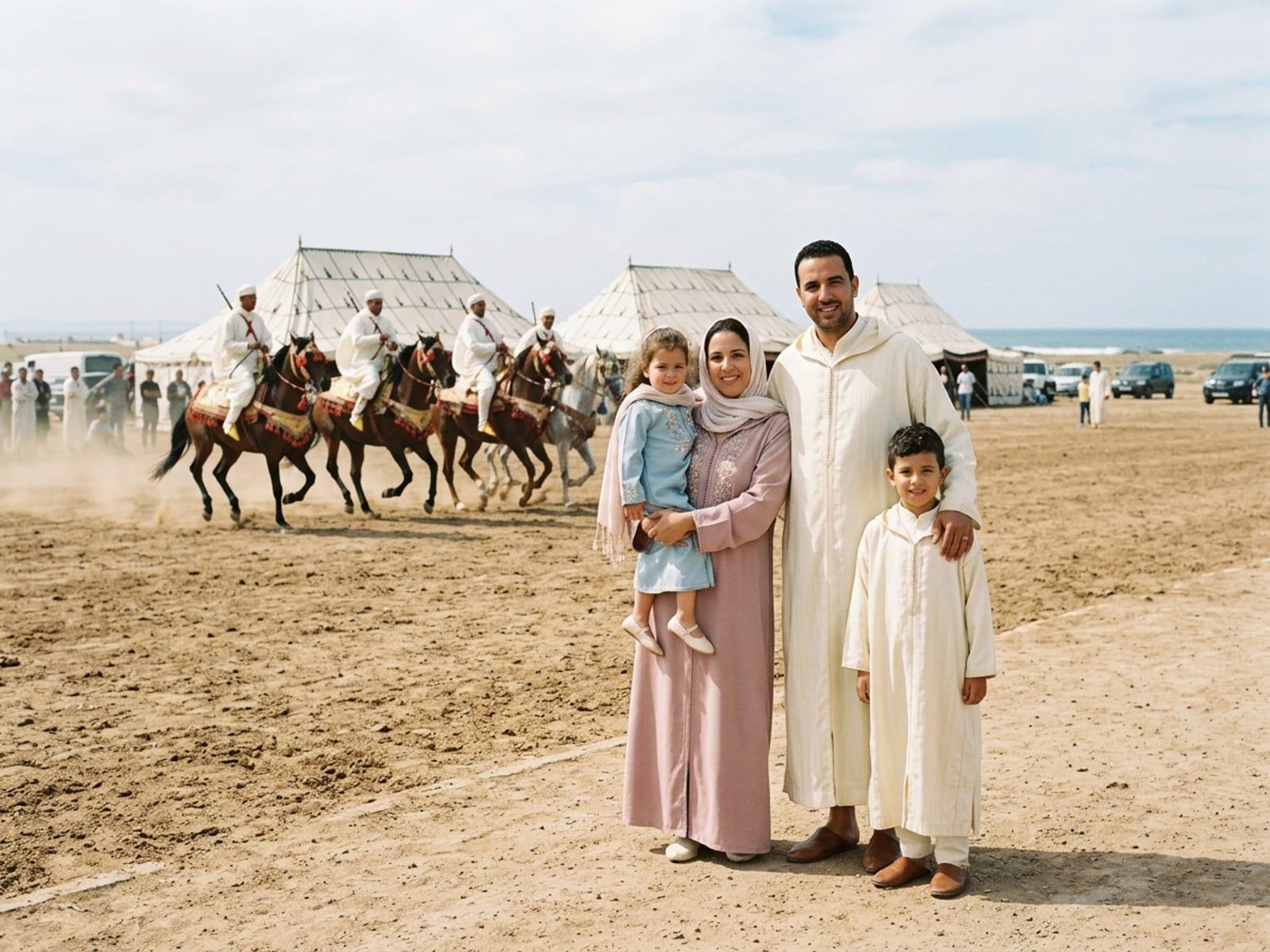
Fifteen to twenty-five riders in white line their horses up side by side, launch into a gallop on a signal, and at the end fire their guns into the air in a single blast. This is tbourida, Morocco's traditional equestrian art, also known as "fantasia." Each August near El Jadida on the Atlantic coast, a moussem (a festival honoring a saint) runs for more than a week, and horse troupes from across the country perform every day.
A summer festival for an 11th-century saint
The moussem takes place in the village of Moulay Abdellah in El Jadida Province. The saint buried here is Abu Abdallah Mohammed Amghar, a Sufi (Islamic mystic) who lived around the 11th century, in the Almoravid era. The order he founded is considered one of the earliest Sufi orders in the Maghreb (northwest Africa). He is the patron saint of Tit, a small village about 12 km from El Jadida.
The moussem blends religious and popular celebration. Its core is pilgrimage to the saint's shrine, Quran recitation and religious talks, with equestrian performances, falconry demonstrations and evening concerts added on. In 2025 it was held under royal patronage from August 8 to 16, and organizers reported a record of about 450,000 participants. Nearly 42,000 tents were put up for visitors, turning the area into something like a tent city. The 2026 moussem ran from August 7 to 15. Dates change from year to year, so, as the Casablanca regional tourism office advises, check the official website for the latest schedule.
Tbourida is about the beauty of the line
Tbourida was inscribed on UNESCO's Intangible Cultural Heritage list in 2021. UNESCO describes it as an equestrian practice dating back to the 16th century that re-enacts a military procession according to ancient Arab and Amazigh (Berber) customs.
Each troupe has 15 to 25 riders and horses, always an odd number, with the leader in the middle of the line. The performance has two parts. In the first, the hadda, the riders enter in formation and greet the audience with ceremonial movements of their rifles. In the second, the talqa, the troupe charges forward on a signal and fires a volley as one while galloping. That single shot represents everyone riding into battle together. From the quiet line-up before the charge, to the drumming hooves, to the simultaneous blast: in one short run, the troupe's whole coordination is on display.
The riders wear turbans and layered robes, with pointed slipper-like shoes. Costumes and customs vary by tribe and region, and the horses carry saddles and harnesses made and decorated using traditional techniques. Many riders perform a purification ritual and pray before riding, and the skills have been passed down within families, learned by watching.
At the 2025 moussem, 130 men's troupes and 3 women's troupes performed; there are troupes made up entirely of women riders. Performances were split across two arenas so that more people could watch.
Falconry and evening concerts
Alongside tbourida, falconry demonstrations are a fixture of this moussem. The Moroccan government's official news site listed falconry, religious events and talks by researchers as part of the 2025 program. A falconer with a bird perched on one arm is impressive in a very different way from the horses, and children get to see a bird of prey up close. Falcons are living animals, though, so agree beforehand that nobody touches them or shouts.
In the evenings, singers of Moroccan popular music take the stage. In 2025 the lineup included the chaabi (popular song) star Abdelaziz Stati and others, as well as an Ahwash troupe performing Amazigh group dance. That year the music stage was moved from the center of the site to near the main entrance to ease crowding. If you want to stay for the evening shows, have the kids nap back at your accommodation at midday and return in the late afternoon.
For a family, a sensible day might look like this: walk around the saint's shrine and the tent city in the morning, rest at your accommodation through the hottest part of the afternoon, then watch tbourida when it cools off toward evening. The schedule of performances changes daily, so confirm it on site.
Gunfire and dust: preparing children
Up close, the tbourida volley is very loud. Bring ear defenders for small children, and if your child is easily startled, start by watching from farther away. Many kids are fine once they know what's coming, so it can help to tell them before each charge: "There'll be a big bang at the end."
The horses come in at full gallop. Watch from the spectator areas or behind the barriers, and hold your children's hands so they don't dash forward. Each run kicks up dust, so keep cameras and phones in a bag, and sunglasses help children with sensitive eyes.
August in Morocco is hot, with strong sun. Bring hats and water, and avoid watching during the hottest hours, taking breaks as you go. The grounds get extremely crowded, so pick a meeting point in case anyone gets lost, in front of a recognizable tent or gate.
A moussem is also a religious festival. Around the shrine, keep skin covered, and don't point your camera at people who are praying. Photographing riders and horses is normal, but ask before taking close-up shots of individuals.
White clothes to match the riders
There's no dress code for spectators, but white and cream clothes soften the summer sun and match the white-robed riders. A white djellaba (long hooded robe) for boys and a pale embroidered kaftan for girls bring a local feel to festival photos. Wear sneakers that can handle sand, and keep babouche slippers for resting in the tents.
You can also try a family photo in front of a line of white-robed riders with pokesta's AI photos ($1 per photo).
South along the coast from Casablanca
The nearest major international airport is Mohammed V International Airport (CMN) in Casablanca. If you take a breather there on arrival, you could have a seafood lunch at Casablanca's 1917 Central Market before heading south. El Jadida is a port town 96 km south of Casablanca, and the village of Moulay Abdellah, where the moussem is held, is nearby. Staying in El Jadida during the festival and traveling to the grounds each day makes it easier to give children a rest.
El Jadida's old town was once the Portuguese fortified city of Mazagan, and it was listed as a UNESCO World Heritage Site in 2004. The cistern beneath the fortress is a strange, beautiful space where the columns and ceiling reflect in a thin layer of water on the floor; Orson Welles used it in his film Othello. It's a good place to spend the hottest part of the day.
Farther south is Oualidia, a lagoon town known for oyster farming. Entry requirements depend on your nationality, so check your own government's official information before you travel.
References