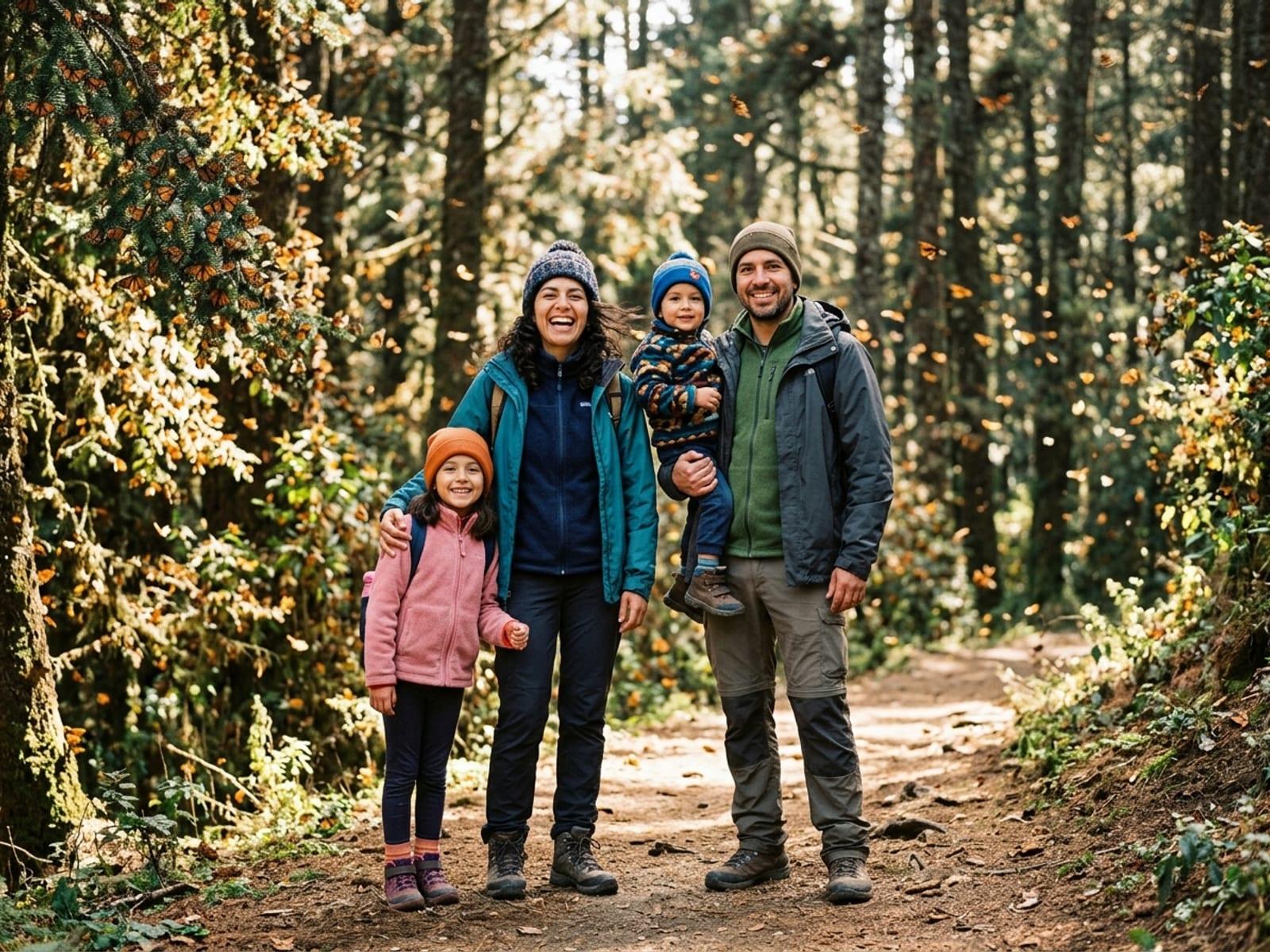
Monarch butterflies (mariposa monarca in Spanish) from North America spend the winter in high fir forests about 100 km northwest of Mexico City, straddling the states of Michoacán and México, and the reserve was inscribed as a World Heritage Site in 2008. The sanctuaries are generally open from mid-November to the end of March, and at places such as El Rosario you walk a mountain trail with a local guide to reach the colonies. It's cold up there, at roughly 2,400 to 3,600 meters, so with children bring layers and a baby carrier, and stay overnight in a nearby town so you can go in the morning.
In a high-altitude fir forest, the trunks and branches are thickly coated in something orange. Step closer and you see it's all butterflies, wings folded. When the sun comes out and the forest warms, they lift off together and stream overhead.
A winter home for butterflies that travel across generations
In autumn, monarchs leave North America and fly south through Texas, then follow the Sierra Madre Oriental, the mountain range along Mexico's east, to reach these forests. Over the course of the migration, four generations of butterflies are born and die. The monarchs that arrive each year are a different generation from those that wintered here the year before. They head for a place they have never been, and still return to the same forests.
The reserve covers about 56,000 hectares of mountains straddling the states of Michoacán and México, about 100 km northwest of Mexico City. The butterflies cluster in forests of a fir called oyamel. These forests create a particular microclimate that lets the butterflies shelter when temperatures drop below freezing or winter rain falls. The butterflies gather on the trees in layer upon layer, until the branches bend under them. Clustering is thought to help them hold in heat, and they fly once the sun has warmed their bodies.
Scientists learned of these forests as a wintering ground in 1975. Where the butterflies gather, an estimated 6 million to 60 million crowd into each hectare.
The numbers swing widely from year to year. An estimated 1.1 billion monarchs wintered here in 1996; by the winter of 2013–14 that had fallen to about 33 million. In 2020 the count recovered to about 105 million, and in the winter of 2024–25 the area of forest covered by colonies reached 1.79 hectares, nearly double the previous winter. Illegal logging, forest fires and unmanaged tourism are cited as threats to the forest.
Choosing a sanctuary
Several sanctuaries are open to visitors. In Michoacán there are El Rosario in Ocampo, Sierra Chincua in Angangueo, and Senguio. On the State of México side are Piedra Herrada and La Mesa, among others. El Rosario is the largest sanctuary in Michoacán, where butterflies are said to cover some 1,500 trees.
At El Rosario you climb a mountain trail of about 2 km to reach the butterflies. The path runs through forest of fir, pine and cedar-like trees, and Mexican snacks are sold around the entrance. You can't take food into the forest, so eat before you go in or after you come out. Sierra Chincua has three lookouts over cliffs and streams, and La Mesa has bike paths and lookouts. At these two sanctuaries, guided horseback rides can take you part of the way, which helps people who aren't confident of their stamina and small children. You'll still have to walk a stretch after dismounting, though, and some horse trails have reportedly been closed to prevent soil erosion. Don't assume a horse means no walking; confirm on site. Piedra Herrada lies above 3,000 meters and involves about 40 minutes of uphill walking. At every sanctuary, local people work as guides, and you follow their instructions.
According to press reports, the 2024–25 season ran from November 15 to March 31, with the sanctuaries open from 8 a.m. to 5 p.m. Opening dates, hours and entrance fees vary by year and by sanctuary, so check the latest information from CONANP, Mexico's National Commission of Natural Protected Areas, or the state tourism boards before you go.
Near the butterflies, stay quiet and don't touch
CONANP sets out rules for visitors to the reserve. Stay on marked trails. Follow your guide's instructions. Don't bring food, alcohol, knives or pets. Don't take plants, animals, mushrooms or anything else from the forest. And near the butterflies, keep quiet, don't use flash, and never touch or take a butterfly. Visitors may stay at the viewing area for up to 18 minutes, and are asked not to use hand sanitizer gel near the colonies.
For children, the hardest part is probably staying quiet. Before you set off, explain that you'll speak softly so the butterflies don't get startled and waste their energy, and that you'll watch your feet because there may be butterflies on the ground too. As it happens, 18 minutes is about as long as a child can watch something with full attention.
Prepare for altitude and cold
The reserve is high in the mountains; the oyamel fir forests grow at roughly 2,400 to 3,600 meters. You'll get out of breath easily, so young children and anyone with health concerns should walk at a comfortable pace. Mornings and evenings are especially cold, so wear layers, a warm jacket that can handle rain, and sneakers you don't mind getting dirty. The butterflies are most active once the sun is out and the forest has warmed up.
The mountain trails are bare earth and turn muddy after rain. Assume a stroller won't work and carry children who can't walk yet in a baby carrier. A day trip from Mexico City and back means a long time on the road, so with small children it's easier to stay in a nearby town the night before, let everyone adjust to the altitude, and set out in the morning. If anyone feels unwell, the adults should make the call to turn back early.
With no flash and only 18 minutes at the colonies, a carefully composed family photo among the butterflies is hard to get; pokesta's AI photos ($1 per photo, and your first one is free) are one way to make one.
When to go and how to get there
The butterflies are in the forests roughly from October to March, and the sanctuaries are generally open from mid-November to the end of March. The gateway is Mexico City International Airport (MEX). The reserve lies in the mountains about 100 km northwest of Mexico City, and the nearest city is Zitácuaro. Staying in Angangueo or Ocampo lets you enter a sanctuary in the morning. If you're in Mexico in early November, you can plan the trip around the Day of the Dead, which falls in the same season. In early February, your visit lines up with Candelaria on February 2, celebrated with tamales and atole in Mexico City. Entry requirements for Mexico depend on your nationality, so check your own government's official information before you travel.
References