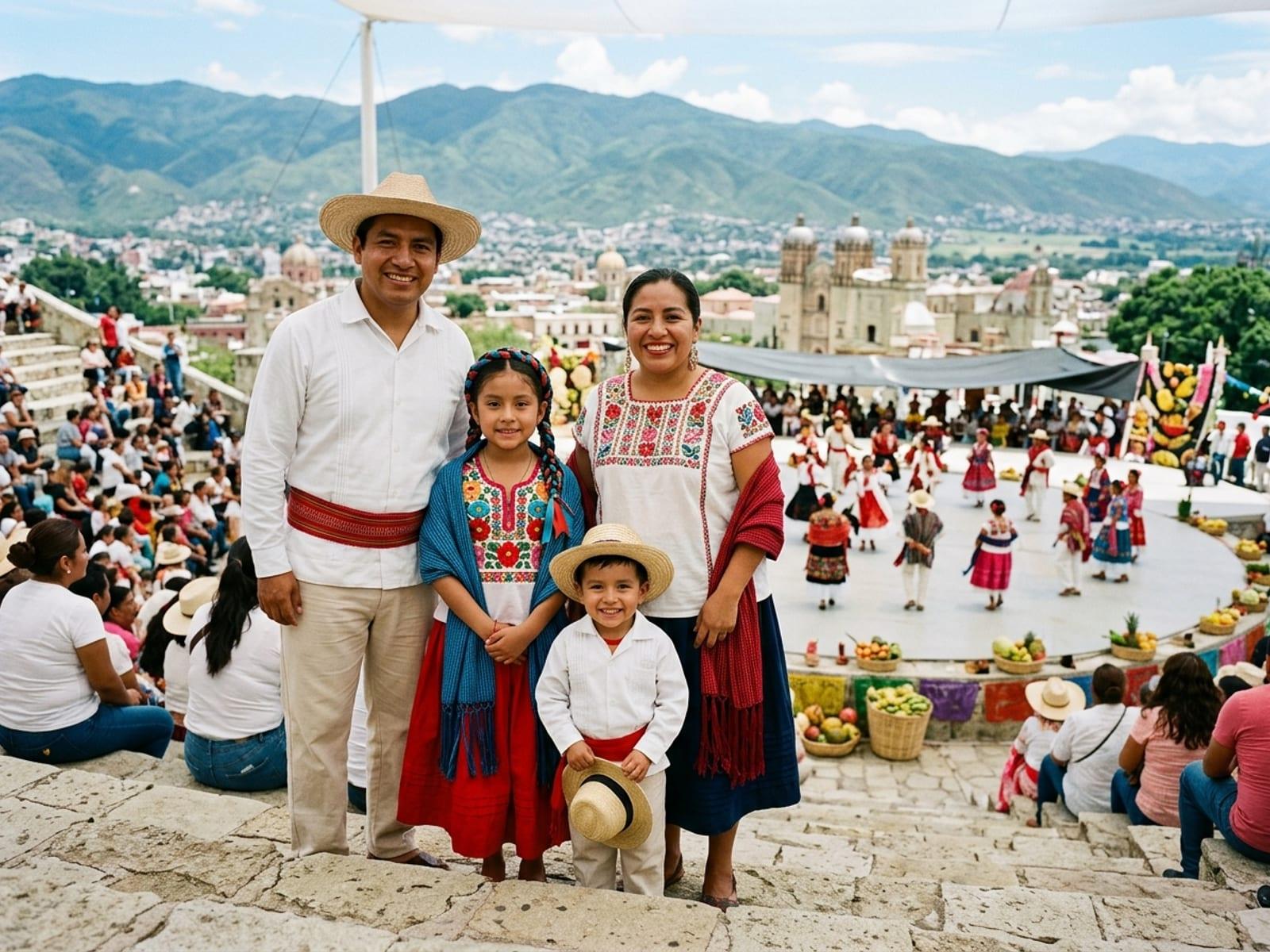
On two Mondays every July, dancers from the eight regions of the state of Oaxaca, in southern Mexico, perform in an open-air amphitheater on a hill above Oaxaca city. This is the Guelaguetza. Costumes and music change completely from one region to the next, so a single performance feels a bit like a tour of the whole state. Some seats are paid and some are free, and the free ones mean getting up very early.
The name is about sharing gifts
The word guelaguetza comes from Zapotec, the language of one of Oaxaca's Indigenous peoples, and is usually explained as "gift," "sharing," or the custom of giving each other gifts and help. You can see that idea on stage: when a regional delegation finishes its dance, its members toss local produce into the audience.
The festival's roots go back before the Spanish arrived. It is thought to have grown out of rites honoring Centeotl, the maize deity, and praying for a good harvest. In colonial times the Church promoted the feast of Our Lady of Mount Carmel on July 16, and people started climbing the hill on the Monday that followed. That is why the festival is also called the Lunes del Cerro, or "Mondays on the Hill."
In the 20th century, after a major earthquake damaged the city, it was reorganized as a festival for the whole state. The 1932 Homenaje Racial, held to mark 400 years since Oaxaca was granted the status of a city, is considered the start of its present form. Since 1969 the rule has been to hold it on the two Mondays after July 16. If the first Monday falls on July 18, the anniversary of Benito Juárez's death, it moves back a week, to July 25 and August 1.
Eight regions take the hillside stage
The venue is the Auditorio Guelaguetza, an open-air amphitheater built into the slope of the Cerro del Fortín and completed in 2010. In 2026 the performances fell on July 20 and 27, with two shows each day, at 10 a.m. and 5 p.m.
The delegations come from regions such as the Central Valleys, the Mixteca, the Cañada, Tuxtepec, the Coast, the Sierra and the Isthmus of Tehuantepec. One of the crowd favorites is the Flor de Piña, or "pineapple flower," danced by women from Tuxtepec in embroidered huipiles with pineapples balanced on their shoulders. The Danza de la Pluma, the Feather Dance, in which men wear huge feathered headdresses, appears almost every year too.
During the festival weeks, processions called convites wind through the old town. In 2026 they ran alongside a mezcal fair and events built around mole, the rich sauces made with chocolate and chiles. Oaxaca's moles, in black, yellow, red and more, are served at market food stalls even outside festival time. Even without a seat on the hill, you can soak up plenty of the festival in the streets.
Paid seats in A and B, free seats in C and D
The amphitheater is split into sections. In 2026, Palcos A and B, the ones closest to the stage, were paid and went on sale on June 1 through the official ticket site, Superboletos. Palcos C and D were free and filled up first come, first served. Prices and how tickets are sold change from year to year, so check the announcements from the Oaxaca state government.
Lots of people line up for the free sections, locals included. Going for a free seat with a small child can mean a long wait in the sun, so with kids it is more realistic to book paid seats early. The performances are also broadcast on TV and online, so another option is to watch from your hotel and then go out to see the convites in town.
The costumes are clothes people still wear
Every costume on stage is clothing that people in that village or town still wear for festivals and ceremonies. The Tehuana outfit of the Isthmus women is a blouse and long skirt covered in large embroidered flowers. The huipil, a loose tunic-style blouse, worn by the Tuxtepec dancers is known for its bright embroidery. Each piece carries meanings that belong to its place.
There's no dress code for the audience. Oaxaca's markets sell embroidered blouses and dresses, plus the shawls called rebozos, and buying one along the way to wear to the show is part of the fun. It's best, though, not to copy strongly ceremonial items such as the dancers' feather headdresses. If the family wears embroidered clothes, the photos you look back on later will feel unmistakably like Oaxaca.
Bring hats and water for the kids
The amphitheater sits on a hillside with stepped seating. A baby carrier is easier than a stroller, and sun hats, water, a light jacket and rain gear are worth bringing. Delegation follows delegation, so the show runs long; pack snacks and a small toy for when little ones lose interest.
Let your children's routine decide between the morning and evening shows. For the 10 a.m. show, have a good breakfast first and you can be back at your hotel to rest by early afternoon. The 5 p.m. show avoids the midday heat, but it ends after dark, when the path down the hill and the traffic home are both crowded. For kids who get sleepy early, the morning show is the better fit.
Before the trip, try watching videos of past performances together. Just saying "there'll be dancers carrying pineapples" gives children something to look forward to during a long show. Each region dances in a set order, so following the program or the announcements to see which region is on stage makes it easier to notice how the costumes differ.
If you get close to dancers during a convite in town, ask before taking a photo, with a word or a gesture. Many costumes are treasured and handed down in families and villages, so avoid walking up and shooting without asking.
Produce is sometimes handed out to the audience. If something comes your way, a smile and a thank-you is all that's needed; in the spirit of the festival's name, enjoy the sharing itself. You can also see what your family might look like in the seats on this hill with pokesta's AI-generated photos ($1 per photo, and your first one is free).
2027 dates and getting there
July 16, 2027 is a Friday, so under the usual rule the performances would be on July 19 and 26. Wait for the Oaxaca state government's announcement to confirm the official dates and when tickets go on sale.
The gateway airport is Oaxaca International Airport (OAX). The historic center of Oaxaca and the nearby archaeological site of Monte Albán were added to UNESCO's World Heritage list in 1987, so you can fit the ruins in before or after the festival. Since the shows are on Mondays, one easy plan with kids is to arrive the weekend before for the convites and mole events, go up the hill on Monday, and visit the ruins from Tuesday on, adjusting as energy allows. Hotels fill up during the festival, so book soon after the dates are announced. Oaxaca also has the Night of the Radishes at the end of the year and Día de Muertos in autumn. Entry requirements for Mexico vary by nationality, so check your own government's official information before you travel.
References