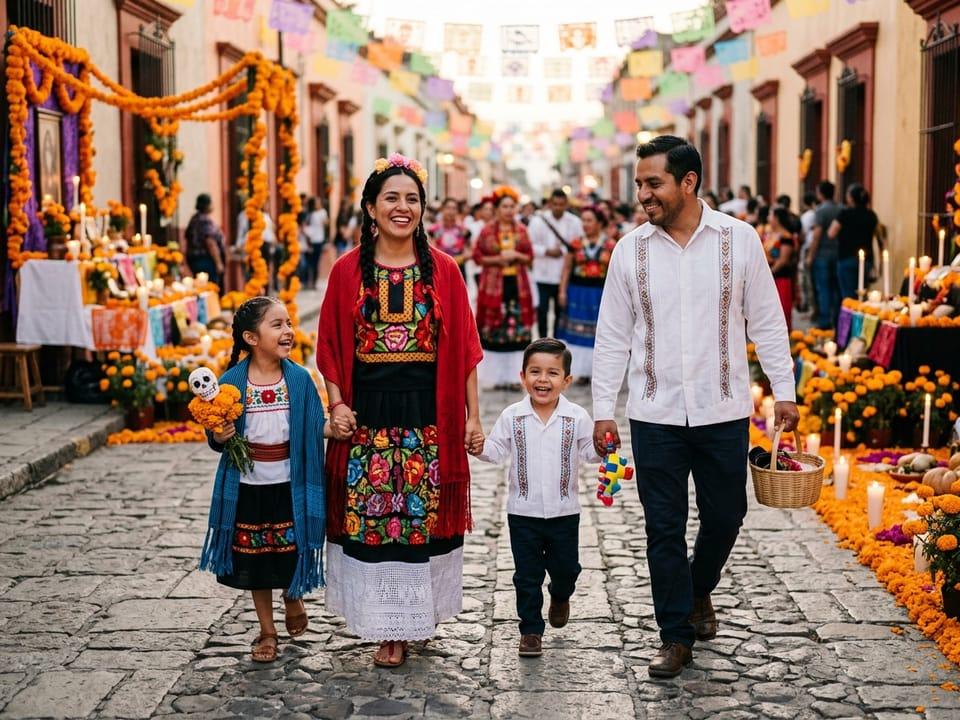
Día de Muertos is a family occasion first. Children's souls are usually welcomed on November 1 and adults' on November 2; in 2027 those fall on a Monday and a Tuesday. For photos, that means two sessions: daylight while the ofrenda is being built, for hands laying petals and a shot of the finished altar, then the evening of November 1 or 2 for one picture of the family beside the candlelit altar.
October 28 to November 2: each day welcomes someone different
According to Mexico's Secretariat of Agriculture and Rural Development, souls are believed to start arriving on October 28, a day for offerings to people who died suddenly, through accidents or violence. October 30 and 31 are for children who died before they were baptized. November 1, All Saints' Day, belongs to children, the "muertos chiquitos," and November 2, the Day of the Dead proper, to adults. On the 2027 calendar that's Thursday the 28th, Saturday the 30th, Sunday the 31st, Monday the 1st and Tuesday the 2nd, so the weekend falls on the 30th and 31st and the two main days are weekdays. If you want the altar finished over the weekend, daylight on the 30th is the calmest time to photograph it. Practice varies by town and by family, and in some places the observance runs as late as November 6. If a grandparent has always done it a certain way, follow their lead.
The dates line up with the Catholic feasts of All Saints and All Souls, and historians still debate how much of the custom predates the Spanish. When UNESCO inscribed the "Indigenous festivity dedicated to the dead" on its intangible heritage list in 2008, it described families laying flower petals, candles and offerings along the path from the cemetery to their homes to guide the souls back, and cleaning and decorating the graves.
The ofrenda's levels, and what the flowers, bread and paper mean
The ofrenda is a home altar for the family's dead, and every element on it means something. The agriculture ministry describes the candles as the light that guides the souls and gives them peace and hope. Water quenches their thirst, salt keeps the visiting spirit from getting lost or corrupted, and incense purifies the space.
The orange marigold, cempasúchil, takes its name from the Nahuatl cempōhualxōchitl, "twenty flowers," and its scent and color are believed to lead souls to the altar. Pan de muerto is a sweet, sugar-topped bread whose shape, the ministry says, represents the cycle of life and death. Papel picado, the cut-paper banners, adds color but also stands for air, one of the four elements every ofrenda should include.
Around them go skulls made of sugar, chocolate or amaranth, and the person's favorite foods and drinks. Toys are left for children who have died, los angelitos, "the little angels." Tamales are among the most common dishes of the day, made both for the altar and for the family table, and warm corn atole is a seasonal staple too. Photos of the people being remembered are, in the ministry's words, the most moving and important detail.
There's no fixed number of levels, either. Citing ISSSTE, the social security institute for Mexico's government workers, the news channel ADN40 reports that ofrendas can have two, three or seven levels: two stand for heaven and earth, three add the underworld, and seven represent the places the soul must pass through to reach rest. The shape of the altar and the number of levels, ISSSTE adds, change with the place where it's made.
Shoot while you build, then once by candlelight
Some of the best photos come before the candles are lit: children laying a path of cempasúchil petals, a grandmother setting down the pan de muerto, someone arranging photos of great-grandparents. Shoot these in daylight near a window. Get down to a child's eye level and include hands; a close-up of hands placing something can say more than a face. When the altar is done, take one wide shot and a few close-ups of each level. Next October, they'll show you exactly how it was set.
For the candlelit family photo, turn off the flash and the overhead light, brace the phone on a table and use night mode. Stand beside the altar rather than in front of it, so the flowers and photos stay visible and the candles light one side of everyone's face. Candles, papel picado and dry marigolds all catch fire easily, so keep flames away from paper decorations and children's clothes, and never leave candles burning in an empty room. LED candles are a safe stand-in when small children are in the picture.
Before you post, think about the photos on the altar. They're of real people, sometimes recently lost. Ask the relatives closest to them whether they're comfortable with the ofrenda being shared online.
Keep the Catrina off the altar
La Catrina, the elegant skeleton lady drawn by the printmaker José Guadalupe Posada, was later painted as a full-length figure by the muralist Diego Rivera in a 1946–47 fresco. She has since become an icon of Mexican culture and plays a big part in today's celebrations; plenty of people dress as Catrinas and Catrines.
For a family photo, outfits can carry the theme without face paint: embroidered blouses with rebozos, a huipil, black with marigold-orange accents, a crown of cempasúchil. If children do wear face paint, use products made for skin, test a small patch first and take the photos early in the evening before it smudges.
Humor is part of the season; calaveras literarias, the rhyming mock epitaphs, poke fun at the living and the dead alike. Still, the ofrenda belongs to the family. Keep costumes and props off the altar and leave it for the offerings.
In Yucatán, October 31 is for children: altars change by region
What goes on the altar, and how it's dressed, varies a lot from region to region. In the same ADN40 piece, an anthropologist at the National Autonomous University of Mexico (UNAM) says the first regional difference shows in the offerings: Oaxaca can't do without tamales wrapped in banana leaves, Yucatán has cochinita pibil, a pork dish, and in Michoacán the decorations in the cemeteries stand out. Even in Mexico City, the boroughs of Xochimilco, Tláhuac and Milpa Alta keep the most traditional forms. A roundup by the news site N+, drawing on Mexico's National Institute of Indigenous Peoples (INPI), notes that Zapotec families in Teotitlán del Valle, Oaxaca, offer bread, chocolate, fruit and flowers to the muertos chiquitos and dishes such as mole, tamales and mezcal to adults, while Purépecha families in Jarácuaro, Michoacán, put up a floral arch at the cemetery.
On the Yucatán Peninsula the season is called Janal Pixan, Maya for "food for the souls": October 31 is for children, November 1 for adults and November 2 for all souls. The centerpiece of the altar is mucbipollo, a corn-dough pie baked in a pit in the ground, and the tablecloth is colorful for a child's altar and white or gray for an adult's. In the Huasteca, which spans parts of Hidalgo, Veracruz, Tamaulipas, Querétaro and San Luis Potosí, the celebration is called Xantolo and usually runs from October 30 to November 2, with troupes of dancers in skull and devil masks performing to son huasteco music.
If your grandparents come from another region, photograph an altar dressed their way, in daylight, so the food and the color of the cloth show. The picture keeps a record of where the family comes from.
Cemeteries, and the parade on Reforma
Cemeteries on these days are full of families at their own graves. Photograph your family's grave freely, but ask before photographing anyone else's, and don't use a flash near people who are praying or keeping vigil. In San Andrés Mixquic, in Mexico City's Tláhuac borough, the cemetery goes dark on the night of November 2 for La Alumbrada, when candles are lit on the graves. In Mixquic, and in Pátzcuaro and Janitzio in Michoacán, families spend the whole night beside the graves.
Mexico City's big parade began in 2016. Its tenth edition, on Saturday, October 31, 2026, set off at 2 p.m. from the Diana the Huntress roundabout on Paseo de la Reforma and finished in the Zócalo; city authorities put the turnout at 1.6 million. That year a monumental ofrenda also stood in the Zócalo from October 29 to November 2. For 2027, wait for the dates on the city's official tourism site. For how the parade began, tips for watching with children and Oaxaca cemetery etiquette, see our Day of the Dead travel guide.
When in doubt, shoot at home before the candles go on
For most families, home is the place: the altar is there, and so are the people. A studio with marigolds and a painted backdrop suits families who want a Catrina portrait with professional makeup. A parade or public altar has atmosphere but gives you little control.
If relatives in another city or country can't make it this year, pokesta can create an AI family photo beside an ofrenda or on a marigold-lined street from each person's own phone photos. Your first image after signing up is free, and after that it's $1 per photo.
If you do only one thing, photograph the finished ofrenda in daylight before the candles are lit. Next year's altar starts with this year's photos.
References
- Indigenous festivity dedicated to the dead (UNESCO)
- Día de Muertos, la fiesta más emotiva de México (Secretaría de Agricultura y Desarrollo Rural, in Spanish)
- El origen del Día de Muertos (INAH, in Spanish)
- José Guadalupe Posada, referente visual del imaginario mexicano (Secretaría de Cultura, in Spanish)
- Día de muertos 2026 en la Ciudad de México (Mexico City official tourism site, in Spanish)
- Day of the Dead (Wikipedia)
- Los niveles de la ofrenda de Día de Muertos: qué significa cada uno y por qué no todos los altares tienen los mismos (ADN40, October 18, 2026, in Spanish)
- 11 Tipos de Ofrendas por Día de Muertos 2026 (N+, October 21, 2026, in Spanish)
- Janal Pixan (Wikipedia, in Spanish)
- Xantolo (Wikipedia, in Spanish)
- Gran desfile de Día de Muertos deleita a más de un millón y medio de personas (Excélsior, October 31, 2026, in Spanish)