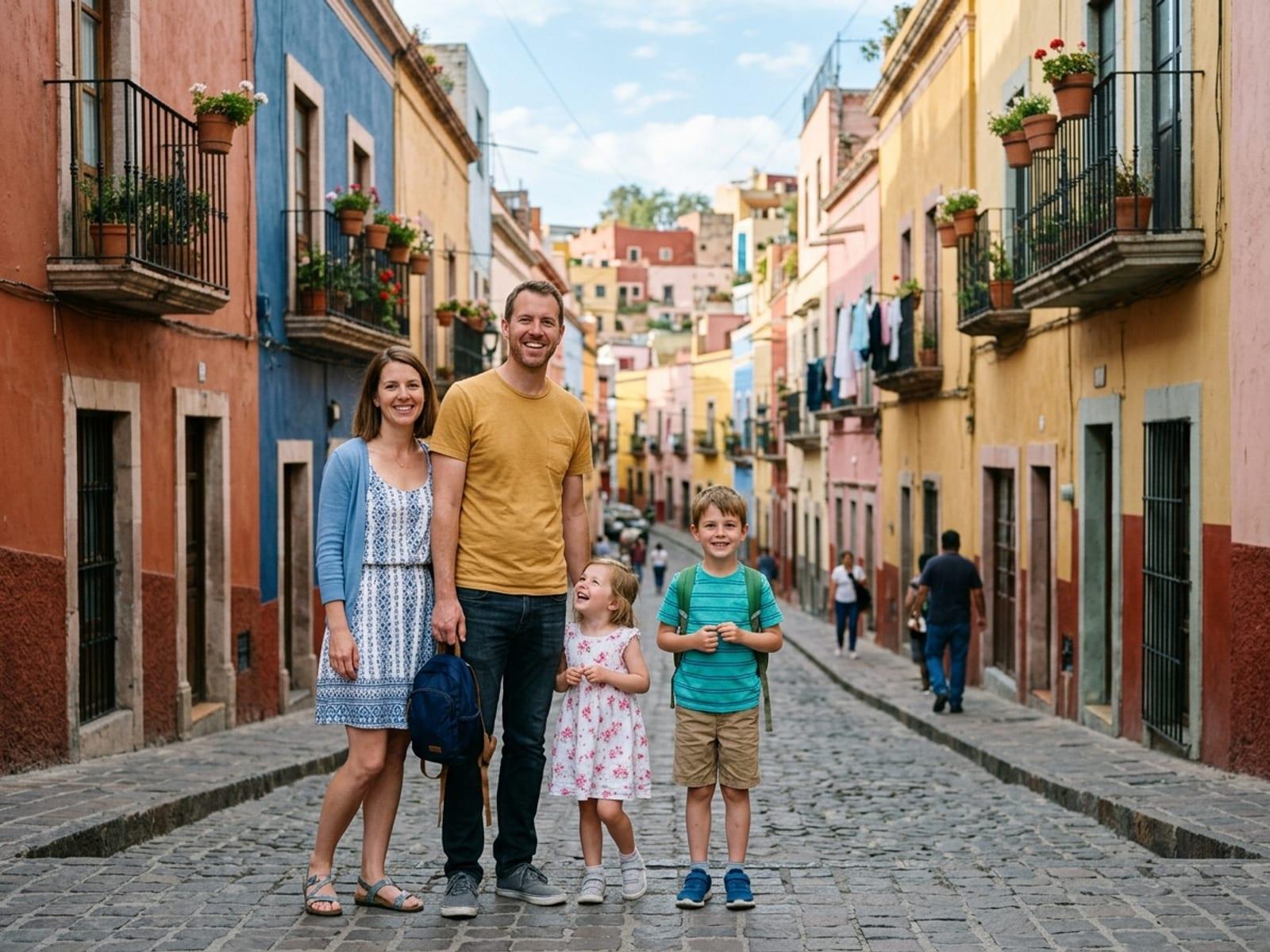
Guanajuato is a silver-mining town in central Mexico whose colorful houses fill a narrow valley, inscribed in 1988 as a World Heritage Site, the "Historic Town of Guanajuato and Adjacent Mines." The Callejón del Beso, the funicular up to the El Pípila lookout and the roads that run underground are the highlights, and you can visit any time of year. Children can walk the center, but at about 2,045 meters the slopes and stairs add up, so ride the funicular up, walk down, and bring a baby carrier for little ones.
Yellow, pink, sky-blue and orange houses are stacked like building blocks on both sides of the valley. The town grew rich on silver in the 18th century, and its car traffic has been sent into tunnels beneath the streets, leaving a web of slopes and alleys above ground for people on foot.
A silver town with roads underground
The town was formally established as a mining settlement in 1548 by the Spanish viceroy Antonio de Mendoza. The La Valenciana mine began operating in 1774 and at its peak is said to have produced about two-thirds of the world's silver. That wealth filled the valley with churches, theaters and grand mansions. The mine still operates today on a smaller scale. Near its entrance stands the Church of La Valenciana (Church of San Cayetano), built between 1765 and 1788 by the first Count of Valenciana and lined with gilded altarpieces. In town, some mines are open to visitors, such as the Bocamina de San Ramón, where you can walk down an old mine shaft. It's a way to show children, with their own eyes, how a silver town came to be. Farther south, Taxco took its silver in a different direction and became a town of silversmiths, and seeing both tells the story of Mexican silver well.
The first surprise of walking here is the roads running underground. Several of the main roads through central Guanajuato pass through old tunnels. They were originally built between the colonial era and the early 19th century to divert the Guanajuato River, which flowed through town, and to prevent floods. Once the river had been rerouted, the tunnels were turned into roads for cars. Watching buses and cars pass under stone arches feels like a small adventure for kids. These are roadways, though, so hold children's hands firmly whenever you walk through a tunnel.
The town sits at about 2,045 meters. Climb a hill and you'll be out of breath almost at once. Take it easy on your first day and give your body time to adjust to the altitude.
The Alley of the Kiss and the Pípila lookout
The best-known alley is the Callejón del Beso, the Alley of the Kiss. At its narrowest it is only 168 cm wide, and balconies on opposite houses nearly touch. Legend has it that a couple who kiss on the third step, painted red, are promised seven years of happiness. If you visit with children, have them stretch their arms toward both walls and feel just how narrow it is.
For a view over town, head to the lookout at the Pípila monument on San Miguel hill. Guanajuato state's tourism board points out that the old red funicular from behind the Teatro Juárez makes the climb easy. Pípila is a hero of the 1810 War of Independence, a miner who joined Miguel Hidalgo's army and is said to have set fire to the door of the Alhóndiga de Granaditas. From the lookout you can take in the whole colorful town. On the way back you can walk down the San Miguel slope, painted with murals by local artists, to the center. Ride up and walk down, and the kids' legs will last.
One theory holds that the town's name means "hill of frogs" in Purépecha, an Indigenous language. It's said to lack firm evidence, but looking for a frog-shaped hill with the kids on the way up makes a small game of the walk.
The square by the theater and the student minstrels
The heart of town is the Jardín de la Unión, a triangular plaza in front of the Church of San Diego. Benches and a bandstand sit in the shade of trees clipped into rounded shapes, and student musical groups often play here. Right next door, the Teatro Juárez is a neoclassical theater built between 1872 and 1903, which opened with Verdi's "Aida." A short walk away is the main building of the University of Guanajuato, made of green stone, with a grand staircase of 113 steps leading down to the students' alleys. Its ground floor houses the university's natural history museum.
For lunch or a break, the Mercado Hidalgo, opened in 1910 to mark the centenary of independence, is handy. The building has a four-faced clock tower, with food and household goods on the ground floor and crafts and souvenirs on the upper floor.
At night the callejoneadas begin: student minstrel groups lead visitors through the alleys, singing as they go. The tradition belongs to students of the University of Guanajuato, but it's also run as an event for visitors. It's mostly songs and jokes, so you'll get the atmosphere without understanding the language, but it can go on late and involves a lot of walking uphill, so decide whether to join based on your children's ages.
Decide on the Mummy Museum by your child's age
Guanajuato has the Mummy Museum, which displays bodies that mummified naturally and were found in the municipal cemetery. The collection holds 111 mummies, 59 of them on display. It's one of the town's well-known sights, but it has been pointed out that it can be a real shock for young children. The adults should decide beforehand whether the whole family goes, based on each child's age and temperament. If you're unsure, take turns going in while the other adult stays out with the kids, or choose somewhere else.
One alternative is the Alhóndiga de Granaditas, the building where the first battle of the War of Independence took place on September 28, 1810. It is now the Regional Museum of Guanajuato. The house where the painter Diego Rivera was born and spent his early childhood is also open as a museum. For kids who like picture-book displays, try the Museo Iconográfico del Quijote, opened in 1987. There you can compare how many different artists, from José Guadalupe Posada to Salvador Dalí, pictured the gaunt knight and his squire Sancho Panza.
Almost any bend in these colorful slopes works as a backdrop. Before the trip, you could make a family shot there with pokesta's AI photos ($1 per photo, and your first one is free).
When to go and how to get there
You can visit Guanajuato any time of year. In October, the Festival Internacional Cervantino, an arts festival that grew out of short student plays in 1972, fills about 70 venues around town and draws big crowds. If you'd rather walk the streets in peace, avoiding that time is worth considering. In spring, you could pair the town with the Feria de San Marcos, held from April into May in Aguascalientes, another city in central Mexico. The gateway is Bajío International Airport (BJX), between León and Silao. The town is full of hills and stairs, which makes strollers hard to use, so bring a baby carrier for little ones. Entry requirements for Mexico depend on your nationality, so check your own government's official information before you travel.
References