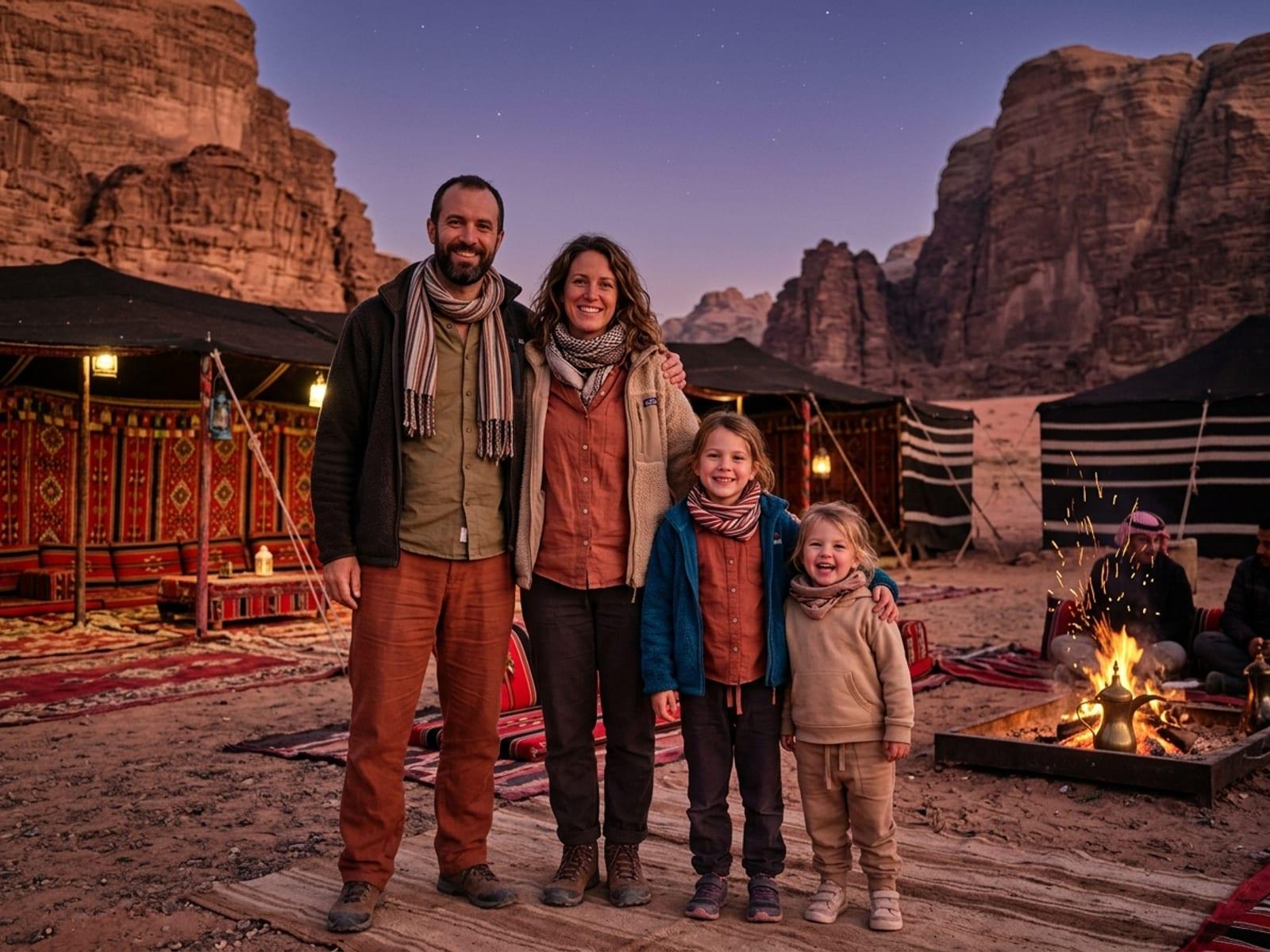
At a desert camp ringed by red sand and rocky peaks, an oven buried in the sand is opened around sunset, and out come meat and vegetables that have been slowly cooking underground. In Wadi Rum, the desert of southern Jordan, the dinner most often served to visitors is zarb, a dish of the Bedouin, the region's traditionally nomadic people. Unlike most dinners, you get to watch it come out of the ground. The camps are about 60 km east of Aqaba. Spring and autumn are the most comfortable seasons, and desert nights get cold, so pack a warm jacket for the kids.
Meat and vegetables, slow-cooked under the sand
Zarb is cooked in an oven sunk into the ground. In Jordan, this dish baked in a pit dug in the earth is treated as a feast. It usually holds chicken and lamb along with vegetables, and once cooked it's eaten with rice and starters such as tabbouleh.
How the oven is built, what goes in it and how long it cooks all vary by camp and by cook. It's made especially often around Petra and Wadi Rum, and camps commonly serve it as dinner for guests. When you book, ask whether your camp serves zarb and roughly what time they dig it up, so you don't miss the moment.
A desert valley that stood in for Mars
Wadi Rum is a valley in southern Jordan about 60 km east of Aqaba, the port city on the Red Sea. Carved out of sandstone and granite, it covers about 720 square kilometers, making it the largest wadi (dry valley) in Jordan. In 2011 it was inscribed as a UNESCO World Heritage Site, a mixed natural and cultural one, under the name Wadi Rum Protected Area.
T. E. Lawrence wrote about the area during the Arab Revolt of 1917 and 1918. Parts of the 1962 film Lawrence of Arabia were shot here, which helped put Jordan on the tourist map. In 2015, the Martian surface scenes in The Martian were filmed here, and since then it has appeared in Dune, Rogue One and the 2019 live-action Aladdin, among others. Look up scenes from films your kids know before you leave, and they'll have their "this is the place!" moment when you arrive.
The village of Rum, at the entrance to the valley, is home to a few hundred Bedouin. Most belong to the Zalabia tribe, who settled here around 1980 and have built up ecotourism within the protected area. It's local people like these who run the camps, cook the meals and arrange the vehicles that drive into the desert. The village has black tents woven from goat hair alongside concrete houses, as well as a school, small shops and the headquarters of the Desert Patrol.
Inside the valley you'll also find traces of life far older than zarb: the remains of a temple built by the Nabataeans, the people who built Petra, and inscriptions and drawings carved into the rock by people going back to prehistoric times. Ask your guide whether your 4x4 tour can stop at some of these. There's also a ride of about 14 km on a Hejaz Railway train pulled by a restored early-20th-century locomotive.
A day at camp, then stars and coffee after dinner
The usual pattern in Wadi Rum is a 4x4 drive among the dunes and rock formations during the day, then back to camp in the late afternoon for a zarb dinner. You can also watch camel races, hike among the rocks, or float above the valley in a hot-air balloon. The Jordan Tourism Board also highlights experiences such as Bedouin cooking classes, pottery at a women's cooperative in the village of Disi, and making kohl, the traditional eyeliner. There are even events that give you a taste of a Bedouin wedding.
Families who love walking should know about the Jordan Trail, a long-distance trail that runs the length of the country. The Petra to Wadi Rum section is about 125 km over six days, and Wadi Rum to Aqaba about 76 km over five. Walking a whole section with children isn't realistic, but even a short walk near camp lets you hear the sand and feel the rock in a way you don't from a car.
After dinner it's time for the stars. Far from any city lights, the desert sky fills with stars on a clear night. There are tours that pair an astronomer's commentary with telescope viewing, and gatherings where you sit outdoors with tea, coffee and dates and listen to a storyteller.
Arabic coffee is central to Bedouin hospitality. The beans are roasted over a fire, mixed with cardamom and served a little at a time in small cups. The Jordan Tourism Board describes hospitality as an essential part of Bedouin culture. Coffee is for adults, so don't press it on children; sharing tea and dates with them is just right.
With kids, plan for temperature swings and sand
The desert has big temperature swings between day and night. The sun is strong during the day, and once it sets the cold comes fast. Pack hats and sunscreen for daytime, and make sure every child has a warm jacket for the night. Even in spring and autumn, nights can get colder than you'd expect.
4x4 tours on sandy ground are bumpy, so an adult should hold small children securely, and it's worth checking in advance whether you can get a vehicle with proper seats. Sand easily gets into cameras and eyes, so it helps to have scarves you can pull over your mouth and nose. Toilet and shower facilities vary a lot between camps, so ask when you book.
If the zarb includes meat on the bone, pull it apart before handing it to younger children. The steam is very hot right after the food comes out of the pit, so watch the unearthing from a few steps back.
Your family at camp at dusk, red cliffs behind you: you can try that picture before you go with pokesta's AI photos ($1 per photo).
When to go and how to get there
Summer days are fiercely hot and winter nights very cold, so with children, spring (around March and April) and autumn (around October and November) are the most comfortable seasons.
On the day you stay at camp, aim to arrive about two hours before sunset. That gives you time to settle in while it's still light and to watch the cliffs change color as you wait for dinner.
The nearest airport is King Hussein International Airport (AQJ) in Aqaba, and Wadi Rum is about 60 km east of Aqaba on the Red Sea. You can also drive south from Queen Alia International Airport in Amman, which makes it easy to combine with Petra on the way. Both use lamb, but zarb has little in common with mansaf, the celebration dish in which the meat is simmered in jameed sauce.
The situation in the Middle East can change at short notice, and travel advice and entry requirements vary by nationality. Check your own government's latest official information while planning and again before you leave.
References