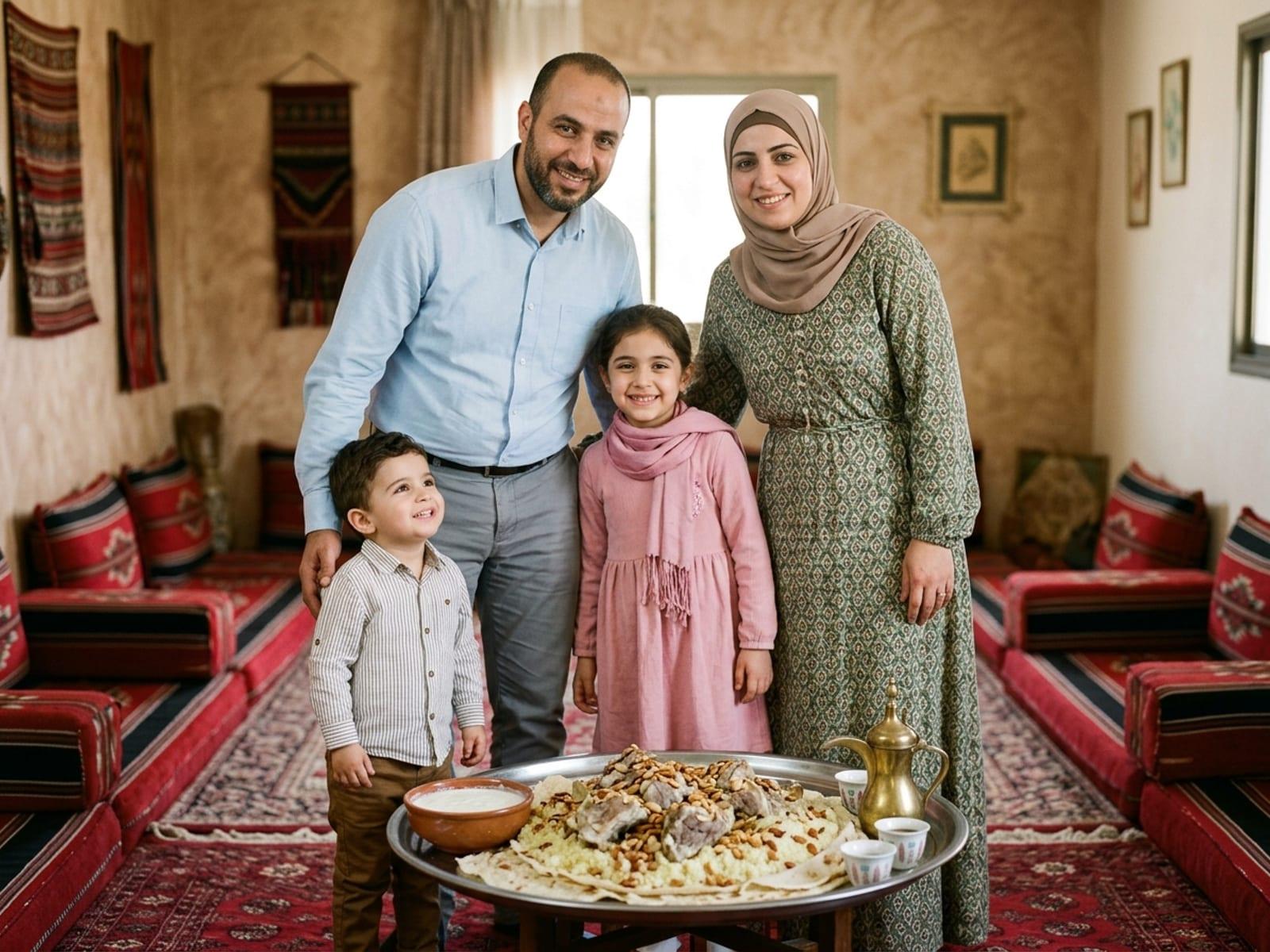
Thin flatbread is spread over a big round tray, rice is heaped on top, and bone-in pieces of lamb are laid over the rice. Toasted almonds or pine nuts are scattered over everything, and warm yogurt sauce is poured on as you eat. This is mansaf, Jordan's national dish. It sits at the center of every gathering worth celebrating: weddings, births, graduations, Eid and Christmas, Independence Day. In 2022 it was added to UNESCO's Intangible Cultural Heritage list as "Al-Mansaf in Jordan, a festive banquet and its social and cultural meanings." Visitors can order it year-round at Jordanian restaurants and are welcome to use a spoon. For a family, a shared platter works best, with some rice and meat set aside for the kids before the sauce goes on.
A dish named after a big tray
The name mansaf is said to come from a word meaning a large tray or platter. That the dish shares its name with the vessel tells you something: mansaf isn't served in individual portions. It's made for a crowd gathered around one tray.
The inscription was decided in 2022 at the 17th session of UNESCO's Intergovernmental Committee for the Safeguarding of the Intangible Cultural Heritage, held in Rabat, Morocco. In its decision, the committee described mansaf as central to social and cultural occasions in Jordan, and said that preparing and sharing it is a social event that conveys the values of hospitality and equality. The know-how is passed down not only in families but also through formal settings such as schools and museums, and safeguarding plans have been drawn up, led by the Ministry of Culture. Even the time people spend cooking together, chatting and singing as they go, is part of the tradition.
There are stories that link its origins to Abraham's hospitality in the Old Testament, or trace it back to Mesha, a 9th-century BC king of Moab. The original Bedouin mansaf, though, was just meat, broth (or ghee) and bread. Rice was added only after it caught on in northern Jordan in the 1920s, and the use of jameed is also thought to be relatively recent. The mansaf you eat today took shape over roughly the past hundred years.
Its status as the "national dish" has a history of its own. The scholar Joseph Massad has pointed out that the Jordanian state promoted mansaf as the national dish after independence, and that similar dishes have long been eaten in neighboring parts of Palestine and Syria. Rather than calling it uniquely Jordanian, it's closer to the truth to see it as one of the dishes grown out of the region's herding life, and the one Jordan has chosen to cherish as its own symbol.
The flavor comes from jameed, a dried yogurt
The ingredient that defines mansaf is jameed. Sheep's or goat's milk is boiled, fermented, salted, shaped into balls and dried until it sets into hard white rounds. These are soaked and dissolved in water to make the sauce the lamb is cooked in. Jameed is a cornerstone of Jordanian cooking, and Karak in the south is known for producing especially good jameed.
The meat, large bone-in pieces of lamb (or goat), is simmered in this yogurt sauce. It's often seasoned with hawayej, a blend of spices and wild herbs, and in Jordan jameed itself has long been seen as a symbol of generosity. Under everything is a paper-thin flatbread called shrak or markook. Rice goes on top (in the past it was bulgur, cracked wheat), then the meat, then almonds or pine nuts. Extra sauce comes in a separate bowl so everyone can add as much as they like while eating. The tang and saltiness of the yogurt, rice soaked in rich lamb juices, all scooped up with a piece of the thin bread: it's the taste of a herding life rich in milk and meat.
Salt and Karak are the towns most often named for great mansaf. If your route through the north or south passes either one, it's worth trying the dish there.
Standing, right hand only, and no blowing on the rice
The traditional way of eating mansaf comes with a few rules. You stand around the tray with your left hand behind your back and eat with your right hand only. Gather rice, meat and sauce with your fingertips into a small ball and bring it to your mouth with three fingers. Blowing on the rice to cool it is considered rude.
These days, though, eating mansaf with a spoon and your own plate is completely normal, both at home and in restaurants. Visitors don't need to force themselves to eat by hand. If you're a guest, everyone around you is eating by hand and you'd like to join in, start by gathering a small mouthful. Just remember to use your right hand, and the gesture will be appreciated. Ordering, bills and tipping are covered in restaurant etiquette in Jordan.
Mansaf also has a history of being served at the truces and peacemaking gatherings that settle disputes between tribes. When tribal heads visit one another, a host who slaughters a sheep or goat for the meal is understood to be signaling reconciliation.
Eating mansaf with children
Mansaf comes in big servings with plenty of meat. Some restaurants serve it by the portion and some on a large shared tray, so if you're eating as a family, ask about size before ordering to make sure it's right for sharing and you don't over-order. The jameed sauce is quite tangy and salty, so for children, set aside some rice and meat before the sauce goes on; it's easier for them to eat. The meat is on the bone, so pull it apart before handing it to younger kids. If a child doesn't like the smell of lamb, there's no need to push.
There's no dress code, but in Jordanian homes and smarter restaurants, clothes that cover shoulders and knees fit in better. If you're invited to a celebration, dress up a little. After the meal you may be offered Arabic coffee, scented with cardamom and served in small cups.
A family gathered around a big tray of mansaf makes a lovely photo, with the steam and colors of the food. For a family gathered around a holiday table, you can create an Eid al-Adha feast photo with pokesta's AI photos ($1 per photo). For more on mansaf at celebrations, see our Independence Day article.
Where to eat it, and when to go
You can eat mansaf all year round. For visitors, the easiest option is a restaurant serving Jordanian food. Because the lamb takes a long time to cook, it isn't always available on demand, so if you have a particular day in mind, check with your hotel or the restaurant in advance.
The gateway is Queen Alia International Airport (AMM), about 30 km south of central Amman. The situation in the Middle East can change at short notice, and travel advice and entry requirements vary by nationality. Check your own government's latest official information while planning and again before you leave.
References