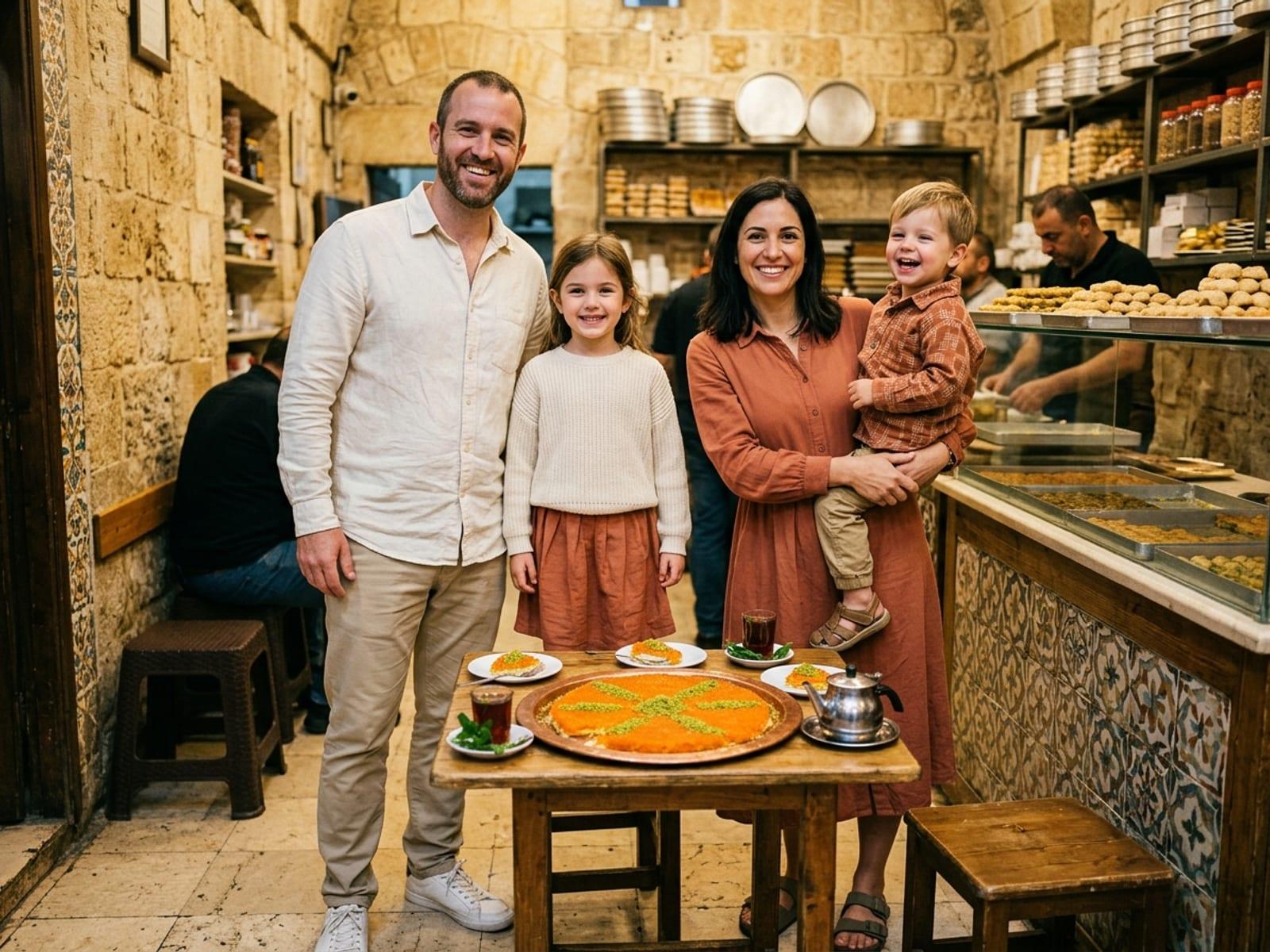
A slice is cut from a huge round baking tray and set on a plate. The top is bright orange and scattered with crushed pistachios, and when your fork goes in, white cheese stretches out from underneath, while fragrant syrup soaks through from above. Ask anyone in Jordan about sweets and knafeh is likely the first thing they mention. You get the saltiness of the cheese and the sweetness of the syrup in the same bite, and it's at its best eaten warm. In Amman you can get it year-round at sweet shops in the old downtown; it is very sweet, so a small child will be happy sharing an adult's plate.
Born in Nablus, an everyday sweet in Jordan
The most common type in Jordan and Palestine is knafeh nabulsieh, Nablus-style knafeh. As the name suggests, it's believed to have originated in Nablus, a Palestinian city west of the Jordan River, and Nablus is still known as the home of knafeh. It's often introduced as a Jordanian dessert, but its story is layered with the history of people moving back and forth across the river.
In Nablus, knafeh is sometimes tucked into bread and eaten for breakfast. In Jordan, it's loved not just as an everyday treat but as a sweet prepared for celebrations, holidays and Ramadan.
In Amman you'll also often see a different type called knafeh ramlawieh. It's made with pine nuts, walnuts, dough or semolina and clarified butter (samneh), then soaked in syrup. Its name comes from the Palestinian town of Ramla, and it's thought to have spread from there to Jordan.
Coarse, smooth or mixed dough
There are several kinds of dough used as the base of knafeh. Khishneh (coarse) uses long, thin noodle-like strands of dough, while na'ameh (smooth) is made with semolina. The first bakes up looking like bundled threads, the second with a fine, even surface. Some shops also offer a "mix" of the two. On your first visit, ask what they have before choosing.
The filling is nabulsi cheese, a firm, white, salty cheese. It's too salty to use as it is, so it's soaked to draw out the salt before being layered on the dough. For the Nablus style, dough dyed orange is spread over a large tray brushed with clarified butter, the cheese goes on top, and it's baked over a flame, then flipped onto a serving platter. So that bright color on top comes from the dough itself. Once baked, it's drenched in a sugar syrup called atar or qater. The syrup is sometimes flavored with rose water or orange blossom water, which is why the first bite can carry a faint floral scent.
Warm is the standard way to eat it, but versions filled with cream (qashta) are sometimes served cold, and some people eat it at room temperature. It's less a question of right and wrong than of each shop's or family's way of doing things.
Hunting for sweets in the Balad
The easiest place to try knafeh in Amman is the old downtown market district, the area known in Arabic as Wasat al-Balad. King Faisal Street is lined with places to eat and shops selling clothes, souvenirs and books, and at the far end of the street stands the Grand Husseini Mosque, built in 1924. The 2nd-century Roman Theater is a short walk away, so you can combine a sweets hunt with sightseeing.
How you order depends on the shop. Some serve it on plates to eat at the counter or at tables, while at others most customers take boxes home. If you're unsure, watch the other customers for a moment, then point and ask for a plate; that's all it takes. Freshly baked, the cheese inside is very hot, so break it open a little with a fork to let the steam out before giving it to a child. The syrup makes hands and clothes sticky, so a packet of wet wipes comes in handy.
It's quite sweet. For a small child, sharing an adult's plate is plenty. Since it's made with cheese, children with dairy allergies should skip it. Ordering mint or sage tea or water alongside helps clear the sweetness from your mouth.
Try the sweets next to the knafeh too
Sweet shop counters often hold other favorite Jordanian sweets besides knafeh. Baklava, layers of thin filo pastry and chopped nuts soaked in honey or syrup, comes in bite-sized pieces that are easy to share with kids. Halawa, made from sesame flour and milk, often comes studded with pistachios.
During Ramadan, seasonal sweets join the lineup, such as warbat, filo pastry wrapped around custard. After a plate of knafeh, pick one other sweet each and share them around the family. You'll really notice the differences in sweetness and in the textures of the pastry.
While you're walking the old town, look into the Gold Souk (Souk al-Dahab), reached from King Faisal Street, and Saqf al-Sayl, a shopping street built between 1964 and 1971 by covering over a former stream bed. Comparing a street of jewelers with one selling everyday goods is part of the fun of exploring.
What to wear, and getting a good photo
There's no dress code for walking the old town, but Jordan is a predominantly Muslim country, so clothes that cover shoulders and knees fit in better. The city is all hills and stairs, so wear comfortable shoes. The midday sun is strong in summer; save sweets for the late afternoon or evening and the kids will stay in a better mood.
Ask before photographing inside shops or taking pictures of people. A family lined up behind a tray of orange knafeh makes a vivid, colorful photo. If you'd like to turn the idea of a celebration into a picture, you can try a birthday family photo with pokesta's AI photos ($1 per photo). For sweets on Ramadan nights, our Ramadan in Amman article covers qatayef, the seasonal favorite.
When to go and how to get there
Knafeh is available year-round. Some shops change their hours during Ramadan, so check before you head out to avoid a wasted trip.
The gateway is Queen Alia International Airport (AMM), about 30 km south of central Amman. Downtown is hilly, so walk if your hotel is close; if not, take a taxi to the center and explore on foot from there. The situation in the Middle East can change at short notice, and travel advice and entry requirements vary by nationality. Check your own government's latest official information while planning and again before you leave.
References