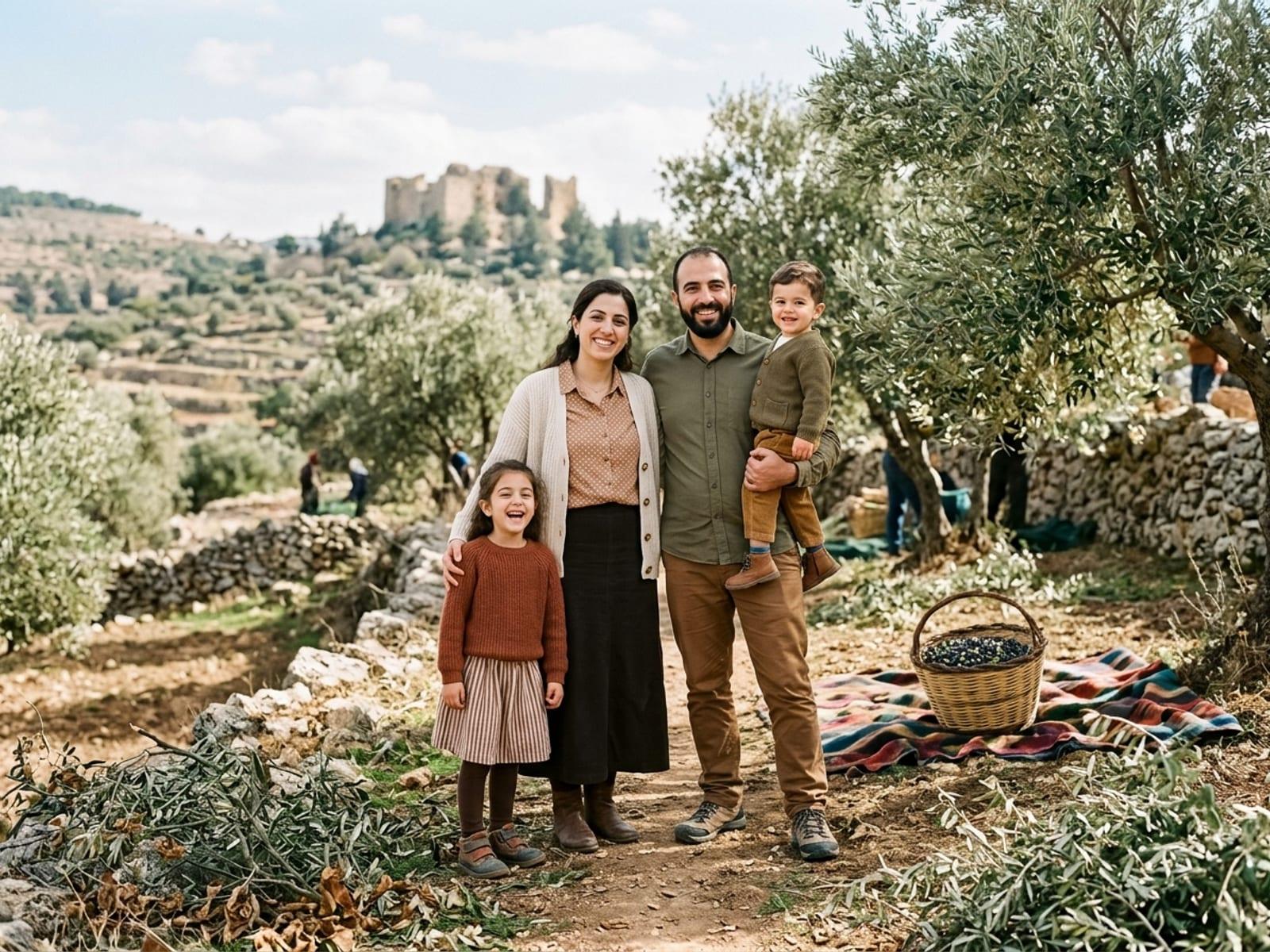
Say "Jordan" and many people picture red desert and rock-cut ruins. Head about 76 km northwest of Amman to Ajloun in the north, though, and the landscape turns to green hills. Dry-stone terraces climb the slopes, lined with olive trees whose leaves have a silvery sheen, and from around October the olive harvest gets under way. Look out over the groves, step into a workshop making olive oil soap, climb to the castle on the hilltop: you can follow the olive, a fixture of every Jordanian meal, from the slopes where it grows to the things it becomes. Most groves are private land, so if your family wants to join in the picking, ask your hotel or a local tour operator to find a farm that welcomes visitors before you go.
Olives on the Jordanian table
Jordan is a major olive grower. Olive oil is the backbone of home cooking, and a classic breakfast is flatbread dipped first in olive oil and then in za'atar, a seasoning of thyme and sesame. The olives themselves turn up on almost every plate of starters.
Olive trees grow mainly in the wetter highlands of the north and center. Ajloun is a hill town at about 720 meters above sea level with a Mediterranean climate and around 470 mm of rain a year. Most of it falls between December and March, and May to September is nearly dry. The fruit that makes it through the dry summer ripens in the autumn.
The link between this land and olives goes back a long way: Ottoman tax records from 1596 list olive trees among the produce taxed in Ajloun. Around the Mediterranean, the olive harvest starts in autumn, from October onward. Depending on ripeness, the fruit is picked at different stages: young green olives, olives on the turn, and fully ripe black ones. Shaking the branches or the whole tree to bring the fruit down is the usual method, while table olives are handled carefully by hand, since bruised fruit turns bitter.
The Soap House and the Biscuit House
In Orjan, a village near the Ajloun Forest Reserve, small workshops turn olives into things for everyday life. At the Soap House, village women make soap from olive oil using traditional methods and sell it under the Orjan name. In the same village, the Biscuit House lets you visit a workshop making local biscuits. Both sit along or at the end of walking trails through the forest, and there are guided routes that take you there.
For children, finding out that soap comes from olives is a small revelation. See the fruit in the grove, see the soap in the workshop, then wash your hands with that soap back home: the olive goes from something you eat to something you use, all in one trip. Workshop visits, trail bookings and opening times can change with the season, so check before you go. Soap is light and hard to break, which makes it an easy souvenir to carry home. Liquids such as olive oil can run into carry-on restrictions, so pack those in checked luggage.
Even the trail names tell the story of olives. One trail starts at an old olive press, and another passes the remains of Byzantine and Roman wine and olive presses, a sign that fruit has been pressed on these hills for centuries.
The forest reserve and the castle on the hill
Ajloun's hills hold something rare in Jordan: forest. The Ajloun Forest Reserve, managed by the Royal Society for the Conservation of Nature (RSCN), is a woodland of evergreen oak mixed with carob, terebinth and strawberry trees. Wildflowers bloom in spring, including the black iris, Jordan's national flower. In 2025 the reserve was designated a UNESCO Biosphere Reserve. Wild boar, red foxes, Persian squirrels and porcupines live in the forest, and roe deer, which had disappeared from the area, are being bred and reintroduced from stock brought from Turkey.
This area is said to have once been known as the largest forest in the Middle East. In Ottoman times, though, many of the trees were cut down to fuel the railway to Mecca. Today's forest is the part that survived and has been protected since. Terraces of olives and stands of oak: trees planted by people and trees that were always here, side by side on the same hills. The reserve has tents and cabins to stay in, available from March to November.
On a hilltop near the town stands Ajloun Castle (Qal'at ar-Rabad). It was built as a fortress in 1184 by Izz al-Din Usama, one of Saladin's generals, and expanded to its present size around 1214. It was built to watch over the road between Damascus and Egypt, and from its height you can see far across the northern Jordan Valley. In 1260 the Mongols destroyed parts of it, including its battlements, and it was later restored by the Mamluk sultan Baybars. Earthquakes in 1837 and 1927 also damaged it. With its stone walls and passages, it's a place where kids can enjoy exploring a real castle, but there are lots of steps, so keep hold of their hands. Admission to the castle is included in the Jordan Pass.
Visiting as a family at harvest time
Most olive groves are private land belonging to local people. Even if you see a harvest going on, don't wander into the grove or pick fruit. Whether you can join in the harvest depends on the farmer, tour company or local group. If you'd like to try, the reliable route is to ask a local travel agency or your accommodation in advance whether there's a farm that welcomes visitors.
The slopes are full of terrace walls and uneven ground. Give children shoes with a good grip and hold their hands on the steps. Autumn days in Ajloun are pleasant, but mornings and evenings are cool. Rainy days start to appear in November, so bring a light jacket and rain gear. Jordan is a predominantly Muslim country, so in the villages, clothes that cover shoulders and knees are the baseline.
A family photo with a basket of freshly picked olives and terraced hills behind you is about as autumn-in-Ajloun as it gets. You can try that shot ahead of time with pokesta's AI photos ($1 per photo).
When to go and how to get there
The olive harvest starts around October, and the timing shifts with the area, the year's weather and the individual trees. Come in spring for the forest flowers, or in October and November to catch the harvest season.
The gateway is Queen Alia International Airport (AMM), and Ajloun is about 76 km northwest of Amman. On the way is the Roman city of Jerash, home to the summer Jerash Festival. Combine the two and you can see the north in one or two days. For Jordan's national dish, see our article on mansaf.
The situation in the Middle East can change at short notice, and travel advice and entry requirements vary by nationality. Check your own government's latest official information while planning and again before you leave.
References