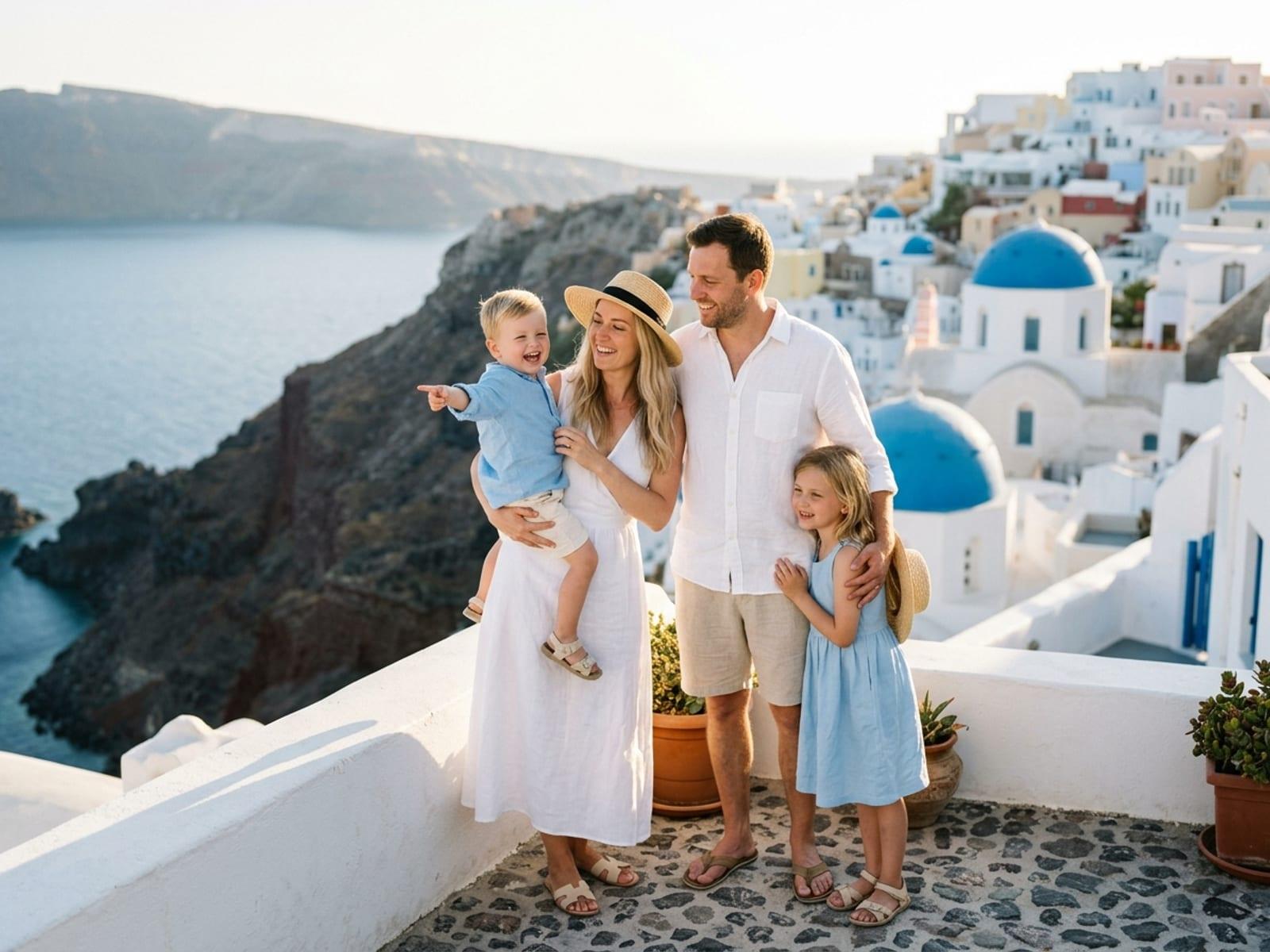
Santorini is a volcanic island in the Cyclades, in the southern Aegean. The cliffs lined with white houses and blue-domed churches are the rim of a caldera, left behind when repeated eruptions made the center of the island collapse. The best months are April–May and roughly September–October, avoiding midsummer, and you get there from Athens by a 45-minute to one-hour flight or by boat from Piraeus. The clifftop villages are all steps and slopes, so bring a baby carrier rather than counting on a stroller.
A crescent-shaped island made by a volcano
Santorini is shaped like a crescent. It was once a round volcanic island, but repeated eruptions caused its center to collapse, and the sea flooded in to form a huge basin called a caldera. Today's island is part of the rim of that caldera, which is why its western side is sheer cliff while the eastern side slopes gently down to the sea.
The biggest of these eruptions happened about 3,600 years ago, in the Bronze Age. It blasted out enormous amounts of ash and rock and dramatically reshaped the island. In the middle of the caldera sit two small volcanic islands formed by later eruptions, Nea Kameni and Palea Kameni.
Nea Kameni's last small eruption was in 1950, and its crater still lets off steam. In summer, tour boats leave the old port below Fira for the island every day, and once ashore you can climb a gravel path to the crater. The island is almost bare of plants and has no shade, so bring water, hats and proper walking shoes for the children.
The island's white houses are stacked one above another along the clifftops. Another feature of Santorini is the cave-like dwellings called hyposkafa, dug into layers of volcanic pumice. Some are now used as hotels or homes.
Sunset in Oia and the clifftop villages
The island's most famous view is the sunset from Oia, the village at its northern tip. Crowds gather in the late afternoon to watch the sun sink into the sea beyond the caldera while the white houses turn orange. The area around the castle ruins in Oia is the most popular spot, but around sunset it gets so packed you can barely move. With children, it's more relaxing to arrive at least an hour before sunset and claim a spot, or to book a clifftop restaurant and watch from your seat.
Fira, the island's main town, spreads along the top of the caldera cliffs and is the gateway to the island. It's full of shops and restaurants, and a small old port sits at the foot of the cliff. Between Fira and Oia are the villages of Imerovigli and Firostefani, both overlooking the caldera, and walking the cliffside path between them lets you watch the scenery change as you go. Pyrgos, a hilltop village inland, sees relatively few tourists and still has a maze of narrow lanes.
Ruins, black sand, wine and tomatoes
In the south of the island lies Akrotiri, a Bronze Age town buried under volcanic ash in the great eruption about 3,600 years ago. Large-scale excavations began in 1967, uncovering multistory buildings, drainage systems and vividly colored wall paintings. The site is covered by a large roof and you walk through it on wooden walkways. Since you're out of the sun even in summer, it's an easy place to visit with children. Tickets cost €20, or €10 reduced. Opening hours change with the season and the day of the week: the 2026 schedule lists 8:00 to 18:00 for the second half of October, and 8:30 to 15:30 on Mondays and Thursdays. Check those hours, along with who qualifies for free or reduced entry, on the Cyclades Ephorate of Antiquities website before you go.
On the east side of the island are beaches of black volcanic sand. Perissa and Kamari have long beaches lined with restaurants and facilities, which makes them easy places for a family to spend the day. The black sand gets very hot in the sun, so wear flip-flops.
Crops grown in the volcanic soil are local specialties too. Santorini's small, intensely flavored cherry tomatoes and fava, a yellow split pea purée, are served at tavernas around the island. For grown-ups, the island is also known for white wine made from the Assyrtiko grape and for sweet Vinsanto.
Whites and blues that blend into the scenery
Santorini has no particular traditional costume, but light clothes in white, pale blue and sandy tones go well with the white houses and blue sea. Coordinating the family's colors is enough to make photos look pulled together.
When it comes to shoes, put comfort before style. The villages are full of cobbled lanes and steps, and heels or thin-soled sandals will wear you out. The sun is strong, so pack wide-brimmed hats, sunglasses and sunscreen.
For a preview of your family in whites and blues against the evening view in Oia, you could try pokesta's AI photos ($1 per photo) before the trip.
Steps, heat and cruise-ship days
The clifftop villages are one set of steps and slopes after another. There are only a few places where a stroller is practical, so bring a baby carrier for little ones. Some cliffside paths and terraces have only low walls, so keep a close eye on children.
The old port at the foot of the cliff in Fira is connected to the town by a cable car or by a flight of about 600 steps. Donkey rides have long been offered on the steps, but concerns have been raised about how the animals are treated, and some people urge visitors not to use them. In high season, the wait for the cable car can be quite long.
Summer on Santorini brings strong sun and high temperatures. Skip midsummer and go in spring (April to May) or autumn (roughly September to October), and the weather is pleasant for walking and taking in the views. Bear in mind that on days when cruise ships call, Fira and Oia suddenly fill with day-trippers. Since 2025, the Greek government has charged cruise passengers a seasonal fee when calling at Santorini and other islands.
In February 2025, a series of earthquakes struck the area around the island. Before you travel, check your own government's travel and safety advice and local announcements for the latest on the island.
When to go and how to get there
Greece's main international gateway is Athens International Airport (ATH), from where you continue to Santorini by domestic flight or by boat. Flights from Athens take about 45 minutes to an hour; boats from the port of Piraeus take about five hours by high-speed ferry and around eight hours by conventional ferry. If you spend the night before an early boat in Piraeus, Mikrolimano's fish tavernas are at the east end of the port. To add another Cycladic island, consider Syros, home of Ermoupoli and its 200-year-old loukoumi. In summer, direct flights to Santorini Airport (JTR) from many European cities increase, so you can sometimes reach the island without going through Athens.
The island has two ports. Ferries dock at Athinios, while cruise ships anchor off the old port of Skala below Fira and send passengers ashore in small boats. The airport is about 6 km southeast of Fira. Island buses start from the bus station in Fira and reach most of the main villages, beaches and sites, including Oia. Timetables change with the season, so if you need to make a boat or a flight with children in tow, check the times at the Fira bus station ahead of the day.
What you need to enter depends on your nationality. Greece is part of the Schengen Area. The EU's electronic travel authorization (ETIAS), which will apply to travelers who can enter without a visa, had still not started as of October 2026, and the EU says it will announce the start date several months in advance. Confirm your own requirements through your government's official information and the EU's official website.
References
- Discover Greece (Greek National Tourism Organisation), "Santorini" https://www.discovergreece.com/cyclades/santorini
- Discover Greece, "8 Best Beaches in Santorini" https://www.discovergreece.com/travel-ideas/best-of/8-best-beaches-santorini
- Wikipedia, "Santorini" https://en.wikipedia.org/wiki/Santorini
- Wikipedia, "Santorini Cable Car" https://en.wikipedia.org/wiki/Santorini_Cable_Car
- Wikipedia, "Nea Kameni" https://en.wikipedia.org/wiki/Nea_Kameni
- Ephorate of Antiquities of Cyclades (Hellenic Ministry of Culture), "Opening Hours & Admission 2026" https://cyclades.culture.gov.gr/en/hours-prices/
- GTP Headlines, "Greece to Charge Cruise Passenger Fee from July 1 — Up to €20 at Santorini, Mykonos" https://news.gtp.gr/2025/06/12/greece-to-charge-cruise-passenger-fee-from-july-1-up-to-e20-at-santorini-mykonos/
- Ferryhopper, "Traveling from Athens to Santorini" https://www.ferryhopper.com/en/blog/featured/athens-santorini-ferries
- European Commission (Migration and Home Affairs), "European Travel Information and Authorisation System (ETIAS)" https://home-affairs.ec.europa.eu/policies/schengen/smart-borders/european-travel-information-authorisation-system_en