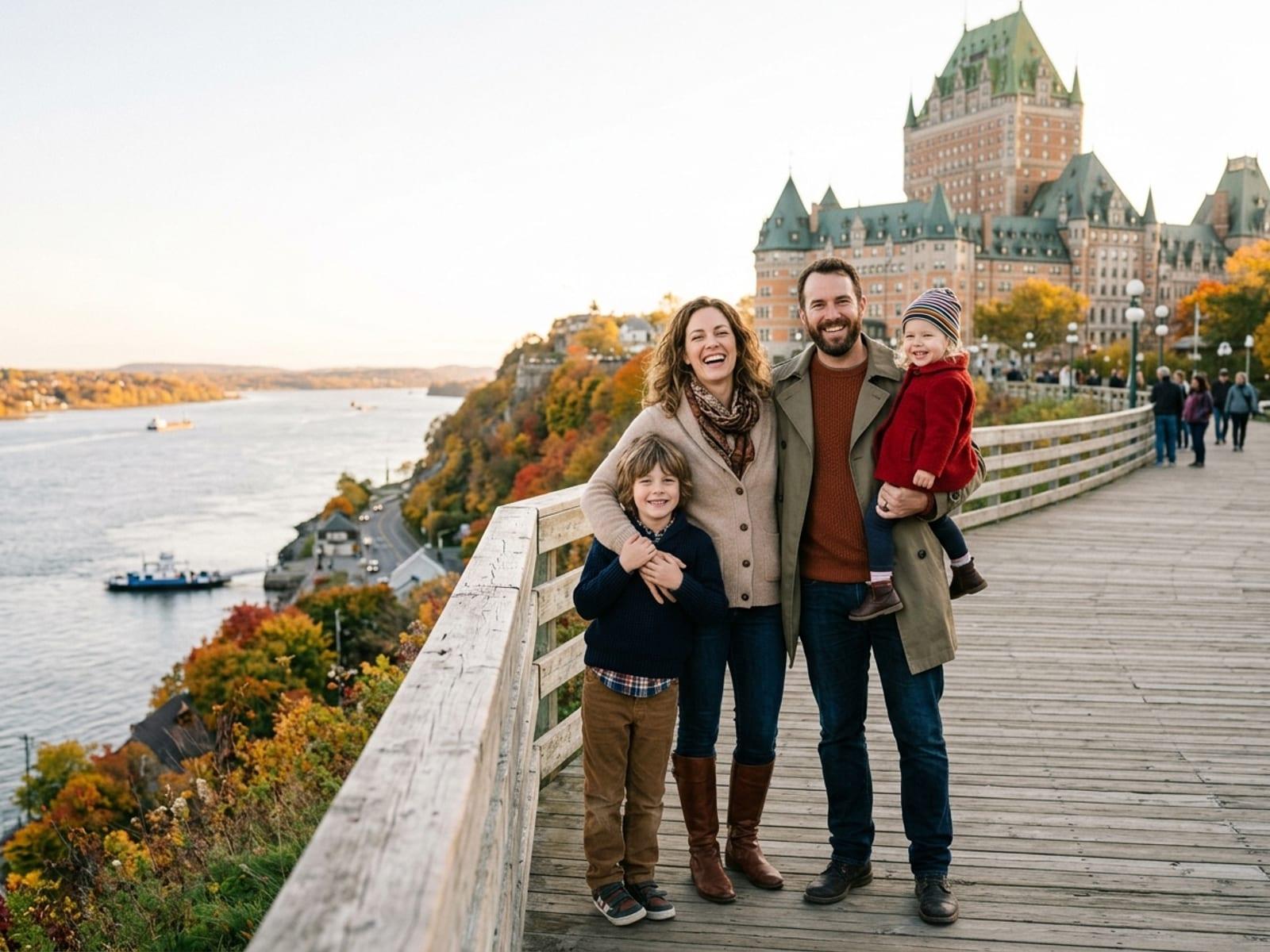
Old Quebec, the walled historic district of Quebec City, became a UNESCO World Heritage Site in 1985 and is built on two levels: Upper Town on the clifftop above the St. Lawrence River and Lower Town along the water. It's full of slopes and stairs, so with a family, walk the terrace by the Château Frontenac and the Citadel in the morning, then ride the 64-metre funicular down to Lower Town before lunch, and you'll keep the uphill walking to a minimum.
1608: Champlain settles at the foot of the cliff
Quebec City's story begins in 1608, when the French explorer Samuel de Champlain built his dwelling and trading post at the foot of the cliff by the river. Its remains are in today's Lower Town, around Place Royale. Champlain later chose the promontory of Cap Diamant, high above, as the site for Fort Saint-Louis, and the town's defences moved up the cliff. Facing the square is Notre-Dame-des-Victoires, a stone church begun in 1687.
Upper Town, on the clifftop, remained the city's military and administrative centre for a long time. Even after the British took the city, the pattern held: officials and clergy lived up top, merchants and craftsmen down below. City Hall, built in 1896, is still in Upper Town, so the seat of local government has never left the cliff. In the late 19th century there were calls to tear the walls down, but Lord Dufferin, then Governor General of Canada, argued for preserving and rebuilding them, and that is why they look the way they do today.
Quebec's provincial government declared the area a historic district in 1963 and enlarged it to 135 hectares the following year. It contains about 1,400 buildings.
If you'd like to learn about the walls with your children, Parks Canada's Fortifications of Québec National Historic Site is a good starting point. In 2026, during the summer season from June 19 to September 7, it offered guided walks along the walls, activities led by guides in period costume, and family programs. Check Parks Canada's official page for each year's dates and prices.
Upper Town: Château Frontenac and Dufferin Terrace
The first thing you notice in Upper Town is the Château Frontenac. Built by the Canadian Pacific Railway, the hotel opened in December 1893 and is named after the Comte de Frontenac, governor of New France, the French colony in North America. New York architect Bruce Price designed it in a château style. It's often called the most photographed hotel in the world, and in 1943 and 1944 it hosted the Quebec Conferences, where U.S. President Roosevelt, British Prime Minister Churchill and others met.
Wrapping around the hotel along the edge of the cliff is Dufferin Terrace, a wide boardwalk. From here you look down on the river and the roofs of Lower Town, all the way across to the town of Lévis on the opposite shore. Beneath the terrace lie the remains of the Château Saint-Louis, home to French and then British governors for more than 200 years, now a Parks Canada National Historic Site.
Beyond the terrace, on the highest point of the cliff, is the star-shaped Citadelle. Built between 1820 and 1850, it has been home since 1920 to the Royal 22nd Regiment of the Canadian Army. Ceremonies such as the changing of the guard take place there, and a cannon is fired at noon to mark the time. The tradition dates from 1871, and apart from a break from 1994 to 2008 it still rings out over the city. If you're on the terrace at noon, the boom may startle your children, so warn kids who are sensitive to loud noises ahead of time. The regiment also has a museum; check the official information for how and when to visit.
A 64-metre funicular links the two levels
The easiest way between Upper and Lower Town is the funicular, which opened in November 1879. It runs 64 metres at a steep 45-degree angle between Dufferin Terrace and Rue du Petit-Champlain in Lower Town. It's much safer and easier than leading a child down the steep stairs.
At the bottom you come out on Rue du Petit-Champlain, which runs along the foot of the cliff, close to Place Royale at the heart of Lower Town. For a family day in the old city, we suggest walking the terrace and the Citadelle in Upper Town in the morning, taking the funicular down before lunch and exploring Lower Town. Ride it back up at the end of the day and you'll barely have to walk uphill at all.
See the old city from the river on the ferry
From the Lower Town riverbank, a ferry crosses to Lévis on the far shore. The route has a long history: the first steamboat ran in 1818, and since 1910 the crossing has operated year-round, winter included. It still carries an average of about 1.5 million passengers a year and is part of everyday life for locals. A round trip makes a short river cruise, and looking up from the water at the Château Frontenac and the old city on the cliff gives you a view you can't get from inside the city. Check the operator's official website for timetables and fares.
Before the ferry ran through the winter, up until around 1909, the river often froze from mid-January to the end of March. People crossed to the other side on an "ice bridge" marked out with posts, on foot or by horse-drawn sleigh. Today, icebreakers keep the route open in winter, and the ferry carries an average of 300,000 cars and 100,000 bicycles across the river each year. Ride it in winter and you may find yourself crossing a river full of floating ice.
Tips for walking with children
The old city is full of cobblestones, slopes and stairs. A baby carrier works better than a stroller, and children should wear shoes they're used to walking in. Streets ice over in winter, so non-slip soles are essential. For a winter trip, you could time your visit to the snow festival, the Quebec Winter Carnival. For food, sharing a plate of the province's famous poutine will refuel a family worn out from walking.
French is Quebec's official language, so start with "Bonjour" when you walk into a shop. You can see what a family photo on the terrace with the château-style hotel behind you might look like with pokesta's AI photos, at $1 per photo with your first one free.
Getting there by air and rail
The gateway airport is Québec City Jean Lesage International Airport (YQB), about 17 km west of the city. If you're coming by train from Montreal, VIA Rail arrives at Gare du Palais, a station building from 1915 with a castle-like look of its own, not unlike the Château Frontenac. On a morning train out of Montreal, a bag of wood-fired Montreal bagels from Mile End takes care of breakfast. Canada's entry requirements depend on your nationality, so check your own government's official information before you travel.
References