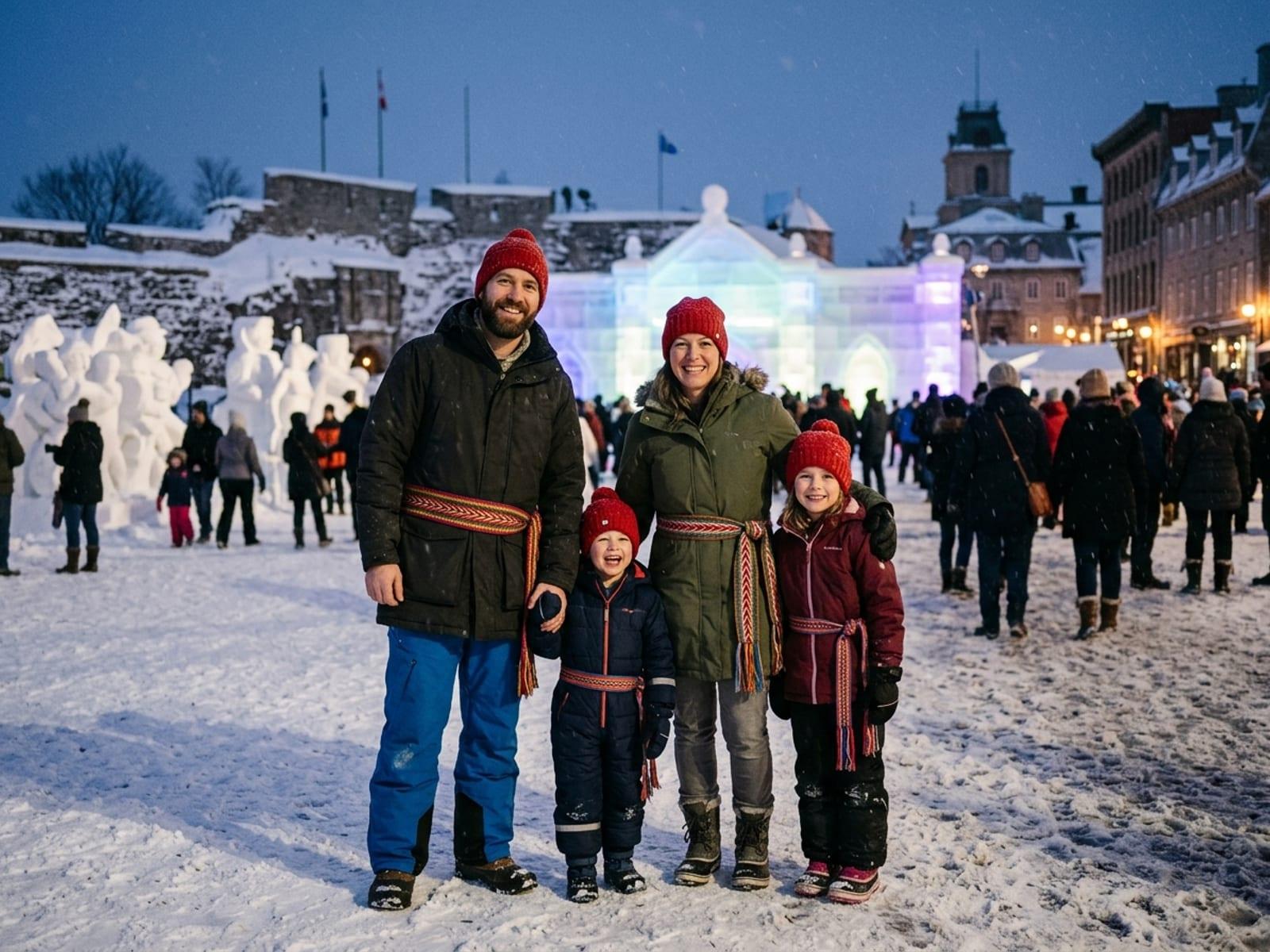
Every February, in the depths of winter, Quebec City throws a 10-day party called the Carnaval de Québec, or Quebec Winter Carnival. The star is Bonhomme, a snowman in a red cap, and the program is built around enjoying the cold rather than hiding from it: a palace made of ice blocks, snow sculptures, night parades. The 2027 edition runs from February 5 to 14. Children 12 and under can get onto the sites without an entry pass, which makes this an easy festival to bring a family to.
It began as a way to liven up the quiet season
According to the City of Quebec, the first carnival was held from January 29 to February 3, 1894. Local business people organized it to bring some life to the winter months, when visitors were scarce. Even that first edition had an ice palace in front of the provincial legislature, ice sculptures, canoe races on the river and a parade of floats.
Smaller events followed over the years, but the carnival died out during the Great Depression and the Second World War. It came back as an annual event in January 1955, and that was the year Bonhomme Carnaval made his first public appearance, receiving the keys to the city from the mayor. He is said to stand 7 feet tall (about 2.1 meters), and you can pick him out by his red cap and black buttons. Ever since, Bonhomme has been treated as the master of the city for the length of the carnival, and as lord of the ice palace.
The brightly colored sash around Bonhomme's waist is a ceinture fléchée, or arrow sash, adopted in 1955 as a cultural symbol of the carnival. The official carnival shop sells these sashes alongside knit hats.
Ten days of ice palaces, parades and canoes on the river
The festival grounds spread inside and outside the walls of Old Quebec, centered on the Plains of Abraham just outside the fortifications. The official site lists Bonhomme's ice palace, snow and ice sculptures, two night parades and musical evenings among the highlights. Quebec's tourism board also mentions sledding, skating, wall climbing and activities for children.
The ice palace is the stage for the opening and closing ceremonies, and at night it doubles as an outdoor dance party. For photos, go just after sunset, while there is still a little blue left in the sky. Compared with full darkness, you keep both the texture of the ice and the color of the sky.
The carnival's signature event is the ice canoe race on the St. Lawrence River. Teams push and paddle their canoes across a mix of frozen surface and open water. When the carnival was revived in 1955, this race between Quebec City and Lévis on the opposite shore was already one of its highlights. The night parades and the canoe race are free to watch, though paid grandstand seats are also available.
The Plains of Abraham stay open as a park during the carnival. Entries from the snow sculpture competition line the grounds, and the corner closest to the Citadel turns into something like a winter fairground. Winter sports such as snowshoeing, dog sledding and hockey take place outdoors, and a masquerade ball has traditionally been held at the Château Frontenac. Around 1,400 volunteers help run the event each year, and attendance has reached around a million in some years, so expect Old Quebec to be crowded on weekend evenings.
The same plains host one of the carnival's oddest traditions, the snow bath (bain de neige), where people in swimsuits roll around in the snow. It's cold just to watch, but children tend to stare in disbelief. For adults, a warm alcoholic drink called caribou has been part of the carnival for a long time.
The Effigy pass, and what it means for children
To get into most of the sites, you buy an Effigy, a pendant-style pass shaped like Bonhomme, and wear it on your coat. The design changes every year, so some people collect them. Prices vary from year to year; in 2026 the regular price was $39 plus tax. For 2026, the official site said children 12 and under did not need an Effigy. Conditions can change, so check the FAQ on the official site before you go.
In 2026, a family play site called Gougoune et Doudoune at Espace 400e stayed open after the carnival ended. Getting onto the site was free, but the activities needed a separate paid pass.
Keeping small children happy in the cold
The official site says the grounds are only partly accessible to people with reduced mobility, and a companion gets in free when the person they are helping has an Effigy. Strollers struggle on snowy paths, so a baby carrier is the safer choice for little ones. Sleds for pulling children can be rented at the information kiosk, though there are only so many.
With preschoolers, a realistic plan is to enjoy the snow sculptures and sledding while it's light, then skip the long wait for the night parade and catch a little of it near your hotel. If you meet Bonhomme, line up for a family photo with him. Next to a child, his size really comes across. Before you pose in front of the snow sculptures, agree with your kids that nobody touches or climbs on them.
Dress everyone in layers, with waterproof snow pants, boots, gloves and hats that cover the ears. Children lose heat faster than adults, so decide in advance that you'll warm up indoors once an hour. A spare pair of gloves lets you swap out wet ones after playing in the snow. The night parades involve a lot of standing around, and toe warmers or a hot drink can make a real difference to a child's mood. There are heated rest areas on site; find out where they are when you arrive.
If you want to look the part, a red knit hat and an arrow sash like Bonhomme's are the easy options. A row of red hats against the white snow also makes it easy to spot your family in a photo taken from far away. You can try a picture of your family in red hats in front of the ice palace with pokesta's AI photos, at $1 per photo, with your first one free.
When to go and how to get there
The carnival runs for 10 days from early to mid-February each year; in 2027 it's February 5 to 14. Opening hours differ by day of the week, and some days don't start until late afternoon, so check the program for the times of anything you don't want to miss.
The gateway airport is Québec City Jean Lesage International Airport (YQB), and many travelers connect through Montreal or Toronto. City buses (RTC) serve the carnival sites, and during the festival a shuttle runs between Upper Town and Espace 400e. Given the hunt for parking, public transit is easier than driving. Right next to the sites, the walled UNESCO streets of Old Quebec make an easy daytime walk, with the funicular linking Upper and Lower Town.
After a cold day outside, the hot gravy on the province's signature dish, poutine, goes down very well. If you come back around March, when the snow starts to melt, it's sugar shack season, when maple taffy is made by pouring hot syrup onto snow.
Canada's entry requirements depend on your nationality, and some travelers need an eTA (Electronic Travel Authorization) before flying. Check the Government of Canada's official website, and look at your own government's travel advice for safety information.
References