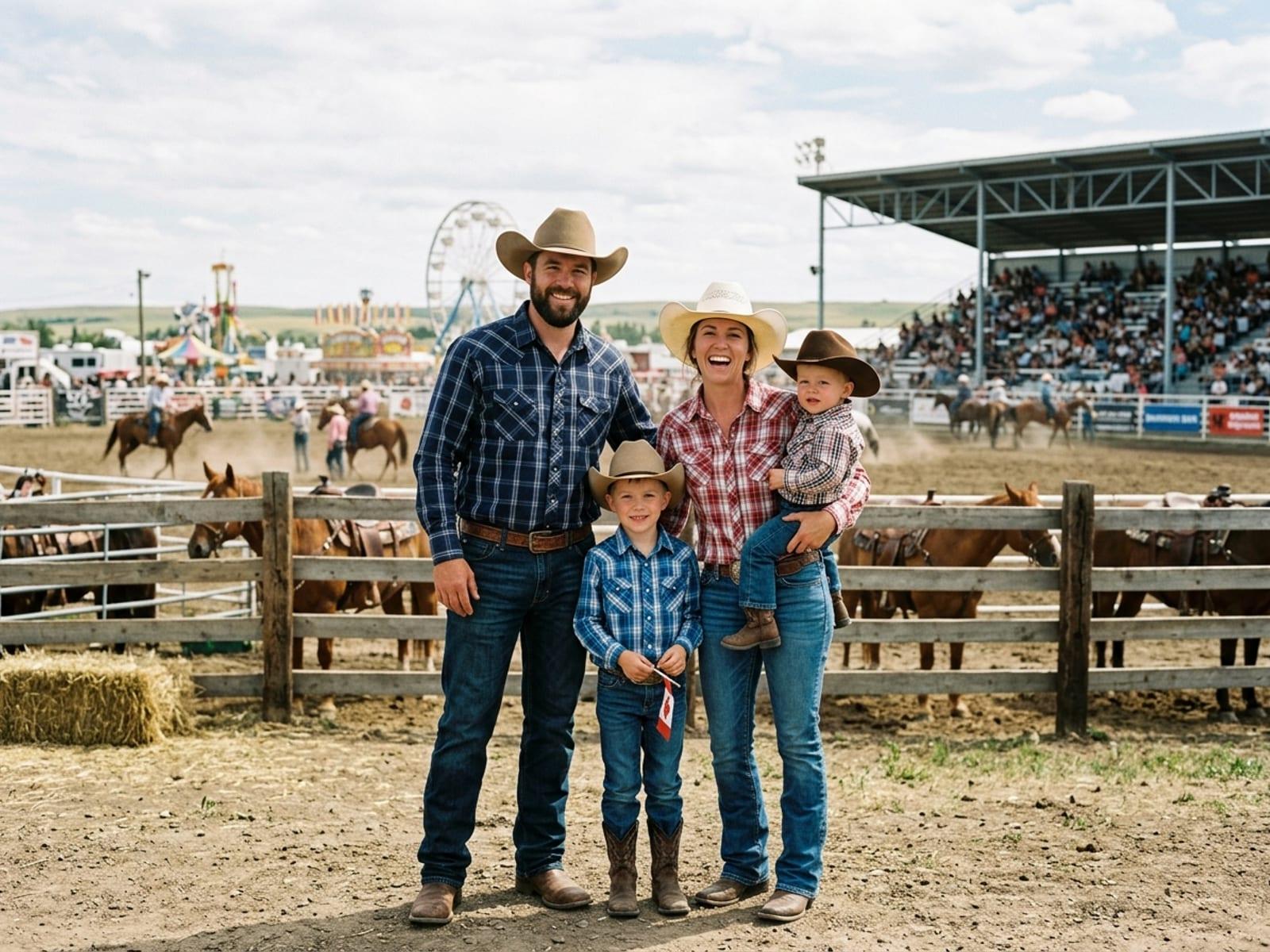
For 10 days every July, Calgary in the western province of Alberta hosts the Calgary Stampede. There's rodeo and chuckwagon racing on the grounds, but the festival spills well beyond them: people all over the city spend those days in jeans and cowboy hats, and free pancakes are handed out from early morning. The 2027 Stampede runs from July 9 to 18, and in 2024 it drew a record of about 1.48 million visitors. With children, take the CTrain to the grounds and pick either the afternoon rodeo or the evening show rather than both.
An agricultural fair and a rodeo that joined forces
The Stampede traces its roots to an agricultural exhibition held by a local agricultural society in 1886. In 1912, an American promoter named Guy Weadick staged the first "Stampede," built around rodeo. The two came together in 1923, creating today's combination of exhibition and rodeo, and chuckwagon racing started that same year.
The pancake breakfasts also go back to 1923, when chuckwagon driver Jack Morton is said to have invited passersby to join him for breakfast. During the festival, Stampede breakfasts still pop up all over the city. Part of the fun is that you can feel the festival without setting foot on the grounds.
Rodeo, chuckwagons and the evening show
Everything centers on Stampede Park, close to downtown. A parade through the city streets on the first Friday kicks things off. It's a tradition going back to 1912, when the first parade drew 75,000 people, more than the city's population at the time.
The daytime draw is the rodeo at the GMC Stadium, every afternoon at 1:30. There are seven events, including barrel racing, bull riding, saddle bronc and bareback. Each event winner takes home $100,000, and about $1 million in total is paid out on the final championship day, making it one of the biggest rodeos in the world. Much of the livestock is raised on the 22,000-acre Stampede Ranch near Hanna, Alberta. At 7:15 p.m. the same stadium hosts the Evening Show: the Rangeland Derby, with chuckwagons flying around the track at full tilt; relay races by Indigenous teams; and the Grandstand Show, in which young local performers sing and dance. It ends with fireworks.
Twenty-seven teams enter the chuckwagon races, competing for a total purse of $1.15 million. Rodeo and Evening Show tickets are for reserved seats, and an advance ticket includes park admission for that day. Inside the park you'll also find midway rides, livestock exhibits and areas for children. If your kids want more time with the cattle and horses, the Royal Agricultural Winter Fair, held indoors in Toronto every November, is a fair where the livestock shows are the main event.
Be aware that horses have died in accidents at the chuckwagon races and the rodeo in some years, and the events continue to draw criticism on animal welfare grounds. The organizers have revised their safety rules repeatedly. If your family isn't comfortable showing children animal competitions, you can leave the rodeo out and build your day around everything else.
Meeting the Treaty 7 Nations at Elbow River Camp
In one corner of the park is Elbow River Camp, where the five First Nations connected to Treaty 7 in this area, the Kainai, Piikani, Siksika, Tsuut'ina and Stoney Nakoda, put up 26 tipis. It used to be called the "Indian Village" and was renamed in 2018.
The camp has jewelry and crafts for sale from Indigenous makers, traditional bannock (a fried bread) with saskatoon berry jam, and dance performances, along with a youth powwow and a competition in the traditional hand game. By long custom, a young woman chosen each year from one of the five Nations joins the Stampede as one of its official representatives. Don't peer into the tipis uninvited, and ask before pointing a camera at anyone.
The white hat, and what to wear
During the Stampede, Calgarians dress in jeans, plaid shirts, western boots and cowboy hats. Visitors doing the same will fit right in. You can buy your hat and boots before the trip or shop at a western-wear store in town. A full day in boots you haven't broken in is a recipe for blisters, though, so for children, sneakers plus a hat and a western shirt is a sensible compromise.
The white felt cowboy hat has a special meaning in Calgary. A local hat shop made the first ones for the 1946 Stampede, and from 1950 the mayor began presenting them to visiting dignitaries. Today, tourism staff and airport volunteers perform a welcome ceremony called "white hatting," in which the recipient recites a pledge and finishes with a "Yahoo!" The hat was added to the city flag in 1983. You can try a photo of the whole family in matching white hats with pokesta's AI photos, at $1 per photo, with your first one free.
What visitors should not copy is Indigenous feather headdresses or ceremonial dress. Western wear is more or less the festival's uniform, but Indigenous regalia is part of a living culture with its own meaning.
Getting around with kids, plus dates and access
You'll be outdoors for long stretches. A cowboy hat doubles as a sunhat, so it's worth getting one for the kids too. Water and sunscreen are essential. The grounds are crowded, so pick a meeting point in case anyone gets lost, and put a note with a parent's phone number in your child's pocket. It can cool down in the evening, so pack a light jacket.
With preschoolers, it's safest to choose either the afternoon rodeo or the Evening Show, not both. The Evening Show finishes with fireworks, so it wraps up quite late.
Admission prices and the rules for children are announced each year. There are discounted "value days" during the festival, but which days and what conditions apply change from year to year, so check the official site before you settle on a date.
The dates follow a rule: the Stampede runs for 10 days starting on the first Friday of July. If that Friday falls on Canada Day (July 1) or the day after, it starts the following Friday instead.
The gateway airport is Calgary International Airport (YYC). To reach the park, take the Red Line of the CTrain light rail to Victoria Park/Stampede or Erlton/Stampede station. Driving usually means a long hunt for parking, so even with kids the train is the more reliable choice. After the festival, a drive west into the Rockies brings Lake Louise and Moraine Lake in Banff into the same trip. Carry on over the mountains into British Columbia and July is apricot and peach season in the Okanagan Valley orchards.
Canada's entry requirements depend on your nationality, and some travelers need an eTA (Electronic Travel Authorization) before flying. Check the Government of Canada's official website, and look at your own government's travel advice for safety information.
References