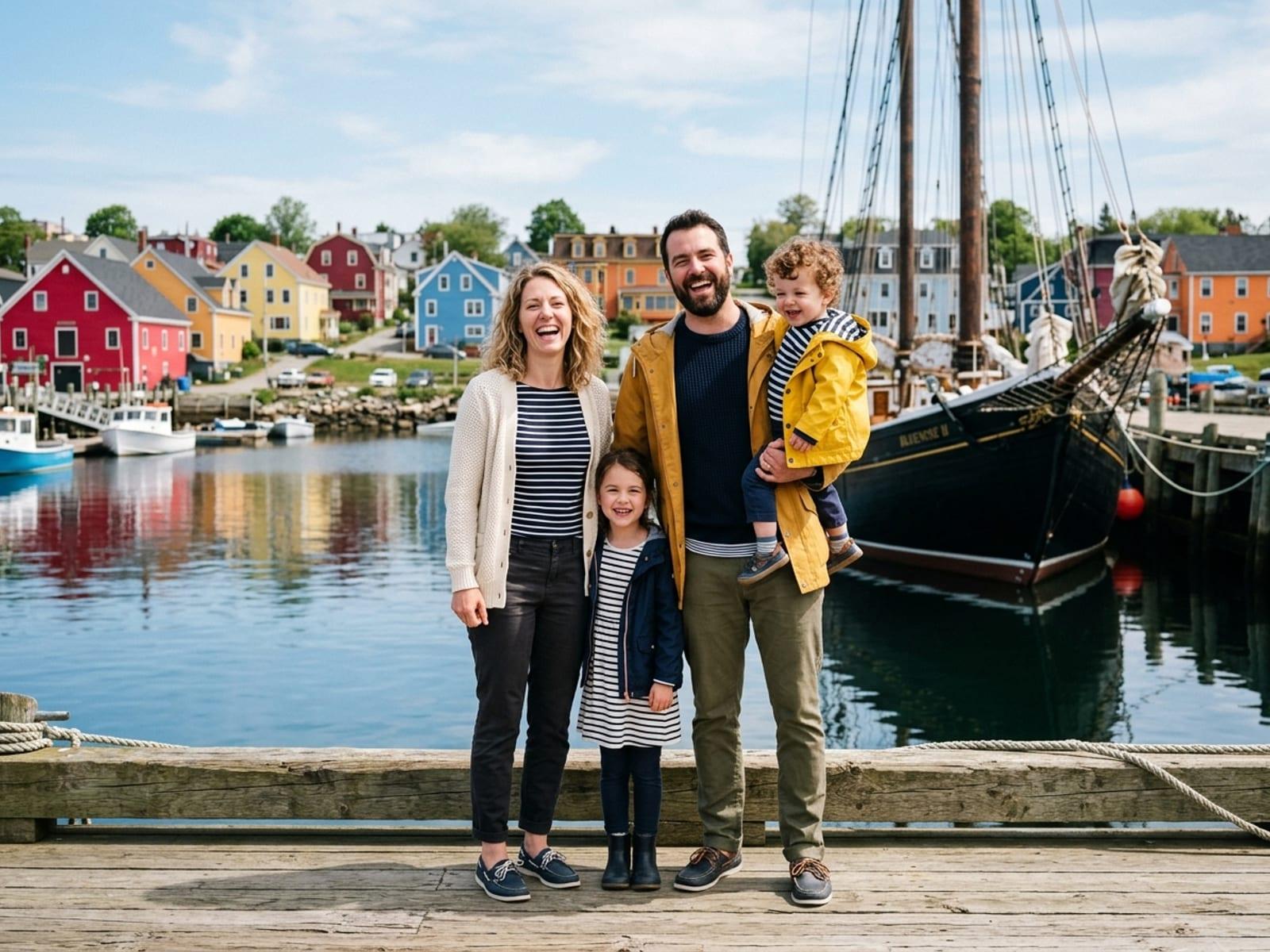
Lunenburg, in the eastern Canadian province of Nova Scotia, is a small town of brightly painted wooden buildings climbing from the harbor to the top of the hill. The grid of streets it was laid out on in 1753 survives largely intact, and in 1995 it was inscribed as a UNESCO World Heritage Site. The town grew rich on North Atlantic fishing, and it is also the home of the Bluenose, the schooner pictured on Canada's ten-cent coin. It's about 100 km southwest of Halifax, the provincial capital, close enough for a summer day trip or an overnight stay to show children the history of life on the sea.
A town planned on paper in 1753
Lunenburg was founded in 1753 as part of British colonial policy. That year, Britain recruited more than 1,400 Protestant settlers from across Europe, most of them artisans and farmers.
The plan laid narrow streets out in a tight grid with little regard for the lay of the land. Because the town sits on a steep, south-facing slope, the streets running up from the harbor are mostly hills. UNESCO describes Lunenburg as the best surviving example of a planned British colonial settlement in North America, and listed it together with the wooden buildings that have come down from the 1800s. Today the colorful shopfronts and signs are the face of the town.
Several buildings are worth seeking out on the hill and along the streets. St. John's Anglican Church, built of wood in 1763, is a large church in the "Carpenter Gothic" style, Gothic architecture rendered in timber. Old Town also has the wooden Zion Evangelical Lutheran Church, built in 1890, and the Knaut-Rhuland House, a museum in a house from 1793. On top of the spire of St. Andrew's Presbyterian Church turns a big weathervane in the shape of a cod, made of hammered copper, a fitting touch for a fishing town. As you walk, see if your kids can spot the fish in the sky.
For a long time the town's economy rested on the offshore fishery. The harbor still has a shipyard building aluminum boats, another with a dry dock, and wharves used by inshore fishing boats, along with one of Canada's largest fish processing plants. Lunenburg still lives by the sea.
The Bluenose, "Queen of the North Atlantic"
The ship that made Lunenburg famous was the Bluenose, a fishing and racing schooner built in 1921 at the town's Smith and Rhuland shipyard. She was built partly to avenge a Nova Scotia fishing boat's loss to an American vessel the year before, and she won the International Fishermen's Trophy race in 1921. She kept beating American challengers after that and defended the trophy again in 1938, in the last race between working fishing schooners.
She was designed by William James Roué and launched in March 1921. She wasn't built just for racing: under Captain Angus Walters, she fished the North Atlantic like any other working vessel. When the age of sail in the fishery ended, she became a cargo ship in the Caribbean, and in January 1946, loaded with bananas, she struck a reef off Haiti and sank. Her crew all survived.
The Bluenose was pictured on a postage stamp in 1929, and in 2021, 100 years after she was built, a commemorative silver coin was issued. The schooner on the back of Canada's dime was said, when it first appeared in 1937, to be a composite of several ships, but in 2002 the Canadian government declared that it depicts the Bluenose. Show your kids a dime before you head down to the harbor and the story suddenly gets much more real.
On July 24, 1963, a replica, Bluenose II, was launched in Lunenburg. Out of respect for the original's record, Bluenose II doesn't race officially. A major restoration was announced in 2009, and she was relaunched in 2012 (the work wasn't fully finished until the summer of 2016, at a cost of about $24 million). Today she spends much of the year at the wharf of the town's Fisheries Museum of the Atlantic. In summer there are deck tours, harbor cruises and programs where you can try a deckhand's job. Sailing schedules change from year to year, so check ahead if you want to go aboard.
Learning about fishermen's work at the Fisheries Museum
The Fisheries Museum of the Atlantic, a red building on the waterfront, is housed in a former fish processing plant and displays the history and tools of the region's fishery. The fishing vessel Cape Sable is moored at its wharf, and you can go on deck and into the wheelhouse. A photo of your child at the wheel makes a very Lunenburg picture.
In 2026 the museum's special exhibit, running from August to October 24, covers more than 400 years of African Nova Scotians' relationship with the sea. October 24 was also the last day of the museum's 2026 season. Check the official site for each year's season and hours. In late November, the town also holds a winter event that lights up the boats in the harbor.
Walking a hilly town with kids
Old Town is small enough to explore on foot, but the grid is full of hills, so a baby carrier is easier than a stroller. With little ones, stick mostly to the flat streets along the harbor and climb the hill just once to look down over the town. From the harbor side, the colorful buildings stack up the slope in tiers, so that's the direction to shoot from. For a photo of your family in front of the colorful houses and the black schooner, you can try pokesta's AI photos, at $1 per photo, with your first one free.
It's a seaside town, so even in summer, mornings, evenings and foggy days can be chilly. A light sweater or rain jacket is a good idea. On rainy days you can rebuild the plan around the museum exhibits, which is one of the things that makes this town easy to visit. On wharves and boats, keep an eye on children at all times and stay away from edges without railings.
In a fishing town, sharing seafood dishes as a family is part of the fun. If anyone has shellfish or other allergies, check with the restaurant when you order.
When to go and how to get there
With the Bluenose II programs and museum season in mind, June to September is the easiest time to visit. If you go in autumn, confirm the museum's closing date and the Bluenose II schedule first.
The gateway airport is Halifax Stanfield International Airport (YHZ). Lunenburg is about 100 km southwest of downtown Halifax, and a rental car is the easiest way to get there. Stopping at fishing villages along the way and making it a day trip or overnight gives you breathing room. Back in Halifax, before or after, try the donair, the sweet-sauced beef wrap that became the city's official food.
On a summer trip, it's worth crossing to Prince Edward Island for a lobster supper, a tradition that began as a church fundraiser.
Canada's entry requirements depend on your nationality, and some travelers need an eTA (Electronic Travel Authorization) before flying. Check the Government of Canada's official website, and look at your own government's travel advice for safety information.
References