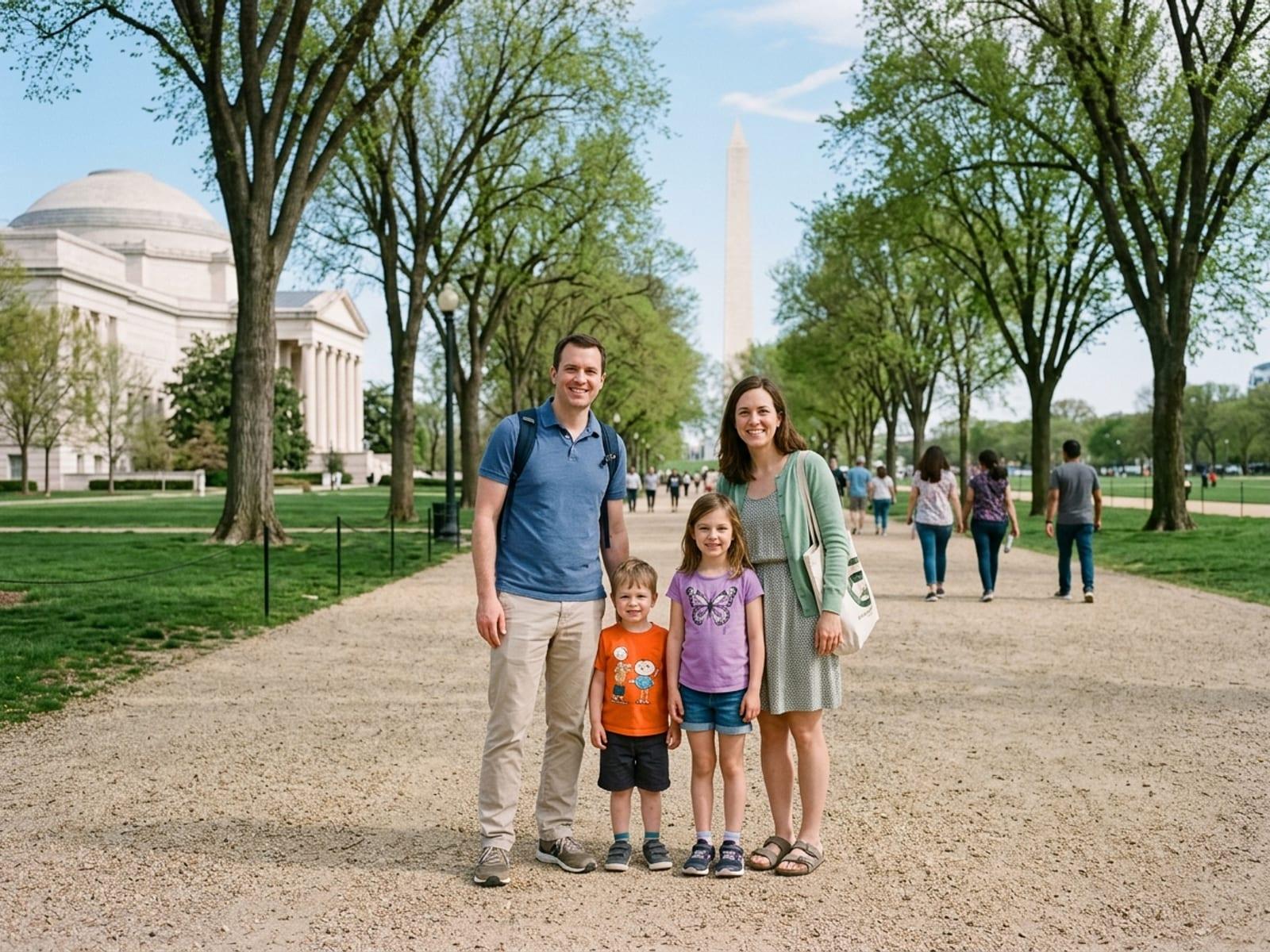
A complete Tyrannosaurus skeleton, aircraft that actually flew, an African elephant weighing 11 tons. On the National Mall in Washington, D.C., the Smithsonian Institution's museums sit within walking distance of each other, and almost all of them are free. The one exception to walking straight in is the National Air and Space Museum, where you need to reserve a free entry pass in advance. You can't see everything in a day, so the best way to enjoy it as a family is to choose two or three museums based on your children's ages and interests.
Museums founded on a British scientist's bequest
The Smithsonian Institution was established on August 10, 1846, using money left to the United States by the British scientist James Smithson (1765–1829). The bequest arrived in America in 1838 as about 105 bags of gold coins, and Congress created the Institution as the way to put it to use.
Today it runs more than 20 museums and galleries plus the National Zoo, with collections of over 150 million items. It welcomes around 30 million visitors a year. Apart from its design museum in New York City, almost every site is free to enter. The Smithsonian Castle on the National Mall, completed in 1855, is its oldest building and is still the Institution's headquarters.
The Natural History Museum: an elephant, dinosaurs and a blue diamond
The first stop for most families is the National Museum of Natural History, which opened in 1910. It recorded 3.3 million visits in 2025. Step into the rotunda at the main entrance and you're greeted by Henry, an 11-ton African elephant who has stood there since 1959.
The dinosaurs are in the fossil hall, which reopened in June 2019 after a renovation. At the center of the vast, "deep time"–themed hall is a complete skeleton known as the Nation's T. rex. There's also an ocean hall with a model of a North Atlantic right whale and a giant squid specimen, and a hall of geology, gems and minerals where the blue Hope Diamond is on display. A butterfly pavilion and insect exhibits are here too, but some exhibits close for renovation and other reasons, so check the official site before you go.
Admission is free and no ticket is needed. According to Washington, D.C.'s tourism office, the museum is open daily from 10 a.m. to 5:30 p.m. and closed only on December 25 (checked October 2026).
Air and Space: don't forget the free timed pass
The National Air and Space Museum is another favorite with kids, but here everyone, regardless of age, needs a free timed-entry pass. You can reserve up to nine at a time on the official site. Your entry time is fixed, but there's no limit on how long you can stay once inside. The only entrance is the door on the Jefferson Drive side, so if you're coming from the other side of the Mall you'll need to walk around.
Galleries currently open include one on the Wright brothers and the beginnings of flight, and a hands-on gallery about how things fly. According to the museum, the how-things-fly gallery has more than 45 interactive stations, and there are free highlights tours led by volunteers and science demonstrations at mobile carts. A major renovation is still underway; as of October 2026, a gallery on living in space was scheduled to open on October 30 and a military aviation gallery on November 11.
For bigger aircraft, head to the Steven F. Udvar-Hazy Center, the museum's second site in Chantilly, Virginia, near Dulles International Airport. The Concorde supersonic airliner and the SR-71 Blackbird reconnaissance plane are on display, and an observation tower lets you watch planes taking off and landing at Dulles. Entry is free, but parking costs extra.
Toddlers to American History, animal lovers to the pandas
The National Museum of American History opened in 1964 as the Museum of History and Technology and took its current name in 1980. It has Wegmans Wonderplace, a play space for children from birth to age 6, with a child-size version of chef Julia Child's kitchen and a tugboat where kids can play captain. For ages 6 to 12 there's Spark!Lab, where children can try inventing and building. On the first floor there's the full-size Julia Child's Kitchen exhibit, so kids can compare it with their small version. On the second floor, the actual Star-Spangled Banner, the War of 1812 flag that inspired the US national anthem, has a gallery of its own. USS Constitution, which fought in that same war, can still be boarded near the end of Boston's Freedom Trail. When little ones are worn out from walking, this museum is also a good place to let them rest.
A little away from the Mall, in Rock Creek Park, is the National Zoo, opened in 1889. It's free too, and giant pandas Bao Li and Qing Bao, who arrived from China in October 2024, have been on view since January 2025. The nearest stations are Woodley Park and Cleveland Park on the Metro's Red Line.
Two museums a day, the most popular one in the morning
Many of the museums open at 10 a.m. With children, go first to the one you most want to see and take in the exhibits you came for before the late-morning crowds build. Bags may be screened at the entrance, so traveling light makes getting in quicker. The Natural History Museum has its own café, so lunch there followed by one more museum in the afternoon is a manageable amount.
The Mall is long from east to west, and the walk between museums is farther than it looks. A stroller makes getting around easier, but D.C. summers are hot and shade is scarce in places, so bring water and hats. For the National Mall, Smithsonian station (Silver, Orange and Blue lines) is the most convenient Metro stop, and the Natural History Museum is also walkable from Archives station (Green and Yellow lines). There's very little parking, so public transit is the realistic option.
Pairing a visit with spring blossoms? Book early
The museums are open all year, but late March to early April coincides with the National Cherry Blossom Festival, when the whole city gets crowded. The gateway airport is Washington Dulles International Airport (IAD). Head north by train and you can detour to Philadelphia for a cheesesteak. Entry requirements for the United States vary by nationality, so check your own government's official information before you travel.
To see how a family photo in front of a dinosaur skeleton might turn out, you can try pokesta's AI photos ($1 per photo, and your first one is free).
References