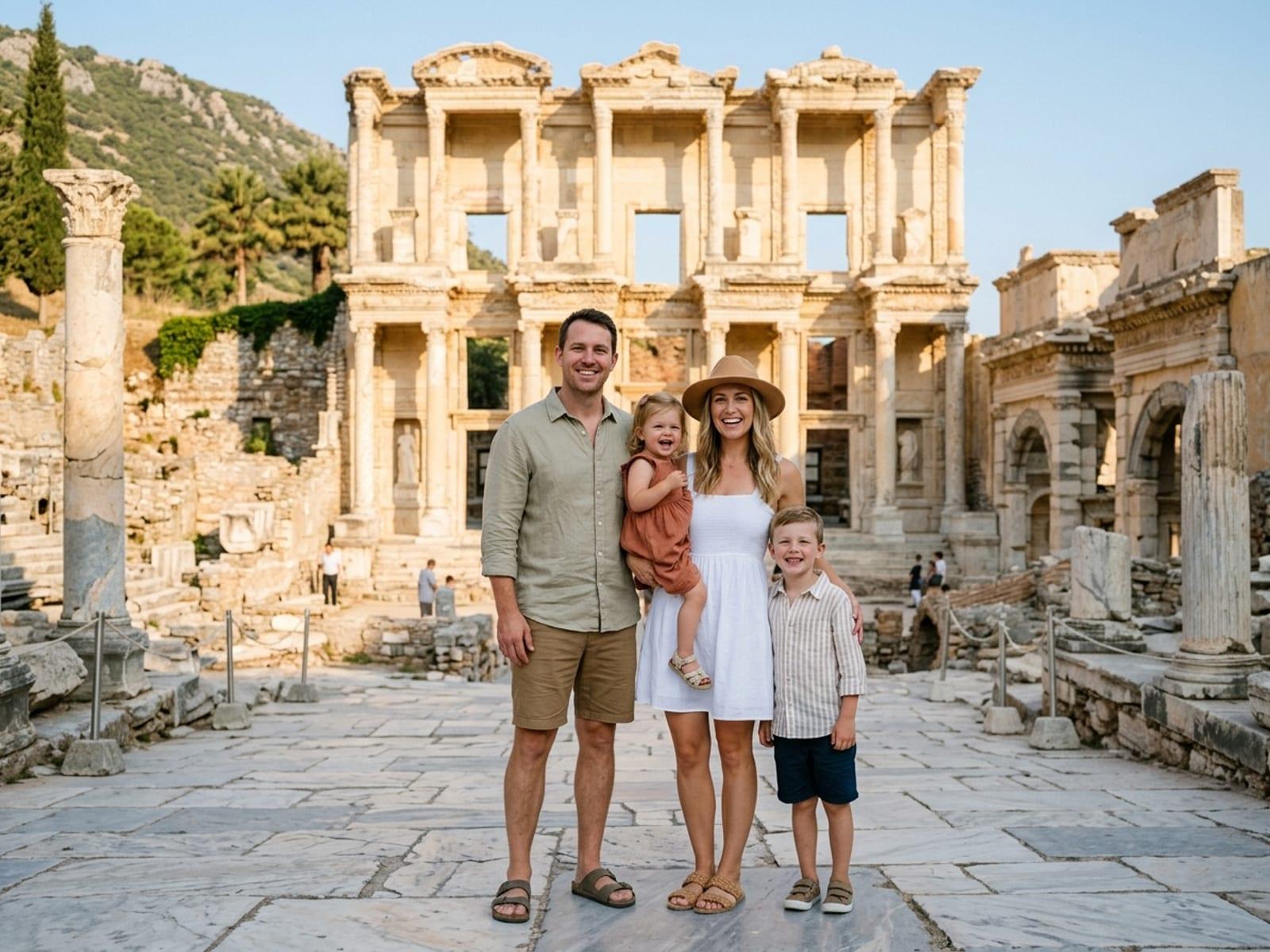
Walk down an old paved street and a two-story facade of columns rises ahead of you: the Library of Celsus, from Roman times. Ephesus (Efes in Turkish), on Turkey's Aegean side, began as a Greek city and later flourished as the capital of the Roman province of Asia. It became a World Heritage Site in 2015. You can get there by train from İzmir. With children, go in spring or autumn; in summer, arrive when the gates open at 8 a.m. and rest under the roof of the Terrace Houses, and the whole ancient city is walkable.
A great port city of the ancient world
Ephesus grew rich as a center of trade between East and West, with a large harbor at its heart. The city developed around the Temple of the goddess Artemis and later became an important place in the spread of Christianity. The ruins now sit 3 to 5 km from the sea because silt carried by the river gradually filled in the harbor. Cut off from its Aegean trade, Ephesus slowly declined.
Its history is long. Around the 10th century BC, Greek settlers founded a city on the site of an older one, Apasa. In the early 3rd century BC, Lysimachus, one of Alexander the Great's successors, moved the inhabitants from near the Temple of Artemis to a new site about 2 km away. In 27 BC Emperor Augustus made it the capital of the province of Asia, and it's also known as the city where the Apostle Paul lived for about three years. In 431 the Third Ecumenical Council met at a church near the harbor. After that the city declined, and by the 15th century it was abandoned. Excavations began in the late 19th century, and Austrian researchers have been working there since 1895.
The Temple of Artemis was counted among the Seven Wonders of the Ancient World. Only a single column stands today, but imagining its former size is a good way to start a conversation with kids.
The Library of Celsus and the Great Theater
The site's main attraction is the Library of Celsus. It was built around AD 125 in memory of Tiberius Julius Celsus Polemaeanus, governor of the Roman province of Asia, largely through the efforts of his son Gaius Julius Aquila. It's said to have held nearly 12,000 scrolls. The facade has two tiers of columns and statues, and standing close and looking up, you're struck by its height.
The other big sight is the Great Theater, built into a hillside. It's said to have held about 25,000 people; plays were staged there, and in the later Roman period, gladiator fights as well. Facing seating that fills the whole slope makes it easy for children to picture more than 20,000 people gathered in one place.
The site also has the Odeon, a smaller theater; the Agora, a public square; baths; and the remains of a public latrine, a long bench lined with holes. A toilet where people sat side by side is a great way to get kids talking about how people lived long ago.
The Terrace Houses under their roof
Another place worth seeing inside the site is the Terrace Houses. These are the remains of six Roman-era mansions built in three levels up the slope, with floor mosaics and wall frescoes in good condition. They're now covered by a large protective roof, so after walking in the strong sun you can catch your breath in the shade while you look around. How visits work and what they cost changes over time, so check on site.
Preparing for heat and stone paving
There's little shade at Ephesus, and the marble paving reflects the sun. In summer, go in right after opening. According to the Ministry of Culture and Tourism (checked in October 2026), the site is open daily from 8:00 to 18:00, and the ticket office closes at 17:45. At certain times of year there are also evening openings after dark on some days. Admission includes entry to the Ephesus Experience Museum, the site's exhibition facility, and audio guides are available. Hours, prices and evening-opening dates can change, so check official information before you go.
The old paving has big steps in places and can be slippery. A baby carrier works better than a stroller, and children need shoes with good grip. Bring hats, sunscreen and plenty of water. The site is spread over a slope with lots of ups and downs, so decide in advance what you most want to see, and take breaks as the kids need them.
Selçuk, the town below
About 2 km northeast of the ruins is the town of Selçuk. On Ayasuluk Hill above the town stand a citadel, the ruins of the Basilica of St. John, built by Emperor Justinian in the 6th century in honor of the Apostle John, and the İsa Bey Mosque, built in 1375 by the Aydınid principality; the hill is also part of the Ephesus World Heritage Site. The Basilica of St. John was damaged in 1090 and 1308 and fell into ruin, and was excavated in 1927. Finds from the site are on display at the Ephesus Archaeological Museum in town. About 7 km from Selçuk is the House of the Virgin Mary, long believed to be where Mary spent her last days, and pilgrims come to visit. Outside Selçuk is Şirince, a village known for its wine, olive oil and old houses from the days when Greek residents lived there.
If you miss the family shot in front of the Library of Celsus on the day, pokesta's AI photos ($1 per photo) can make one.
By train from İzmir
The site is open year-round, but with children, spring and autumn, away from midsummer, are the easiest seasons for walking. The gateway is İzmir Adnan Menderes Airport (ADB). Selçuk station has been served by İzmir's İZBAN commuter trains since 2017, and regional trains from İzmir to Söke, Nazilli and Denizli also stop there. Taking a Denizli-bound train lets you continue on to Pamukkale and Hierapolis. In İzmir itself, you can eat your way through Kemeraltı Bazaar. Entry requirements for Turkey vary by nationality, so check your own government's official information before you travel.
References