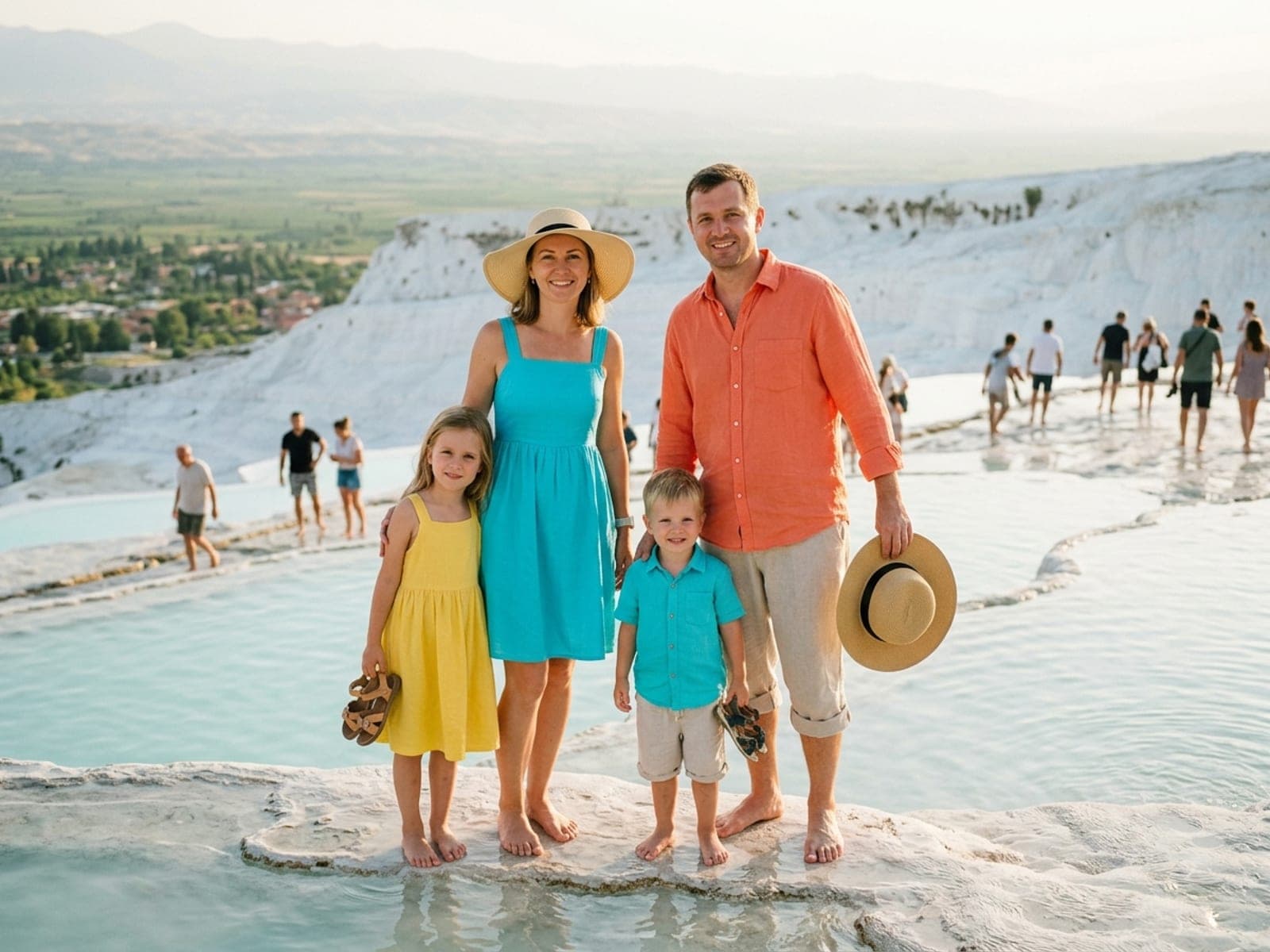
A slope as white as fresh snow, with shallow pale-blue pools stepping down it one after another. Pamukkale, in southwestern Turkey, means "cotton castle" in Turkish. These white terraces, built by hot spring water, and the ancient city of Hierapolis on the plateau above them were inscribed together in 1988 as a World Heritage Site valued for both nature and culture. You walk barefoot over terraces with warm water running across them and swim in a thermal pool with Roman columns lying on the bottom. For children, it's a World Heritage Site you take in with your feet as much as your eyes.
Terraces made by hot springs
Pamukkale's white terraces are made of a stone called travertine. When hot spring water rich in calcium flows out onto the surface and meets the air, calcium carbonate settles out and hardens, building the terraces up little by little. Seventeen hot springs rise on the plateau, with temperatures from 35 to 100°C. The white slope is about 2,700 meters long, 600 meters wide and 160 meters high, and it gleams white even from the city of Denizli, some 20 km away.
More than two million people visit each year. To protect the terraces, the flow of water is controlled, and sections are closed in turn to let them recover their whiteness. If some pools are dry when you visit, that's part of the conservation work.
There's one rule for walking on the terraces: take your shoes off and go barefoot. It's to avoid damaging the white stone, so you carry your shoes in your hand. The wet stone can be slippery, so hold small children's hands and take it slowly.
Hierapolis on the plateau
Above the white terraces lie the ruins of the ancient city of Hierapolis. A settlement was founded around the 3rd century BC, and in the 2nd century BC it was developed into a city under Eumenes II of the Kingdom of Pergamon. It prospered as a spa town, and after a major earthquake left it in ruins in AD 60, it was rebuilt in the Roman style with imperial funding.
The highlight is the theater, curving in a semicircle into the hillside. Probably built under Emperor Hadrian, it's said to have held 15,000 people, and its stage building is about 91 meters long. On the edge of the city is a necropolis where around 1,200 tombs line the road for more than 2 km; Turkey's Ministry of Culture and Tourism describes it as the largest cemetery in southwestern Anatolia. There's also a 5th-century octagonal building commemorating the martyrdom of the Apostle Philip, and an archaeological museum housed since 1984 in the Roman great baths.
One place to be careful is the small cave known as the Plutonium, the "gate to the underworld." It gives off carbon dioxide, which can suffocate, and in antiquity only priests were allowed in. Keep children away from anything outside the permitted viewing area.
A thermal pool full of columns
The part of Hierapolis children may love most is the Antique Pool, a thermal pool inside the ruins. Also called Cleopatra's Pool, it took its present form when a marble colonnade collapsed into the spring in a 7th-century earthquake. The columns and blocks from that collapse still lie under the water. The water is warm in every season, and you can swim and float among Roman columns.
Using the pool costs extra on top of the site admission. If you plan to swim, bring swimsuits, towels and a bag for wet things. The stones on the bottom are large and uneven, so small children are safer with a float or held in an adult's arms.
Order of visit and beating the heat with kids
The site is large, and covering the white terraces, Hierapolis and the pool takes from half a day to a full day. There are entrances at the south and north gates, plus a pedestrian entrance where you climb up from the bottom of the terraces. Walking barefoot up the terraces into the ruins is the scenic route, but there's almost no shade and the white stone reflects the sun. Avoid midday in summer and go early in the morning or in the evening. Bring hats, sunglasses, sunscreen and plenty of water.
Strollers are hard to push on the stone paving of the ruins and can't be used on the terraces, so a baby carrier is better for little ones. Bright clothes look great against the white terraces and blue water. But barefoot, with shoes in one hand and a child in the other, you won't have a hand free for the camera. pokesta's AI photos can make the family-on-the-terraces shot for you ($1 per photo).
Evening on the terraces, and a nearby spa village
The terraces look their best once the sun gets low. The white slope takes on soft colors in the evening light, and the sky is reflected in the pools. If a day of sightseeing has tired you out, you can rest at your hotel at the foot of the hill and go back up to the terraces in the evening. Turkey's tourism board also promotes paragliding and hot-air balloon tours over the site, but conditions such as minimum age differ by operator, so check in advance if you're going with children. Bathing here is nothing new, either: the tourism board's site notes that people have been soaking in the pools formed by the thermal waters of Hierapolis for thousands of years.
In Karahayıt, a village a little way from the terraces, hot muddy water rises from the ground, a spring with a completely different look from white Pamukkale. In summer, the lavender fields of Gözler, a village about 30 km from the terraces, are another detour the tourism board recommends.
Opening hours and getting there
According to the Ministry of Culture and Tourism (checked in October 2026), the site is open daily from 8:00 to 18:00, while the ticket office and the pedestrian entrance at the bottom of the terraces close at 17:00. Hours may change by season, so check official information before you go. Audio guides are available.
Pamukkale is about 18 km north of the city of Denizli. The nearby Denizli Çardak Airport (DNZ) has flights from Istanbul. If you're arriving internationally, İzmir Adnan Menderes Airport (ADB), the Aegean gateway, makes a good base, and regional trains run from İzmir to Denizli via Selçuk, the gateway to Ephesus. From Denizli, minibuses or a rental car get you to Pamukkale. It's easy to combine with İzmir's Kemeraltı Bazaar and the ruins of Ephesus. Entry requirements for Turkey vary by nationality, so check your own government's official information before you travel.
References