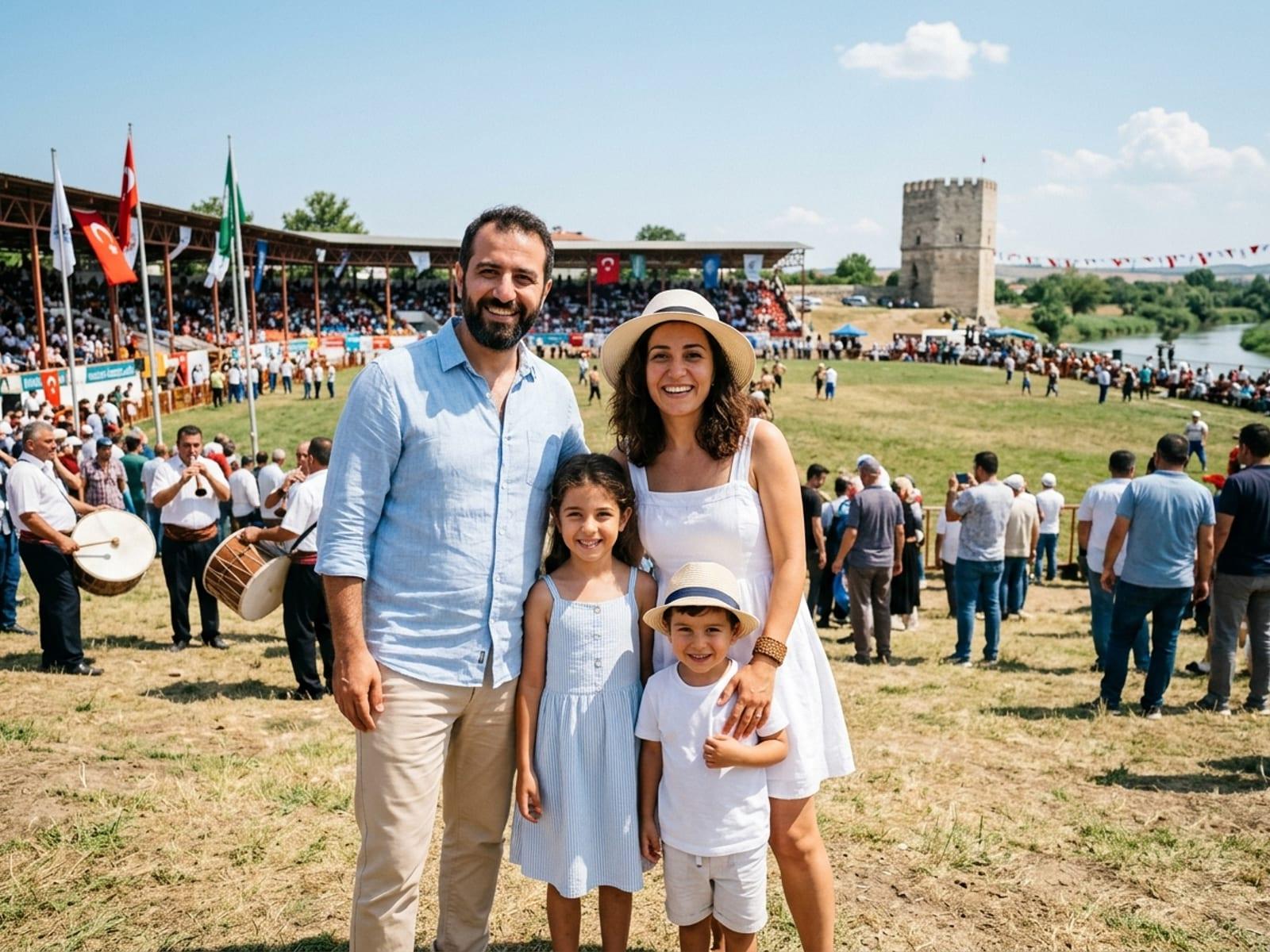
Two wrestlers, bodies slick with olive oil and wearing nothing but heavy trousers of water buffalo or cowhide, lock together on the grass. Kırkpınar oil wrestling (yağlı güreş) takes place every summer in Edirne, in northwestern Turkey near the Greek and Bulgarian borders, and is said to date back to the 14th century. It was added to UNESCO's list of Intangible Cultural Heritage in 2010, and Guinness World Records recognizes it as the longest-running sports competition. The tournament lasts three days. In 2026 the stands were free on the first day, and that's the day to bring children.
The "forty springs" behind the name
Kırkpınar means "forty springs" in Turkish. According to tradition, it began around 1360, when Ottoman soldiers started holding a wrestling contest every year. After the Balkan War of 1912 the venue moved close to the Bulgarian border, and since 1924 the tournament has been held at Sarayiçi, on an island in the Tunca River on the edge of Edirne. Sarayiçi is where the Ottoman Edirne Palace once stood.
The tournament has a patron called the ağa, whose role has been to host guests and award prizes. In the past the next year's ağa was chosen at auction, and the highest bidder became the main sponsor of the following year's event. From 1928, in the middle of the Great Depression, the Turkish Red Crescent and a child protection society took over the organizing for 36 years, and since 1964 the Edirne municipality has run it. Today a committee handles much of what the ağa used to decide.
UNESCO notes that wrestlers of any age or region can enter, regardless of religion, language or background, and that generosity, honesty and respect for tradition are what make a wrestler a role model. The techniques have been handed down from master to apprentice, learned by actually wrestling.
Drums, shawms, rituals and bouts
According to UNESCO, the tournament opens with a ceremony hosted by the ağa, with music from forty bands of davul drums and zurna, a reedy wind instrument. The golden belt awarded to the champion is carried through the city in a procession, and prayers are said at the Selimiye Mosque, itself a World Heritage Site.
Before each bout, an announcer called the cazgır introduces the wrestlers to the crowd, chanting their names, nicknames and favorite moves in rhyming verse. Then, before they grapple, the wrestlers perform the peşrev, a ritual entrance set to the drums and shawms. It serves as greeting, prayer and warm-up all at once, and is one of the most cherished moments of the whole event. The band keeps playing traditional tunes throughout the bouts.
A bout is won by getting a grip on an opponent's oil-slick body and pinning his back to the ground, forcing him to sit, or lifting him and carrying him three steps. A wrestler also loses if his leather trousers, the kispet, are pulled off. There used to be no time limit; wrestlers kept going until someone won. Since 1975, though, top-division bouts have lasted 40 minutes, followed by a 15-minute scored period if there's no winner. Other divisions get 30 minutes, then 10.
Wrestlers compete in divisions by size and age, and the winner of the top division earns the title of başpehlivan, chief wrestler. Only a wrestler who wins three years in a row gets to keep the golden belt, made of 14-carat gold.
Day one is free; the finals are ticketed
The 665th tournament was held from July 3 to 5, 2026. On the first day, Friday the 3rd, entry to the stands was free. The second day and the third day, with the finals, were ticketed. In 2026 there were two seat types for each: 1,750 and 1,400 lira on day two, and 2,600 and 1,750 lira on day three, sold through the ticketing site Biletix. The cheaper seats were reported to have sold out.
The tournament is usually held from late June to early July, but dates and prices change every year. Check the Edirne municipality's announcements before you plan your trip.
With kids, go on the first morning, and plan for the heat
Edirne summers are hot, with average July highs of around 33°C. The outdoor arena has little shade, so hats, sunscreen and water bottles are essential. Light-colored clothes in white or beige, in breathable fabrics with long or light sleeves, work best. With small children, avoid the heat of the early afternoon. Watching a few bouts in the morning and then heading back into town is plenty.
The drums and shawms are loud, and the crowd roars when things get exciting. If your child is sensitive to noise, ear defenders are a good idea. The wrestlers are all men, but as UNESCO notes, the spectators come in every age and from every background. Glistening, oiled wrestlers grappling low to the ground are unlike anything most children have seen, and the image tends to stay with them.
Take photos from the stands, where you won't get in the way of the wrestlers or the cazgır. If you want a shot of the whole family in the stands, pokesta's AI photos are another option, at $1 per photo with the first one free.
Edirne, and how to get there
Edirne was the Ottoman capital before the empire moved its seat to Istanbul. In the center of town stands the Selimiye Mosque, designed by the architect Mimar Sinan and listed as a World Heritage Site in 2011. Near the Sarayiçi grounds, a small bridge crosses the Tunca and an Ottoman stone tower, the Adalet Kasrı (Tower of Justice), makes a handy landmark when looking for the arena. The town's signature dish is tava ciğer, thin slices of liver coated and fried, served with cacık, a cold mix of yogurt and cucumber.
The international gateway is Istanbul Airport (IST), from where you head west overland. The town fills up during the tournament, so either book accommodation as soon as the dates are announced or plan to stay in Istanbul and go as a day trip. Entry requirements for Turkey depend on your nationality, so check your own government's official information.
Turkey offers completely different traditions in each season: the Istanbul tulip festival in spring, the Sema ceremonies in Konya in winter. If you're picking one thing in summer that you can only see in Turkey, a contest on the grass with more than 650 years behind it is a strong candidate.
References